Now that you know what you want to do (as a reenactor or interpreter), who you’re going to portray (your persona), and (after careful research and/or use of the Galactic Style Guide) what you’re going to wear while doing it, the time has come to gear up and clothe your persona in appropriate ‘garb’. If you know how to sew, great! If not, it’s always a good time to learn! A simple websearch for ‘basic sewing stitches’ will yield plenty of tutorials. Even though we’re depicting a high-tech society, tailor droids break down now and then, so hand-sewing is fine too! (the first time I made my Jedi tunics, I opted to sew the main seams with a sewing machine, and then finish the seams by hand).
When it comes to making or buying elements of one’s kit, it always pays to remember The Designer’s Paradox:
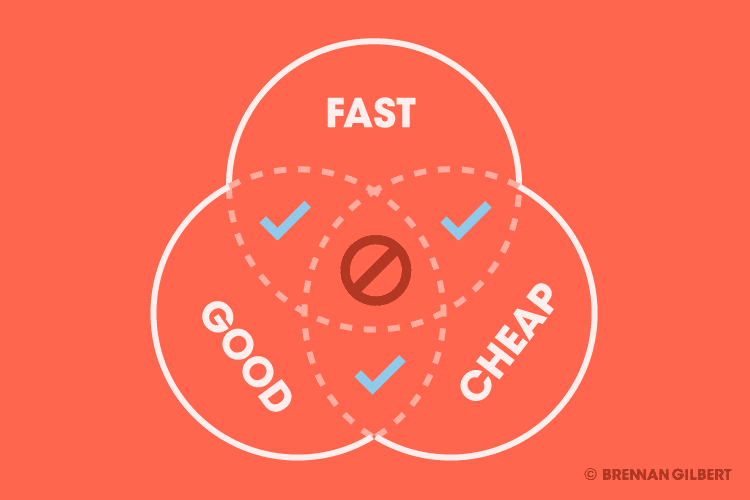
Choose carefully, because you can only pick two!
In other words, getting something cheap and good takes time; fast and good costs money up-front, while cheap and fast will cost you in the long run.
Since there are plenty of how-to pages out there (costume tutorials abound on the internet), I will try to keep this short and sweet.
A quick primer on fabrics and their properties as they pertain to our purposes:In general, Star Wars is a natural fiber setting. Even though it was created in the 1970s, there are very few costumes onscreen that make use of synthetic fabrics, let alone knit, stretchy modern ‘activewear’. This plays into the ‘used universe’ look, as natural-fiber fabrics age very differently than synthetics, and due to variations in dye and manufacture (especially for ‘rustic’ weaves), they show more character onscreen.
- Vegetable fibers:
- Cotton—widely available, but takes forever to dry. Dyes fairly easily.
Ex.: Han and Luke’s denim trousers in Episode IV, Han’s shirt & ‘Tobias Beckett’ flight suit. - Linen—fibers of the flax plant. Dries much faster than cotton, supposed anti-microbial properties. More expensive; somewhat harder to dye. Generally has more ‘texture’ than cotton—i.e. it ‘reads’ as less costume-y!
- Hemp—fibers of the cannabis plant. Very tough-wearing. Ex.: duster and canvas holster of ‘Beckett’ in SOLO.
- Cotton—widely available, but takes forever to dry. Dyes fairly easily.
- Animal fibers:
- Wool—spun hair of sheep or goats. Water-repellent due to natural oils (lanolin); resists burning; highly insulating; moisture-wicking; retains heat when wet; can soak up 35% its weight in water. Very dye-friendly! Ex.: brown Jedi robes; Luke’s Episode V fatigues, Rebel communications techs in Episode VI (gabardine), Han Solo’s pants (SOLO), pretty much everything ‘Dryden Vos’ wears (SOLO)
- Silk—made from silkworm fibers. Good for insulating layers; ex.: Leia’s classic white gown (crepe de chine), Qui-Gon’s tunics (jersey silk undertunic and raw silk outer tunic), Palpatine’s dark red Episode III Senate robes (silk velvet), Lando’s Episode V cape lining (silk damask), Lando’s shirt in SOLO.
- Synthetic fibers:
The main downside to synthetics (aside from the petroleum they are made from, and their lack of breathability) is that they MELT: A single spark from a campfire will easily and quickly burn a hole straight through a 100% synthetic fabric; such molten plastic sticks to human skin. Beware.
-
- Nylon—tough wearing, dyes very easily using vinegar. ex. Rebel Hoth pilot jackets. ‘Cassian Andor’ blue jacket.
- Polyester—moisture-wicking, probably best paired with a natural fiber (see below):
- Blends:
- Wool/polyester: if a blanket isn’t 100% wool (aka ‘wool blend’) it’s usually been paired with poly.
- Cotton/polyester: General Lando’s Episode VI shirt
- Linen/polyester: Han’s Episode VI duster.
- Linen/rayon: more affordable alternative to 100% linen; unless you know beforehand, it can be hard to tell the difference.
- Linen/silk: Qui-Gon’s poncho; Darth Maul’s tunics; Palpatine’s Episode III Senate under-robes
- Silk/linen/hemp: young Anakin’s slave tunic
- Wool/silk: ‘Dryden Vos’ cape.
Creating clothing and gear for a GFFA persona is a little trickier than for other living-history settings; the most obvious reason is, of course, that the period is ahistoric and so we can’t simply pull clothes off the rack or order them from a historic-clothing supplier.
However, as careful research will show, much of the costumes seen onscreen were based on familiar Earth styles, usually with slight modifications; as George Lucas declared during preproduction for the first film: “I don’t want anyone to notice the costumes. They’ve got to look familiar but not familiar at the same time.”[1]
This is especially true for background characters, who needed to be dressed quickly en mass, and it wouldn’t be practical to clothe each extra in a custom-made costume (this mostly applies to Mos Eisley in Episode IV or Cloud City in Episode V).
As Master Townsend suggests, it is often helpful to start out with a kit for a generic persona, and then later transition to a more specific one once you’ve stuck with it for a while. This is not a bad idea, and it is surprisingly easy to put together a ‘Generic GFFA Commoner’ outfit, simply by carefully modifying items from your local thrift store or military-surplus shop. When in doubt, you can’t go wrong by covering up in some sort of textured robe or wrap! To get a good handle on what the average galactic citizen might wear, check out the monthly Galactic Style Guide series.
The Episode II DVD (at least) includes a short web documentary all about background extras that may be useful in getting a sense of generic style.
Here are several proclamations from John Mollo, costume designer for Episodes IV and V:
“George didn’t want any fastenings to show, he didn’t want to see buttons, he didn’t want to see zips, so we used stuff like Velcro, and things were just wrapped over and tied with a belt…
Ben Kenobi’s shirt is very much Russian.” (The Making of Star Wars, p. 125.)“[George] wanted the Imperial people to look efficient, totalitarian, fascist; and the rebels, the goodies, to look like something out of a Western or the US Marines [in Vietnam].” (Star Wars Costumes – the Original Trilogy, p15.)
“The color scheme basically was the baddies would be black or gray, with the exception of the stormtroopers, and the goodies should be in earth colors—fawns and whites…Mollo tried to keep the colors muted wherever possible. Color is very, very difficult to use. Bright colors don’t work well on film, particularly reds and blues. George always goes for the authentic….and if it’s all garish color, it doesn’t work.” (ibid)
[1] quoted in The Making of Star Wars (JW Rinzler), p.130. (Quoted slightly modified in Star Wars Costumes – the Original Trilogy, p15.)
Researching, compiling, and writing this site takes a lot of time and energy. If you’ve enjoyed reading, have learned something from this post, or will use it as inspiration for crafting an outfit of your own, please consider supporting my work with a small donation below! Thank you!
Make a one-time donation
Make a monthly donation
Choose an amount (US dollars only – unfortunately, I cannot currently accept Republic credits 😉
Your contribution is greatly appreciated and will help me continue to keep this blog ad-free!
(Alternately, you can support my work via ko-fi as well.)
Your contribution is greatly appreciated and will help me continue to keep this blog ad-free!
(Alternately, you can support my work via ko-fi as well.)


3 thoughts on “Step 5 – Craft It!”