Galactic Style Guide – Text

Welcome to another installment of our ‘Galactic Style Guide counterpoint’ subseries, where we help you strengthen your ‘Star Wars eye’ by highlighting and remedying common faux pas that can make your kit look Not Star Warsy. As part of the GSG, the ultimate goal is still to help you create a more accurate ‘outer persona’ – but we approach the goal from the opposite direction!
This month, we’re taking a look at a design phenomenon that’s big on the Disney side of things (whether it be in films made under them, things sold by them, or costumes worn by fans while visiting them) but which was only ever a minimal part of the ‘Star Wars aesthetic’: text on stuff!

The fact that we went six films with zero non-technical Aurebesh (and the first two, most seminal films had NONE at all) should tell you everything you need to know: when it comes to Aurebesh on kit items, it’s always superfluous.
With that in mind, I want to look at some examples to illustrate why you’re better off omitting Aurebesh entirely. Out of respect for the SW costuming/maker community, I’m focusing on publicly-available items sold by Disney, but the point is still applicable: even when executed correctly it’s still largely* unnecessary, and—if used at all—should act as a garnish, not a side dish – let alone the main course! If your impression is relying on Aurebesh to make sense, something’s not working and it might be time to go back to the drawing board.

*As we saw before, pretty much the only folks we saw wearing Aurebesh pre-Disney are prisoners and biker-gang types. Occasionally we see small identifiers like ‘crew’ or ‘staff’, but these simply serve to demonstrate the wearer’s membership in a group as separate from the public.
For a refresher on examples of places where we do commonly see in-universe lettering, check out this GSG entry.

Let’s start off with a couple items featuring completely redundant Aurebesh additions. Did you ever notice that all the top brass at the Death Star’s conference room had matching drinkware?

Here’s the version sold at Galaxy’s Edge:

From one side, it just looks like a slick space-fascist travel mug. From the other side though, it looks like the Empire thinks its officers need to be constantly reminded of who they work for.
more Bad aurebesh products, and how to prevent them!

Galactic Style Guide – Design

Welcome to another installment of our ‘Galactic Style Guide counterpoint’ subseries, where we help you strengthen your ‘Star Wars eye’ by highlighting and remedying common costuming faux pas that can make an outfit look Not Star Warsy. As part of the GSG, the ultimate goal is still to help you create a more accurate ‘outer persona’ – but we approach the goal from the opposite direction!

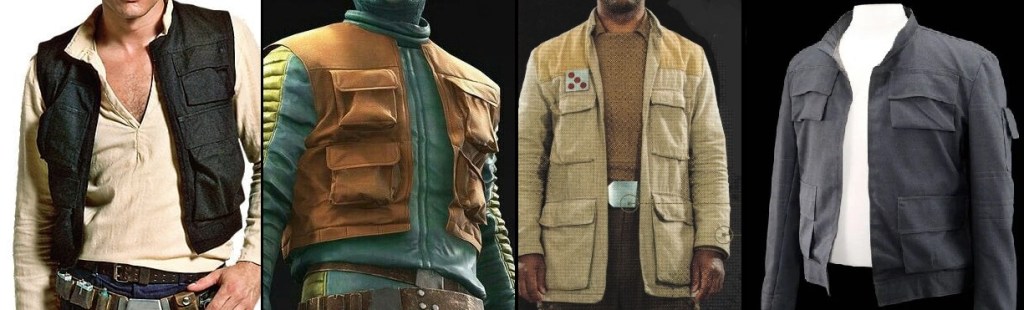
Our last two Style Guide entries on jackets concluded with a bit of homework. I wanted us to look at our source examples and pay special attention to the design elements of each jacket, particularly any areas that used different-colored paneling, the placement of any added details, and the overall degree of symmetry. All of these contribute to this month’s theme of “Design”.
As we’ve seen in previous posts, there are several aspects which are commonly seen in GFFA upper-body outerwear and—taken as a whole—contribute to ‘the Star Wars ‘look”’. In addition to a muted color palette, these include:

-plenty of pockets (typically with flaps)
striped, ribbed, or pleated sections down sleeves
many more examples within!

HOW TO: DIY shemagh scarf

As we’ve seen before, scarves and headwraps are absolutely legitimate pieces of in-universe headwear, but if I had to make a list of commonly-seen ‘reenactorisms’ which have the power to derail my appreciation of an otherwise-solid GFFA outfit, an off-the-shelf, Earth-y, two-tone shemagh/keffiyeh headscarf would have to be near the top. (Also up there? Those zipper-covered, holster-wannabe, drop-leg fanny packs.)
These items are super useful for all sorts of authentic adventuring uses besides looking cool and keeping the sun off one’s head (improvised gathering container, level-one water prefilter, bandage/sling, last-ditch cordage source, etc); however, your standard two-color shemagh has some issues.

Visually, prints or busy motifs are rarely seen in GFFA ‘soft kit’ – solids are the rule by far. (Especially in the Classic Trilogy period; in the Prequels, more variation is seen, but this is typically accomplished by embroidered details, not the actual weaving.)
Thematically, there’s nothing wrong with channeling an ethnic fashion sense for SW purposes…a good scarf or headwrap can make you feel like a romantic desert rebel (Lawrence of Arabia, the Fremen of Arrakis, &c.) which is a perfectly valid GFFA character type! However, in the 21st century, mass-produced shemaghs have a tendency to feel more ‘tacticool prepper bro’ than ‘exotic native insurgent’.
Politically (because of their association as a ‘tactical’ accessory), the shemagh has been embraced by various anti-democratic groups…and we absolutely want to distance ourselves from that kind of sithspit.

BUT what if I told you that for about the same price as an Amazon-bought shemagh, you could make your own headscarf that’s even better? If you want to easily level up your Star Wars costuming and gain some DIY XP, read on!

get started on an Easy afternoon project

We need to talk about Aurebesh (part 1)

In a post earlier this year, I brought up the idea of ‘reenactorisms’—the spread and perpetuation of an inaccuracy being unknowingly (or knowingly) passed around because somebody didn’t do their research. After that initial post, I realized one of the biggest reenactorisms in Star Wars costuming was my most infuriating pet peeve: the phenomenon of backwards Aurebesh letters. Having spent probably-too-much-time thinking about the issue, I thought I’d try something new and devote an entire month to the topic of writing in the Galaxy Far, Far Away. That’s right, folks: welcome to Aurebesh Month!

A quick search of Etsy for the term will easily reveal the problem we are facing: an annoying lack of consistency in how the letters are to be written. A number of these items are geared towards the Batuu-bounding crowd—patches, ID tags, Aurebesh ‘translators’, luggage tags, etc.—and I suspect it is the popularity of the Disney parks (coupled with the recent rise of Cricut-type machines that make cranking out crispy stickers so easy) that has caused the proliferation.

At the heart of the issue is the erroneous idea that Aurebesh has capital letters at all, let alone that it indicates them by horizontally flipping the letters. None of the Aurebesh texts seen at the Galaxy’s Edge park—the writing system’s most high-profile manifestation—includes these backwards capitals, so where did this idea originate???

Continue reading “We need to talk about Aurebesh (part 1)”

Some further thoughts on in-universe branding

In an earlier post, I wrote that I like to play a little game whenever a ‘custom Mandalorian’ costumer comes across my feed. The game is called ‘how many mythosaurs will this costume have?, and which pieces of kit will they randomly adorn?’
Unlike the ur-Mandalorian example (Boba Fett) who bore a single small mythosaur on a pauldron, the ‘custom Mando’ crowd seemingly can’t help but slap them everywhere: side of the helmet, on their cape, covering their entire chest armor, on their blaster stocks, on their belt buckle…sometimes all of the above???
What does this have to do with a truck covered in bald eagles and American flags? I’m glad you asked!

Continue reading “Some further thoughts on in-universe branding”

Staying true to the aesthetic

(I had originally scheduled this to post a few weeks from now, but since writing it the pitfalls described below keep popping up on my feed, so I couldn’t hold my tongue any longer.) After seeing more than my fair share of Star Wars costumers and their outfits online, I’ve noticed a particular trend in the last year or two across various social media platforms, mainly in the case of the Galaxy’s Edge-inspired/Batuu-bounding or OC crowd:

If Luke had trained on Batuu…

The desire to slap a Rebel Alliance starbird, Jedi crest, Sith symbol, Mickey Mouse, or Aurebesh letters on bloody everything seems very strong with this segment of the fandom, and the big driver of this, I think, is of course the consumer market. As a quick test, let’s do a image search for ‘Star Wars backpack’.

Continue reading “Staying true to the aesthetic”