
As Master Townsend tells us,
“Research and discovery are two of the things that make living history so rewarding and fun! For the avid reenactor or interpreter…research is a never-ending process. It’s what makes reenacting such an exciting journey. One reason research is so important, especially for the beginner, is that it allows one to proceed with confidence. The more research that’s gathered to support one’s persona or historical interpretation, the more confidence one portrays.”
Researching the GFFA doesn’t have to be a daunting task, especially with user-friendly resources like the Wookieepedia are at your fingertips. All you need to do is choose a topic, look it up, put on your ‘galactic anthropologist’ goggles, and start reading! Be sure to take notes when necessary, follow any rabbit holes, and enjoy the process!
I could get into a quagmire debate over using Disney!canon or established Expanded Universe content, but I’ll be brief: I mainly rely on ‘G-canon’ and EU media, and heavily limit my use of post-Disney sources. I have personally abstained from Disney’s ‘sequel trilogy’ films, as I don’t appreciate having the stories I experienced for nearly 20 years of my life being summarily dismissed and swept under the rug, only to be undermined by an impatient creative team not willing to give the title the respect it deserved. (For an agnostic, I’m very orthodox in my approach to fictional settings 😉 And if there’s one thing 20 years of Star Wars has taught me from an impressionable age, it’s to resist an Empire wherever I see one…and from where I’m standing, Disney has all the hallmarks of one right now.
(I eventually rented Rogue One very reluctantly…with more than a few grains of salt and the understanding that it was an in-universe holo-dramatization, it was decently enjoyable.)
Normally at this point, I would underline the different kinds of sources that research can draw on: Primary sources (‘first-hand’ accounts, such as letters) and Secondary sources (those written based on research and analysis of primary sources). In my Tolkien arena, I also have to be aware of Tertiary sources (usually things like role-playing games) which are synthesized from primary and secondary sources, and are often avoided.
However, unlike someone like J.R.R. Tolkien—who presents himself as a ‘translator’—the vast majority of Star Wars material doesn’t use an explicit framing device, so these labels don’t really mean as much, but my personal typology is as follows: plot-based materials can be considered Primary Sources, reference books are Secondary Sources, and Disney!Canon materials (if you’re brave!) where not contradicting the prior EU, might be considered Tertiary sources.
It can also be useful to divide sources into In-Universe and Out-of-Universe. Older roleplaying sourcebooks (such as those from West End Games) often contained in-universe documents, such as Mon Mothma’s Declaration of Rebellion. In addition, we know of a few in-universe works that some personas may have been familiar with, such as Paxi Sylo’s segments of Tartakovsky’s Clone Wars, Luke Skywalker and the Shadows of Mindor (the Matt Stover book), and the pieces collected in Star Wars Propaganda: A History of Persuasive Art in the Galaxy (2015).
Reference books like the Complete Encyclopedia, The Jedi Path, or The Essential Guide to Warfare are presented from an in-universe perspective, while the Wookieepedia is an out-of-universe source, as it includes real-world people and dates, and includes citations to outside references and source media (compare to The Essential Chronology, which is arranged by in-universe date, and does not tell what book one should read to learn more about a given event).
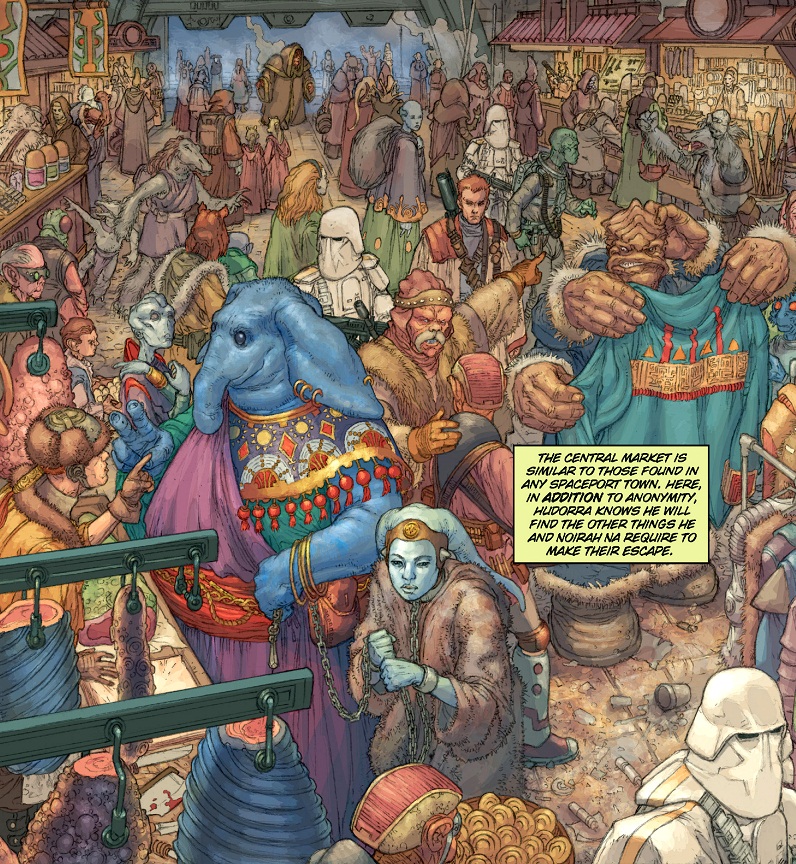
At this early stage of the journey, your research should probably first focus on what Townsend calls the ‘outer person’—the part of your persona that is visible to others; in other words, things like clothes and accoutrements. For example, if I was pursuing a Tatooine shopkeeper persona, I would definitely watch (and re-watch) the Mos Espa chapters of Episodes I and II, paying special attention to the background characters. Watch these scenes with an anthropologist’s eye, at ½ or even ¼ speed to glean as much detail as possible. Don’t be afraid to take screenshots (it’s never too late to start building your image library of references)! I’ve found turning on the foreign language audio track while ‘watching for research’ helps me focus better on the visuals, without being distracted by any dialogue.
Obviously, for our immediate purposes, visual media are the most useful, so I would next check the ‘Appearances’ section of Mos Espa’s Wookieepedia page to see if it appears in any comic books (I know of at least one comic centered on young Anakin’s offscreen adventures). Even a simple Google Image search will likely turn up some useful gems – just pay attention to the sources for what you find! (In general, avoid Pinterest like the plague)
As with historic reenacting, you should be wary of basing your impression on another fan’s artistic interpretation, to avoid perpetuating potential incorrect ‘reenactorisms’. Instead, ask them about their research process – they’ll probably be happy to share their sources and findings. In order to have the most authentic or accurate impression, it’s also important that you avoid basing your impression on fan art you find on the web…such depictions have no oversight, and often are geared more towards the ‘Rule of Cool’ instead of galactic style precedents, so it’s best to focus on official resources for now. If you can find it on the Wookieepedia, it’s probably good to go.
To help you decide what your Outer Persona might consist of, check out the Galactic Style Guide, a curated collection of Star Wars fashion elements grouped by type, which should help you see what looks are common—and therefore, authentic—in the galaxy!
Researching, compiling, and writing this site takes a lot of time and energy. If you’ve enjoyed reading, have learned something from this post, or will use it as inspiration for researching a persona of your own, please consider supporting my work with a small donation below! Thank you!
Make a one-time donation
Make a monthly donation
Choose an amount (US dollars only – unfortunately, I cannot currently accept Republic credits 😉
Your contribution is greatly appreciated and will help me continue to keep this blog ad-free!
(Alternately, you can support my work via ko-fi as well.)
Your contribution is greatly appreciated and will help me continue to keep this blog ad-free!
(Alternately, you can support my work via ko-fi as well.)

