Step 3 – Who Are You? (Personas 101)

Folks who are new to living history (or the ‘costumed arts’ in general) may be surprised to see that Step Three isn’t ‘Go Out And Buy A Bunch Of Stuff’ or ‘Time to Start Sewing!’. Many reenactors have done that very thing, only to find that what they wound up with was A Bunch Of Stuff they didn’t really need once they got more involved in the hobby. At this point, you should simply take a deep breath, and read on!

Now that we have thought about the opportunities that exist around you (or ones you can create!)—the What—it is time to think about Who will be doing the What. It is time to pick a persona. What do we mean when we speak of a Persona? Simply, this is the individual that one ‘portrays’ in one’s ‘impression’ (this step is very similar to the character-creation process at the start of a role-playing game). Continue reading “Step 3 – Who Are You? (Personas 101)”

Step 2.5 – What Will You Do?

Before continuing, you should first decide what you are going to do when you are doing GFFA living-history. In other words, what form will it take?, and how involved will you be? When people are involved in these pursuits for non-fictional settings, we can usually group them in two types: ‘reenactors’, and ‘historical interpreters’. What’s the difference between these? As Master Townsend explains,

“A reenactor, in the truest sense of the word, is like a bit-role actor in a movie. They help fill out the set. Reenactors typically have no speaking role. They usually have limited direct public interaction.
Reenacting is a great entry point into Living History for beginners. You don’t have to develop a specific individual persona to reenact. While it can be the easiest method of Living History, it can be an expensive direction to go*, depending on the persona type one chooses to portray.”

*See the 501st for walking examples of this—a set of stormtrooper armor will set you back several paychecks, but once you assemble and put it on, all you have to do is walk around and you’re in business.

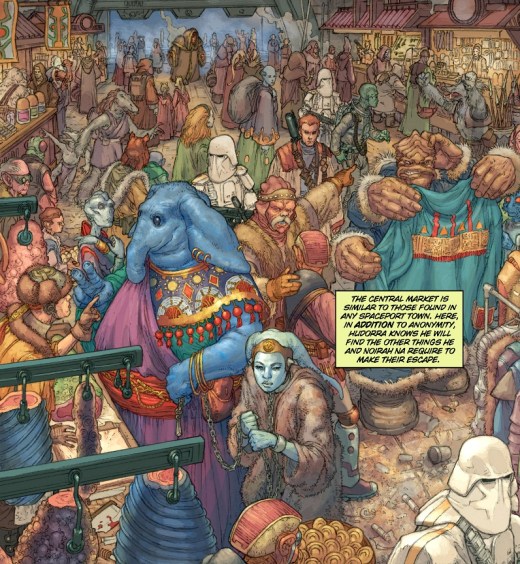
The analogy to background characters in a movie is especially apt in this case, as the background characters in Star Wars films are excellent inspirational examples. These extras don’t interact with the ‘public’—the film audience—but they really help sell the illusion that the Galaxy is a living, breathing, vibrant setting (now there’s a good homework assignment: pick a SW movie and pay attention only to the background characters! I’ve found this is easier with a foreign audio track turned on – if you’re not focused on the dialogue, you can use more ‘brain bandwidth’ for looking at details!).

Townsend’s explanation of a reenactor sounds very close to what a costumed fan already does at a convention—they are an appropriately-costumed warm body that stands around and gets photographed, and the depth of public interaction is shallow. When was the last time you asked a cosplayer what planet they were born on, or asked them what they’re carrying in their utility-belt pouches? Continue reading “Step 2.5 – What Will You Do?”

Step 2 – Connect!

Once you’ve decided to begin your journey, the next step is to Connect (with other people who are interested in what you’re interested in).

This one is easy! There are plenty of places to find people who like Star Wars—everything from message boards, charity societies (501st or Rebel Legion), subreddits (/r/StarWars, /r/StarWarsShips, /r/MawInstallation), to countless facebook groups. There are also plenty of places to find people who like to wear funny clothes and go for walks in the woods.
While there is certainly plenty of overlap between the two interests, as I explained earlier, it simply seems no one has ever tried to join them together in a serious manner. Shall the twain ever meet? I would like to think so, and this blog is meant to show that it’s possible. If social media is more your style, swing on over to join the SWLH facebook group!

It’s often very helpful in historic reenacting circles for a newcomer to link up with a more-experienced Mentor figure to show them the ropes and help them grow, and the same goes for GFFA living history as well. Our facebook group now includes a Mentorship feature to help you do just that. If you’ve managed to find your way here, WELCOME! Leave a comment and say hello!

Step 1 – Overcome the Paradigm

Welcome to the First Steps series! Here at the threshold, before you can “take your first step into a larger world”, you must gather your courage and first Take the Leap to decide to pursue this hobby/sport.
When it comes to doing ‘living history’ in the GFFA setting, this is possibly the biggest and hardest hurdle to overcome, for a couple of reasons. The first obstacle is that the ‘fan’ paradigm doesn’t currently accommodate these activities. What do I mean by that? Continue reading “Step 1 – Overcome the Paradigm”

Introduction

This blog is a place to explore and document my attempts to apply the methods of ‘living history’-style reenactment to the fictional setting of the Star Wars galaxy, or as I’ll usually be calling it here, the GFFA (Galaxy Far, Far Away)!
While the idea of GFFA ‘reenacting’ originates with my buddy J. Book, I was encouraged to start this blog after completing the ‘Getting Started in Living History’ course from Jas. Townsend. While Townsend focuses on the ‘flintlock era’ of American history, the methods laid out in the series are absolutely applicable to any setting, historic or fictional—I’ve even successfully applied it to my other ‘period’, late Third Age Middle-earth. Because of this, I strongly encourage anyone with even the slightest interest in reenacting to check it out.)  My GFFA application of their ‘reenacting roadmap’ can be found collected at the FIRST STEPS page.
Continue reading “Introduction”