Project: Sweater retool 2025

What’s this? Another sewing retool project?? Yes!
What can I say? Maybe it’s just my local shop, but while the offerings at Goodwill seem to be getting worse lately (thanks largely to the influx in garbage-quality fast fashion from places like SHEIN), I still manage to find good (i.e. with Swarzy potential!) pieces now and then. Case in point: this odd women’s sweater-thing made by Kenar – I guess when worn open, it might be considered a cardigan?

At this point in my scavenging career, the initial attribute I scan for is texture (and by extension, fabric content) more than anything like color or design, so considering its fuzzy nap, I instantly had this sweater pegged as wool. As I’m always working towards the goal of GFFA-ifying my modern hiking kit, I thought this could be a good replacement for my current midlayer (an Earth-y, crewneck cashmere sweater) – but not without a little retooling!

tell me this doesn’t look cozy!

The material itself is great – it’s actually a knit, but since it’s 100% wool there’s enough felting going on that it both looks woven and doesn’t unravel when cut! Color-wise, it’s a bit brighter than simply Navy blue and a bit lighter than Royal blue, which is fine for GFFA uses. Obviously I’d prefer something a little lighter or less saturated, but it otherwise checked most of my boxes… except one.

how to swarzify this ugly sweater?

Project: Coat Retool 2024

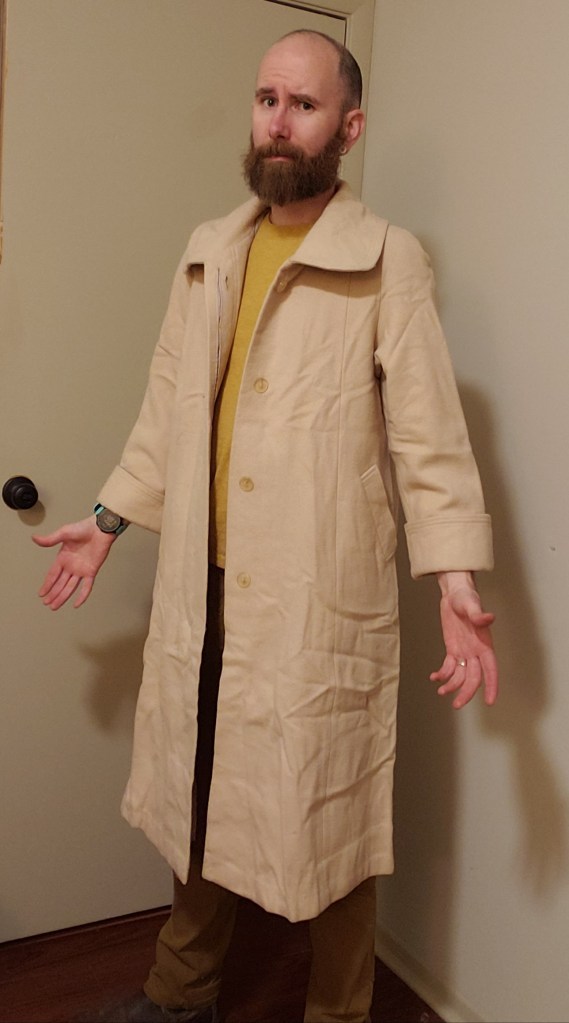
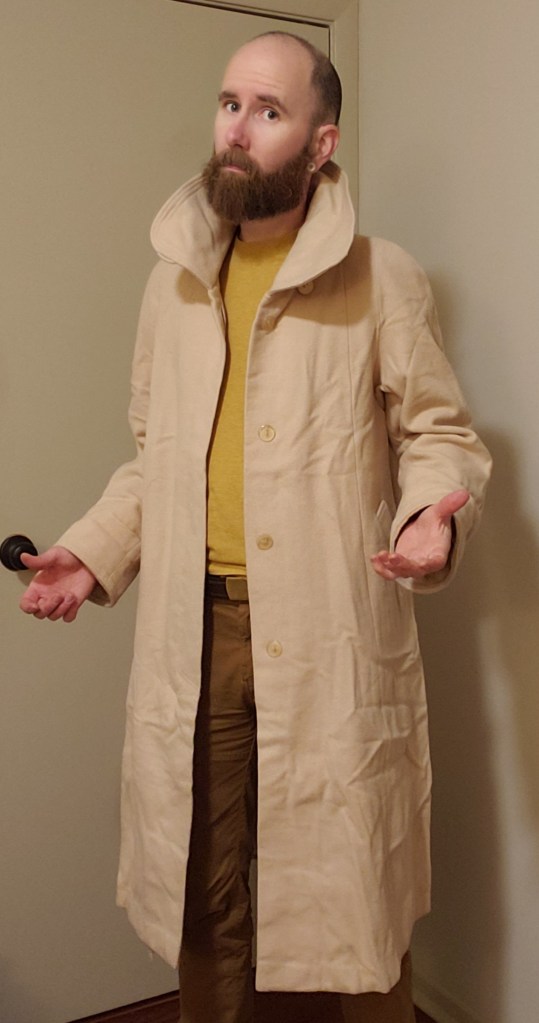
If it feels like it’s been forever since I’ve had a finished project to unveil, you would be right – turns out it’s been nearly a year! The funny thing is, this one has been finished since Christmas, but I’ve been so busy with, y’know, gutting a house and renovating it literally from the ground up to be able to work on nearly anything else (like taking pictures of the final product!) We may have moved in right after the New Year, but it’s only been in the last two weeks that I’ve got my sewing space in a more-or-less workable condition! Anyway, this particular project started last January when I was (as ever) browsing the racks at my local Goodwill, not looking for anything in particular, only to find something in a solid material with great potential Swarziness…if I could just manage to rework it to be less hideous.

In this case, a camel-colored 100% wool coat with a massive collar and weirdly rounded shoulders…major Asian granny vibes. However, I’m always up for a challenge (especially at a price point of just $7!) and was in the market for a lighter-weight coat (my only other option at the time was a Soviet behemoth meant for the Eastern Front!) so I got it home and started making my plan of attack.

what all goes into such a transformation?

Intro to Fabric Prospecting

(This article is a modified version of a workshop I recently taught at the 10th annual Whippoorwill Festival here in central Kentucky)
Greetings, galactic crafters! – and happy ‘May the Fourth’ weekend!
If you’re in search of an authentic GFFA wardrobe that can stand up to the rigors of authentic GFFA activities, I find that off-the-rack fashion pieces from Amazon can only take your look so far. When you’re in the middle of a tariff war and most of that cheap clothing comes from overseas, this might be the perfect time to add a useful skill to the ol’ proverbial toolbox and start creating more of your garments yourself!
So, do you want to create a solid, in-universe outfit but find that the good materials (linen, raw silk, wool, etc.) at the online fabric merchants have gotten too expensive? Or has your go-to big-box craft store gone bankrupt and closed its doors, leaving a choice between one that doesn’t even sell fabric in-store, and another run by Christian Nationalists? Then you should consider Fabric Prospecting!
What’s that? I’m glad you asked!

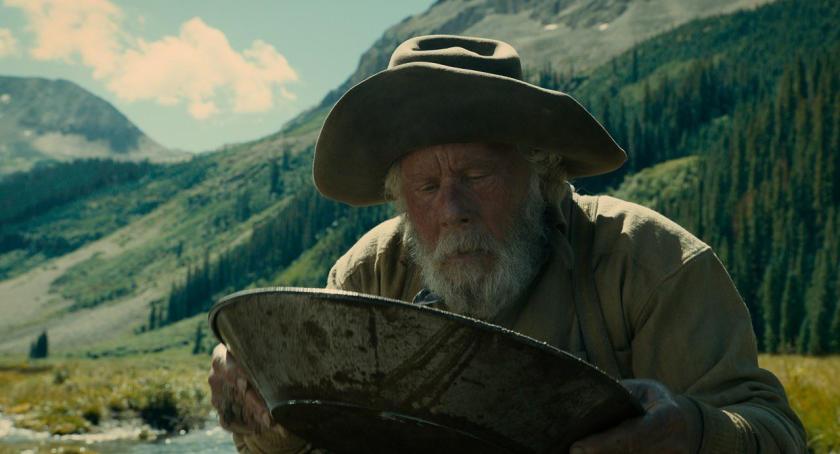
Traditionally, prospecting is done for valuable raw materials—like precious metals, or crude oil—but in the costumed arts, the raw material in demand is quality fabric! As you would expect, traditional markets price these accordingly (especially when compared with synthetics, which are dirt cheap). However, did you know that there’s an oft-overlooked source of high-quality, natural-fiber fabric just waiting to be exploited and put to costumery uses?

learn the secrets of fabric prospecting!

HOW TO: Hide Your Buttons #2

In a previous post, I concluded by saying “when the flavor of the world is ‘no visible fasteners’, then cover up your darn buttons.” However, for some folks that may be easier said than done. If you like the idea of having an outfit be sans visible-fasteners but find the idea of how to actually make it happen a little overwhelming, then this post is for you!
Adding the ability to hide fasteners to your toolbox is a major level-up, especially for those outfitting an Original Character. Off-the-rack items can be great for dressing a ton of far-background characters, or creating a suggestive ‘everyday bounding’ look, but if you’re after a 100%-in-universe-legit look, these kinds of pieces can only take you so far. I hope you’ll note how our main characters almost always wear custom-designed garments, which may still be reminiscent or incorporate elements of familiar/off-the rack pieces, but usually tweaked just a little to give it that timeless GFFA flavor.
In this post, we’re going to show you a second method to create a button-free appearance on an upperbody garment by ‘genderswapping’ our garment, a version of which I’ve used before on this raw silk shirt retool project. How do you swap a piece of clothing’s gender, you ask? Keep reading to find out!

level up your costuming game with this handy skill

HOW TO: Hide Your Buttons #1

In one of my previous entries, I concluded by saying “when the flavor of the world is ‘no visible fasteners’, then cover up your darn buttons.” However, for some folks that may be easier said than done; if you like the idea of having an outfit be sans visible-fasteners but find the idea of how to actually make it happen a little overwhelming, then the next couple posts are for you!
Adding the ability to hide zippers or buttons to your toolbox is a major level-up, especially for those outfitting an Original Character. Off-the-rack items can be great for dressing a ton of far-background characters, or creating a suggestive ‘everyday bounding’ look, but if you’re after a 100%-in-universe-legit look, off-the-rack can only take you so far. I hope you’ll note how our main characters almost always wear custom-designed garments, which may still be reminiscent or incorporate elements of familiar/off-the rack pieces, but usually tweaked just a little to give it that timeless GFFA flavor.
In this post, we’re going to show you one method to create a button-free appearance on an upperbody garment by sewing a very basic cover panel over our buttonholes. Then, in part two, we’ll learn to hide buttons by ‘genderswapping’ our garment. What’s that all about, you ask? You’ll just have to wait and see, but for now let’s get started!

level up your sewing game with this handy skill

HOW TO: Collar conversion

Even if you’re fairly keyed into the intricacies of clothing in the Galaxy Far, Far Away, there’s one easily-overlooked element that plays a major role in helping separate our own modern fashion from that of the Star Wars galaxy: collars!

When he first began designing his world, we read how Lucas “made pronouncements of a general nature” and that he wanted “the rebels, the goodies, to look like something out of a Western” (Rinzler: The Making of Star Wars, p.130; quoted slightly modified in Alinger’s SWCOT, p15). This is an important distinction, as it was one of the broad styles John Mollo used to sort his character designs : “peasant costumes; Western/U.S. cavalry/motorcycle looks; Nazi-style uniforms/armor/cloaks; space technology-type outfits”, etc. (Alinger, p16). More on these categories later!

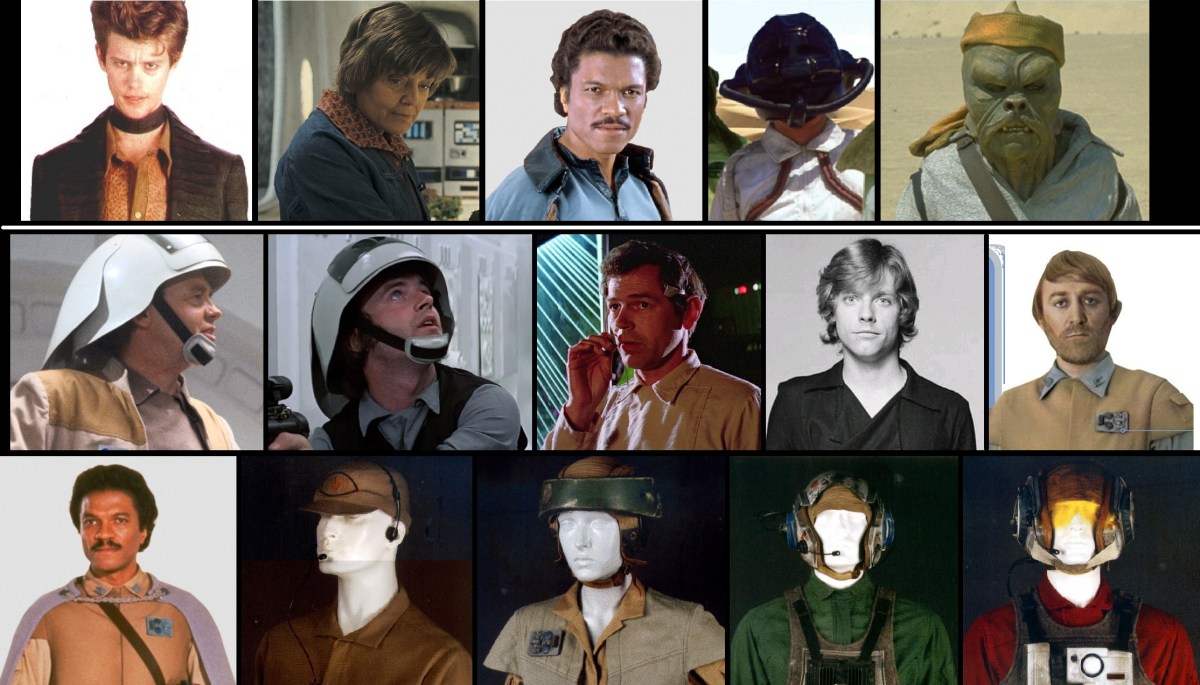
As something so mundane as the collar on a shirt or jacket, it’s likely you may not have noticed the fact that fairly few characters in Star Wars actually wear shirts with modern-style ‘fall collars’. Of course, we do have a few examples, but by-and-large, most characters who wear collared garments wear ones with some form of ‘stand collar’, and quite often these are full-on Mandarin collars.
After thumbing through my reference library, if I had to spitball some numbers, I would say that well over 50% incorporate some form of upright collar, perhaps 20% are collarless, and less than 5% are fall collars – really, the characters above are pretty much all I came up with.

I hope you’ll note that of our samples, the majority of them are Rebel Alliance ranks or ‘character classes’ (officer, fighter pilot, fleet trooper, communications tech, etc.)! Ergo, judging by our samples, the fall collar is generally a good way to give ones’ impression a touch of Rebel Alliance-style militarism, but if you’re portraying an unaffiliated galactic citizen, something that says ‘slightly exotic’ like some flavor of stand collar may be the way to go.
Luckily, most modern shirts with two-piece fall collars are readily adaptable to a more upright style with one easy tweak!

learn an easy minimal-sewing hack to upgrade your outfit!

SWLH 2023-24 site update

Dear readers: happy new year! – I hope your 2024 is off to a good start and holds good times in store!
I want to begin by apologizing for my lack of engagement with this blog over the last season or two.
Whenever one tries to pursue a hobby into something more than a hobby, the threat of burnout is constant, and sadly—despite being a decently-successful member of its Maker community—my mental health when it comes to the Galaxy Far, Far Away took a definite downturn over this past year. (What I really need is to just stay off Star Wars Instagram, which typically takes just a couple swipes to alternately deflate my self-confidence, inflame my inferiority complex, zap my motivation, and/or raise my blood pressure! (Now there are some topics in serious need of unpacking!)

So then, what have I been up to?

-After spending most of 2023 sewing a succession of vest commissions for folks lucky enough to experience the short-lived Galactic Starcruiser (with a particularly hectic late-summer rush to outfit several final-voyage travelers), I had to return to a more conventional job for a steadier (and larger) source of income. Sewing-for-hire is great, and I love seeing my customers get to live their adventures wearing clothes I made for them, but it can’t quite pay the bills (at least not yet)!
Bike-commuting to/from and working a 9-to-5, detail-oriented, standing-desk job demands a totally different kind of energy than full-time crafting, and as a result I’m usually pretty wiped out when I come home, and after household chores, cooking dinner, and giving my partner and doggo the attention they deserve, there’s often very little time for galactic pursuits and other fun! Lately, I’ve been taking a break from the GFFA in favor of indulging my inner six-year-old by building out my herd of Jurassic Park dinosaurs (often repainted and retooled for scientific accuracy, naturally!).

-Just after Halloween I was approached by the host of the Into a Larger World podcast, who had found this blog and wanted to hear all about my approach to the GFFA. Eventually, we were able to chat and record an episode, which you can check out here! It was a ton of fun to sit down and actually talk Star Wars with another person for a change!

-Then there was my annual fall trek with the Middle-earth Reenactment Society, preparations for which took up every moment of free time for the better part of a week. (This time, we decided to do a paddle-in campout, which meant I had to get creative and tackle some major, long-overdue renovations to my rawhide canoe.)

On the way back home from the wilderness trip, I managed to snag something I’d had my eye out for (at least) the last six months  – an old Wedge Antilles pilot helmet from Hasbro’s Black Series.
Why? Because OT flyboys are where it’s at! Yep, that’s right, I’ve been on hiatus long enough to almost finish building a whole new kit!

As I’m currently in the grasp of a polar vortex, we’re stuck waiting on warmer temperatures to return so I can properly weather it and finish up a few pieces, but I’m almost there – and you can be sure a full breakdown will be published in future posts!

So, what does 2024 hold in store for this site? I’m still trying to fight the good fight, and have several Galactic Style Guide entries in the works. I’d still like to do some costumer spotlight-interviews if possible, and I should definitely have some finally-finished projects to show off fairly soon! On the Offworld Outfitters side of things, once we get our Mark 3 vest pattern knocked out (third time’s the charm!), I would like to reopen my commissions, but likely on a more limited scale—ideally, something like one a month or so. I also have plans for a couple of non-vest offerings to put out there—but those announcements will have to wait until the time is right 😉

What are your GFFA costuming/reenacting/living history goals for 2024? Let me know in a comment below, or come chat with us on the SWLH facebook group!

Diamonds in the Rough – Colin “OddViking” Adams (part 2)

Welcome back to our monthly spotlight series, where we discuss Star Wars costumers who have ‘gone the distance’ and put in the effort to create solid, in-universe outfits or personas. This is the second half of our two-part interview with Colin Adams, and after digging deep into the design stages in last month’s entry, we’re ready to follow along as he starts his actual build process!

When first considering this project, Colin said he knew how to sew “at a moderate level”, and knew there were other folks who made custom Mando-style flightsuits. However, he also knew that if he was able to attempt this and succeed at it, not only could he learn some new skills, but he would also be able to alter and tailor it himself! I’ve always been a big fan of Lev Vygotsky’s ‘ZPD’ theory when applied to reenacting-crafting, and it helps to choose projects which not only build on one’s existing skills but which can help push them to the next level – but not to bite off something completely outside your existing skillset! If you’ve never touched a needle and thread before, sewing something as complex as a screen-quality flightsuit for your first project would likely result in you getting frustrated and giving up. There are no ‘skip three levels ahead’ cheat codes IRL, so it pays to work smart, start small, and build on what you already know! Looking back on his project, Colin said that while things like setting a zipper fly were so much more complex than they seemed at first, “I feel like I leveled up two levels doing this suit: it really came out great and fits me perfectly.”

the secrets of authentic Star Warsy crafting continue…

Diamonds in the Rough – Colin “OddViking” Adams (part 1)

Welcome back to our monthly spotlight series, where we discuss Star Wars costumers who have ‘gone the distance’ and put in the effort to create solid, in-universe outfits or personas. This is actually the first half of a two-parter, because our subject has gone so totally above and beyond and built an incredible kit with tons of details that spreading it out over two months is the only way to really do it justice!

If you’ve spent any time exploring Star Wars content on Instagram in the last several years, chances are you’ve seen Colin Adams’ incredible work before. As a professional graphic designer/illustrator, Colin has a very large bag of tools to draw from, and puts them all to good use with a number of impressive cosplays and kits, each fully-detailed and seamlessly dropped into immersive settings with the magic of Photoshop. At the beginning of this year, when I saw Colin was starting a custom Mandalorian build, I knew the final result would be amazing. As we’ve discussed previously in our First Steps series, one of the keys to successfully creating an effective GFFA character is to dedicate time at the beginning of the process to doing your research and really nailing down what the ‘outer persona’ should look like.

creating this incredible mando kit, step by step

Upgrading the Rebel persona: flak vest

As the name of the game in rigorous reenacting is ‘continual improvement’, I’m always on the lookout for things to help add some depth or otherwise level-up my impressions. While Rebel characters typically steer away from the plastoid armor side of things, I realized that the ribbed vests worn by various characters were probably meant to protect the vital organs and so would be perfect for a partisan persona as well!

Rebel pilots, BoShek, Bossk; 1313 mercenaries, Ruusan rebel (Dave Dorman)


A few months ago, my buddy Anders (of DT Blasterworks) sent me a link to a lower-priced rebel pilot-style flak vest he was thinking about buying. Since my initial impetus for building a SectorForces partisan/guerilla kit was to pair Alliance-issued materiel with local planetary style, I had initially considered including one of these vests. The only one I had looked into was produced by Wampa Wear; at $125, while it’s probably—if anything like their flightsuits—extremely well-made and screen-accurate, I couldn’t justify paying that much for a purely costume piece…so the idea returned to the back burner.

However, Anders’ link (and his report that it was decent quality) renewed my interest, so at about 1/3rd the price of a Wampa Wear vest, I pulled the trigger. Out of the package, I could tell the vest fell in the category of “close enough”, about which I’ve written before: presumably, there are variations on the flak vest throughout the galaxy, and they’re not all produced identically. All the same, I still wanted to try my hand at ‘accuratizing’ the cheapo vest to see if I couldn’t get it a little closer to Alliance specs, as a few things stood out to me that could use tweaking:

The to-do list:
-fix the diameter and spacing of the sewn channels
-bind the curved edges with twill tape
-replace the rear buckle
-replace the large side clasps (down the line)
continue reading