Galactic Style Guide – Buttons

Welcome to another installment of our ‘Galactic Style Guide counterpoint’ subseries, where we help you strengthen your ‘Star Wars eye’ by highlighting and addressing commonly-made costuming faux pas. As part of the GSG, the ultimate goal is still to help you create a more accurate ‘outer persona’ – but we approach the goal from the opposite direction!

Since the earliest designs of Star Wars ’77, one of the main signifiers of GFFA fashion is the absence of visible fasteners—as chief costume designer John Mollo said, “George didn’t want any fastenings to show, he didn’t want to see buttons, he didn’t want to see zips, so we used stuff like Velcro, and things were just wrapped over and tied with a belt…”The Making of Star Wars (J.W. Rinzler), p. 125.
Since this is one of the chief ‘rules’ of Star Wars fashion and comes straight from the top, something like 98% of the outfits seen onscreen abide by this rule. When visible fastenings do show up on screen, eagle-eyed costume-minded folks (or those who really want to cut corners) tend to make a big deal of it….although they really shouldn’t.

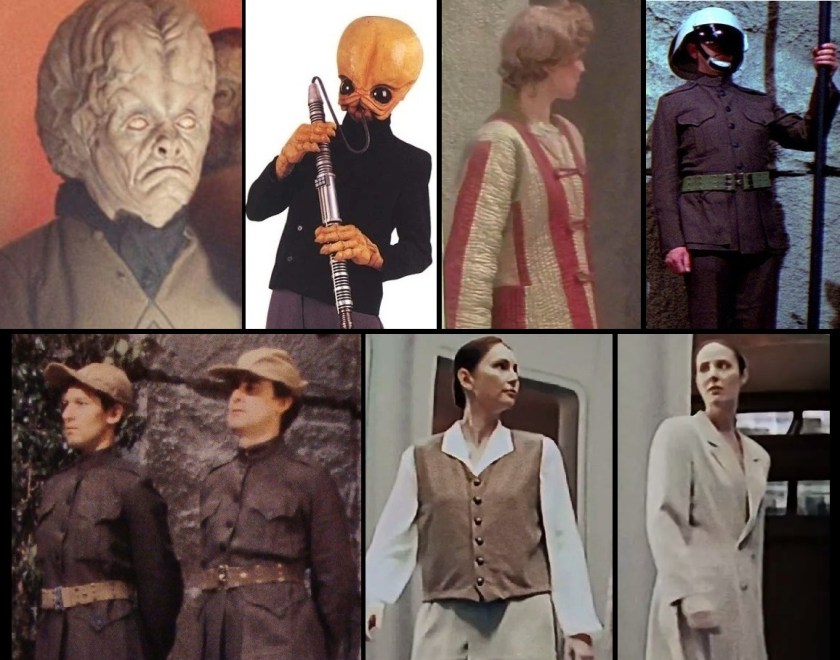
buttons onscreen in OT and PT: Pons Limbic, Figrin D’an (and the rest of the Modal Nodes), Rebel honor guard, Yavin ceremony backgrounders, Tian Chyler, Jango Fett, Elan Sleazebaggano
more visible fasteners after the jump

Galactic Style Guide – Color II

Welcome to another installment of our ‘Galactic Style Guide counterpoint’ subseries, where we help you strengthen your ‘Star Wars eye’ by highlighting and remedying common mistakes that can make an outfit look Not Star Warsy. As part of the Galactic Style Guide, the ultimate goal is still to help you create a more accurate ‘outer persona’ – but we approach the goal from the opposite direction!
As I teased last time, we’re going to be working with at an excellent tool for helping us see the ‘Star Wars look’ in action: Mando Creator . This handy bit of coding lets users create their own two-dimensional Mandalorian outfit by customizing every element in terms of design, color, and decoration. If you’ve used Bitmoji, HeroCreator, or similar avatar-making tools, it’s pretty easy to get the hang of. I’d never played with it before, and in 20 minutes I had made up my own hypothetical Mandalorian kit!:

when you know the rules, it’s really not that hard to make something that looks passably in-universe

One of the coolest parts—at least for the purposes of training our ‘Star Wars Eye’—is the Armor Gallery feature, where we find (in addition to a few novelty designs and face characters like Din Djarin and the Fetts) a wide variety of completed assemblages submitted by other users.

two easy tweaks to boost your in-universe style accuracy!

Galactic Style Guide – Viewscreens and Datapads II

Happy Christmas everyone, and welcome back to the Galactic Style Guide, the monthly series where we break down the ‘Star Wars aesthetic’ in order to help you create a more accurate ‘outer persona’! In this month’s installment (our final post of 2021!) we’re wrapping up our look at those ubiquitous pieces of ‘hard kit’, datapads and viewscreens. While datapads have really taken off in the last couple years (since visitors to the Galaxy’s Edge parks started kitbash-decorating phone cases), if you’re only familiar with them from fanmade creations, you may be surprised to see that the MANY visual examples we have from licensed sources are detailed very differently!

From an in-universe visuals sense, these three examples are perhaps the most accurate homemade ‘datapads’ I’ve seen yet. What is it that makes them so well-done?

Continue reading “Galactic Style Guide – Viewscreens and Datapads II”

Galactic Style Guide – Viewscreens and Datapads I

Welcome back to the Galactic Style Guide, the monthly series where we break down the ‘Star Wars aesthetic’ in order to help you create a more accurate ‘outer persona’! For this installment, we’re taking a look at devices which seem as prevalent in the Galaxy Far Far Away as smartphones are here on Earth. While a comlink fulfils the role of a telephone (audio-only), a datapad or viewscreen fills the niche of a tablet computer, and is used to display or swap visual information (but not to make ‘calls’).

While datapads have really taken off in recent years (after visitors to Galaxy’s Edge started kitbash-decorating their phone cases), if you’re only familiar with them from these fanmade creations, you may be surprised to see that the MANY visual examples from official sources are designed very differently! This post will be primarily concerned with the general design of these devices’ screen sides, and then next month we’ll pay special attention to the rear face, to which so many would-be Batuu-bounders glue so many greeblies.

Continue reading “Galactic Style Guide – Viewscreens and Datapads I”

We need to talk about Aurebesh (part 1)

In a post earlier this year, I brought up the idea of ‘reenactorisms’—the spread and perpetuation of an inaccuracy being unknowingly (or knowingly) passed around because somebody didn’t do their research. After that initial post, I realized one of the biggest reenactorisms in Star Wars costuming was my most infuriating pet peeve: the phenomenon of backwards Aurebesh letters. Having spent probably-too-much-time thinking about the issue, I thought I’d try something new and devote an entire month to the topic of writing in the Galaxy Far, Far Away. That’s right, folks: welcome to Aurebesh Month!

A quick search of Etsy for the term will easily reveal the problem we are facing: an annoying lack of consistency in how the letters are to be written. A number of these items are geared towards the Batuu-bounding crowd—patches, ID tags, Aurebesh ‘translators’, luggage tags, etc.—and I suspect it is the popularity of the Disney parks (coupled with the recent rise of Cricut-type machines that make cranking out crispy stickers so easy) that has caused the proliferation.

At the heart of the issue is the erroneous idea that Aurebesh has capital letters at all, let alone that it indicates them by horizontally flipping the letters. None of the Aurebesh texts seen at the Galaxy’s Edge park—the writing system’s most high-profile manifestation—includes these backwards capitals, so where did this idea originate???

Continue reading “We need to talk about Aurebesh (part 1)”

The great Twi’lek mix-up

I’ve explored the idea of Reenactorisms—the acceptance and perpetuation of an innaccuracy—several times before, but it is worth pointing out that these are not limited to fan creations: official resources can still fall into the pit.
Work on this month’s Style Guide post got me thinking about a key confusion in the depiction of the Twi’lek species: males have ears, but what do females have? The past 20+ years of visual sources suggest they all have cones where their ears should be, but prior to the release of The Phantom Menace in 1999, Twi’lek females most definitely had ears! We can trace the source of this confusing inconsistency by noting the examples of ‘cone’ or ‘ear’ as they appeared in order of release.

1983: Oola—the first depiction of a female Twi’lek—is green. The cones on Oola’s headdress are clearly white, and are also clearly part of the headdress, not protruding from within it.

January 1995: art development/pre-production begins on Episode I

Continue reading “The great Twi’lek mix-up”

Some further thoughts on in-universe branding

In an earlier post, I wrote that I like to play a little game whenever a ‘custom Mandalorian’ costumer comes across my feed. The game is called ‘how many mythosaurs will this costume have?, and which pieces of kit will they randomly adorn?’
Unlike the ur-Mandalorian example (Boba Fett) who bore a single small mythosaur on a pauldron, the ‘custom Mando’ crowd seemingly can’t help but slap them everywhere: side of the helmet, on their cape, covering their entire chest armor, on their blaster stocks, on their belt buckle…sometimes all of the above???
What does this have to do with a truck covered in bald eagles and American flags? I’m glad you asked!

Continue reading “Some further thoughts on in-universe branding”

Avoiding the Perils of Reenactorisms!

As I closed a previous ‘prop philosophy’ post last year I said, “If research and authenticity aren’t kept at the forefront, it is all too easy to fall into the pit of reenactorisms…” However, I realized that while I refer to the concept here from time to time, the term reenactorism may not be well-known to the average reader, so I wanted to use a post to explore what reenactorisms are, their pitfalls, and a few examples from the history of Star Wars.
So: what does the word mean? F.L. Watkins, writing in The Reenactor’s Encyclopedia (2004), describes reenactorisms as practices or items which are “incorrect and have no documentation but are commonly believed to be correct and are widely used”. In other words, it’s when one reenactor copies another reenactor’s mistake—acting under the assumption it is accurate—and thereby perpetuates an inaccuracy. Almost always this is the result of not doing one’s own quality research and assuming others have. A reenactorism is the Costumed Arts version of the ‘telephone’ game, where one person whispers a phrase to their neighbor, who whispers what they (mis)heard down the line, usually mutating the phrase with each iteration and becoming unrecognizable by the end. Whereas those playing the game could easily check if the phrase being passed down is correct by asking the speaker, ‘What did you say?’; in reenacting, we can prevent reenactorisms by asking for evidence or documentation.

For example…quick: what color is a standard Rebel Fleet Trooper’s helmet? If you said ‘White’, consider this:

Continue reading “Avoiding the Perils of Reenactorisms!”

Improve your Mandalorian cosplay with one easy trick!

Familiarity breeds contempt as they say, and once I notice a trend, it starts to bug me and becomes hard to unsee. Each week, I see scores of ‘Custom Mandalorian’ costumes, and like the diehard Disney fans who hide an obligatory ‘hidden Mickey’ in their props, whenever I see a Mando come across my feed, I like to guess how quickly this standard cockeyed, off-kilter, cracked-skull Mythosaur will show up: “Is it hiding in the first photo? Second photo? Third photo?”

A kit which turns out to be sans mythosaur, on the other hand, is always a pleasant, refreshing surprise! (One of the things I really appreciated in The Mandalorian was that—so far as I can tell—none of the non-Boba Fett character designs included this stock symbol.)

Continue reading “Improve your Mandalorian cosplay with one easy trick!”

On the subject of bounty hunting ‘trophies’

As I’ve talked about a few times before, when reenacting any setting (historic or fictional) one of the best ways to add depth to an impression is by including small details or items of ‘pocket trash’! One of the ideas I frequently see discussed in online Star Wars cosplay circles is the idea of ‘hunting trophies’, and a recent thread made me realize I definitely have some thoughts on the subject!

Whether it’s bones and claws from critters, crystals from Jedi lightsabers, battle droid fingers, or actual lightsabers, the notion that a bounty hunter or mercenary character should have a collection of tchotchkes taken from past kills dangling from their belt, blaster, or backpack is one of those trends that the costuming community has really latched onto. However, I submit that this type of decoration is A) actually an impediment to such work, and B) a fan reenactorism not seen in either primary or secondary sources. Be sure to stick around til the end for some ideas on how to more authentically portray these kinds of character in true ‘living history’ style!

continue reading