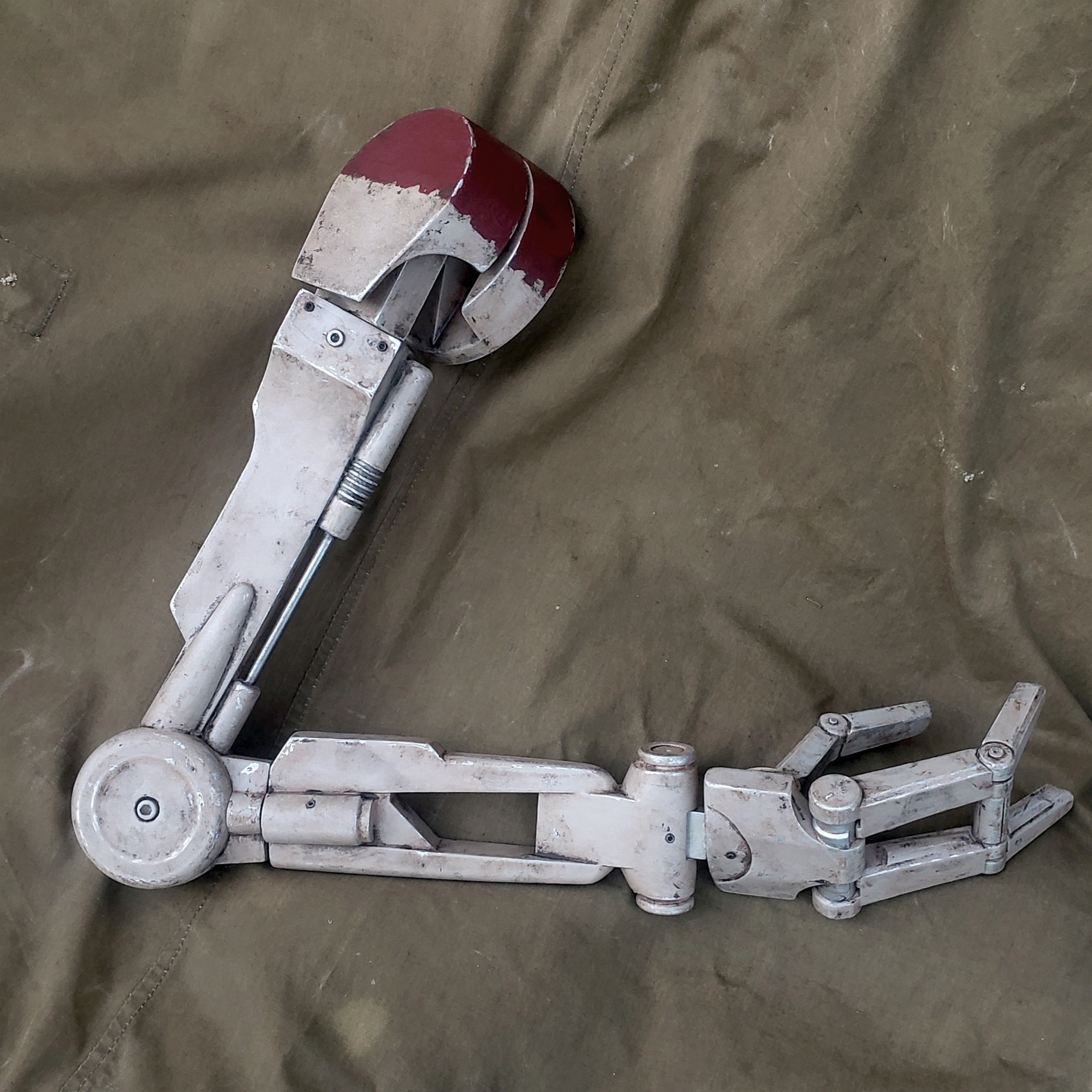
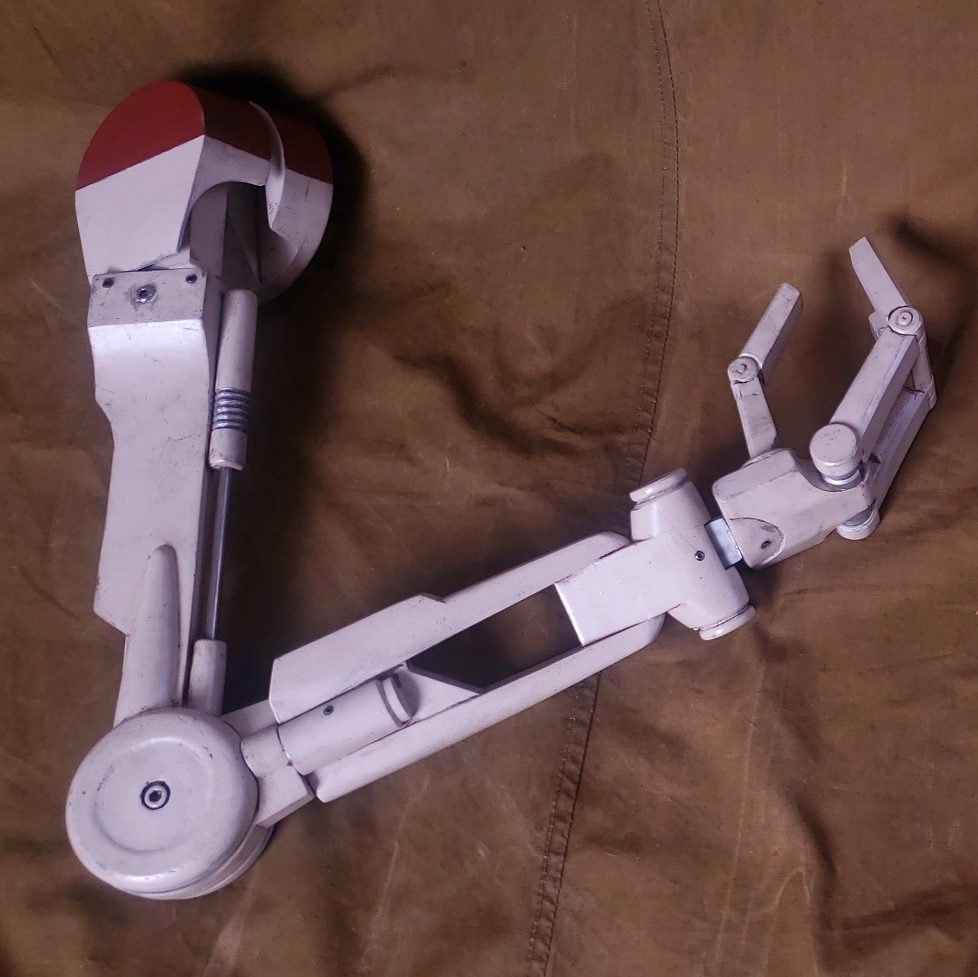
Project: B1 battle droid arm (2022-26 redux!)

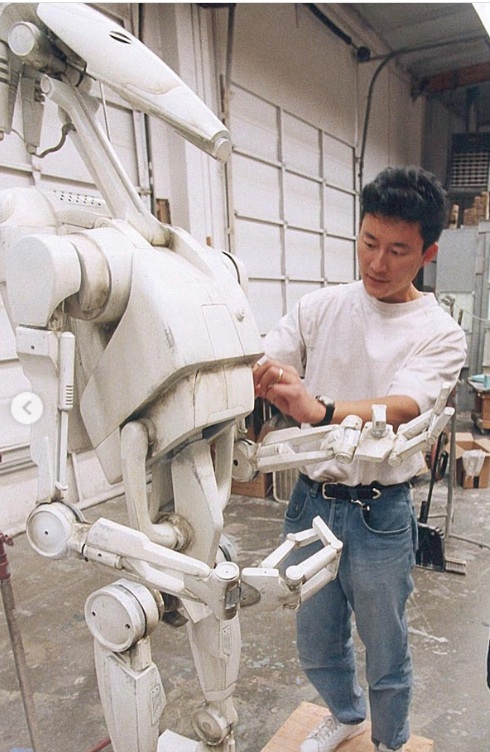
It’s back! Credit for this renovation goes to eagle-eyed site reader S.C., whose critique (back in October 2020 when I first unveiled this project!) that my droid arm looked more bone white than the onscreen droids was absolutely valid! Since the onscreen droids appeared different colors in various scenes, and I was using as my primary reference a physical prop (apparently) from the film, I chalked the discrepancy up to onscreen lighting. However, looking at the auctioned arm and making-of photos, it’s clear that the physical droids created for Episode I were an entirely different color from the CGI droids in the final product – presumably, they were meant as lighting references for the CG artists:
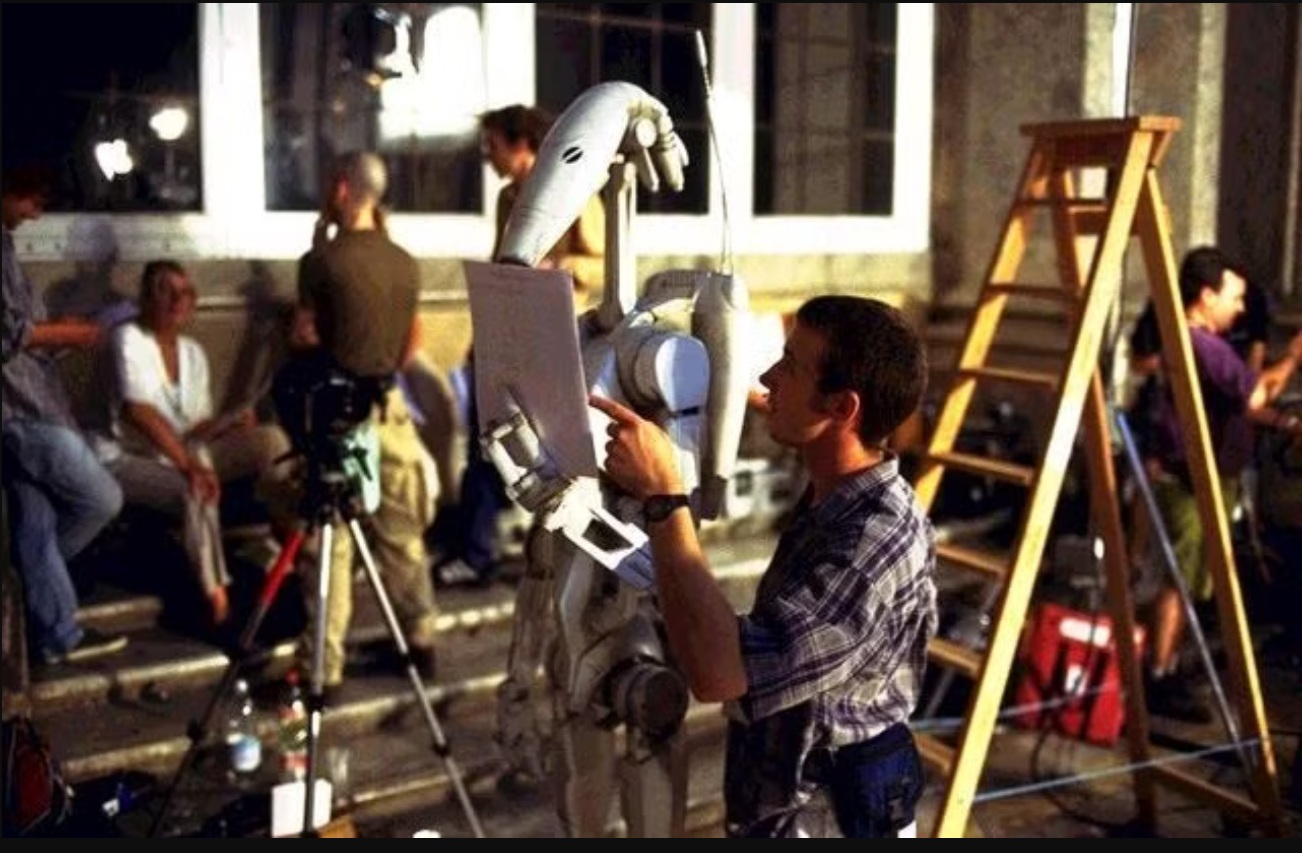
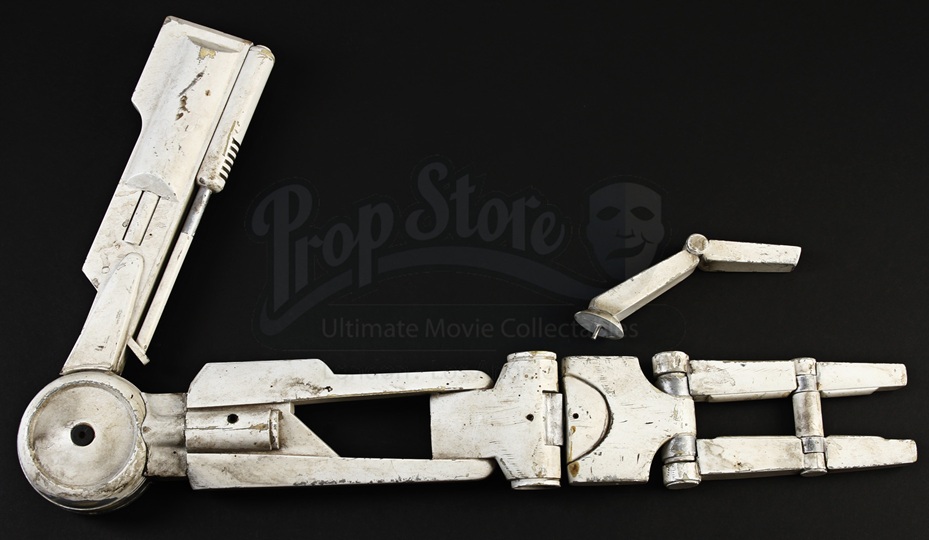
Regardless, a big factor that kept this project from better screen fidelity in the first place is the color inconsistency between the various B1s in Episode I – or at least (as usual), the color grading differences between various editions of the film playing havoc with our perceptions!
Just compare these two shots of the same scene, and the effect that the slightly cooler lighting of the first has on the droids’ color:
the quest for the right battle droid color

Galactic Style Guide – Texture II

Welcome back to the Galactic Style Guide, the series where we break down the ‘Star Wars aesthetic’ in order to help you create a more authentic ‘outer persona’ for your in-universe ‘denizen’ or OC cosplay!

In this entry, we’re wrapping up our look at an element of character design that I think gets frequently overlooked in SW costuming circles – Texture! By the end of this post, I hope you’ll see how this element is actually a key pillar of achieving a authentic, suitably Swarzy look. While the visual effect may be similar to patterns, in this case we’re dealing with the actual physical dimensionality of the fabrics used to create a character’s costume. This degree of dimensionality means that the surfaces of various fabrics catch light in different ways, creating more or less visual interest. Stick around to the end for another kind of texture that can really help give your kit the air of authenticity! First though, we’ll keep it going with some somewhat more familiar or ‘Earth-ier’ textured garments.

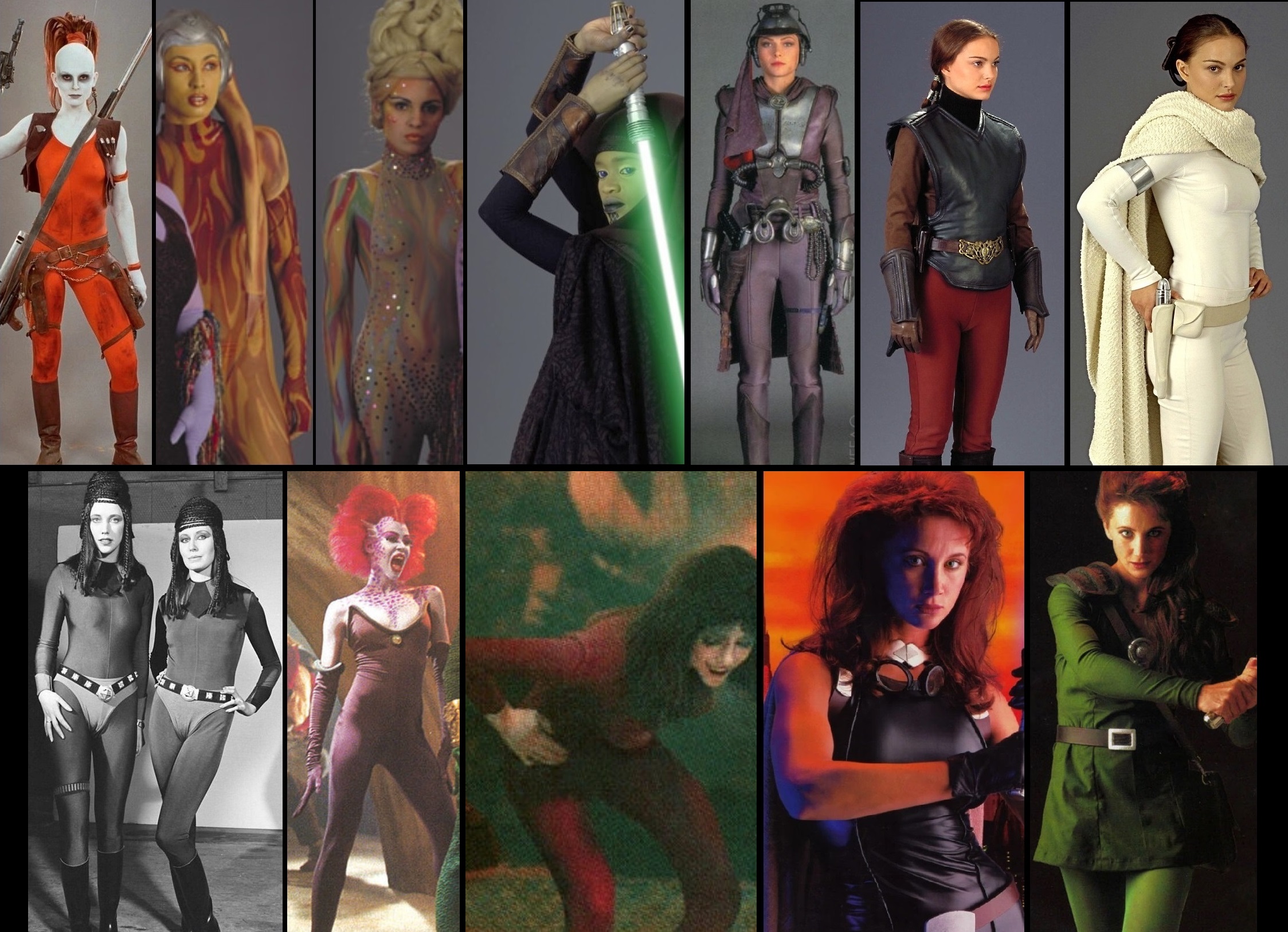
On the lowest end of textured materials, we have various form-fitting garments. Not only do these make up a tiny minority of onscreen costumes, but they also seem to only ever be worn by females:

(Aurra Sing, Ayy Vida, Sel Maa, Luminara Unduli (sleeves) Zam Wesell, Padme pilot disguise (pants) & Geonosis outfit;
the ‘Tonnika sisters’, Rystall Sant, Laudica (@ Jabba’s), Mara Jade x21.)
keep reading for more examples and analysis!

Galactic Style Guide – Texture I

Welcome back to the Galactic Style Guide, the series where we break down the ‘Star Wars aesthetic’ in order to help you create a more authentic ‘outer persona’ for your in-universe ‘denizen’ or OC cosplay!

First up – my apologies for the inadvertent hiatus in regular posts over the last few months. I started a new job back in September and even though I still get to bike-commute each day, the ride is about twice as long and so eats a bit more of my free time each day. Plus, the job itself is super detail-oriented – so when it’s quitting time, my brain is usually pretty fried. Couple this with ongoing new-home improvements (but still no usable workshop or photography space!), putting together a presentation for an out-of-state conference, the constant travel of the holiday season, weekly volunteering, a couple of polar vortices, plus a lack of local opportunities to actually Do something with my hobbies… with the end result that I’ve been feeling more than a bit burnt-out and unmotivated lately. However: the days are getting longer, and I am making an effort to continue contributing to this site!

In our next two Style Guide entries, we’re analyzing examples of an element of character design that I think gets frequently overlooked in SW costuming circles – Texture! Over the next couple months, I hope you’ll come to see how this element is actually a key pillar of achieving a authentic, suitably Swarzy look. While the visual effect may be similar to patterned materials, when we talk about texture, we’re talking about the actual physical dimensionality of the fabrics used to create a character’s costume. The degree of dimensionality means that various fabrics catch light in different ways, creating more or less visual interest.

Let’s get started with a material that may not immediately come to mind as ‘Swarzy’ – yet the overwhelming evidence shows that it definitely is!

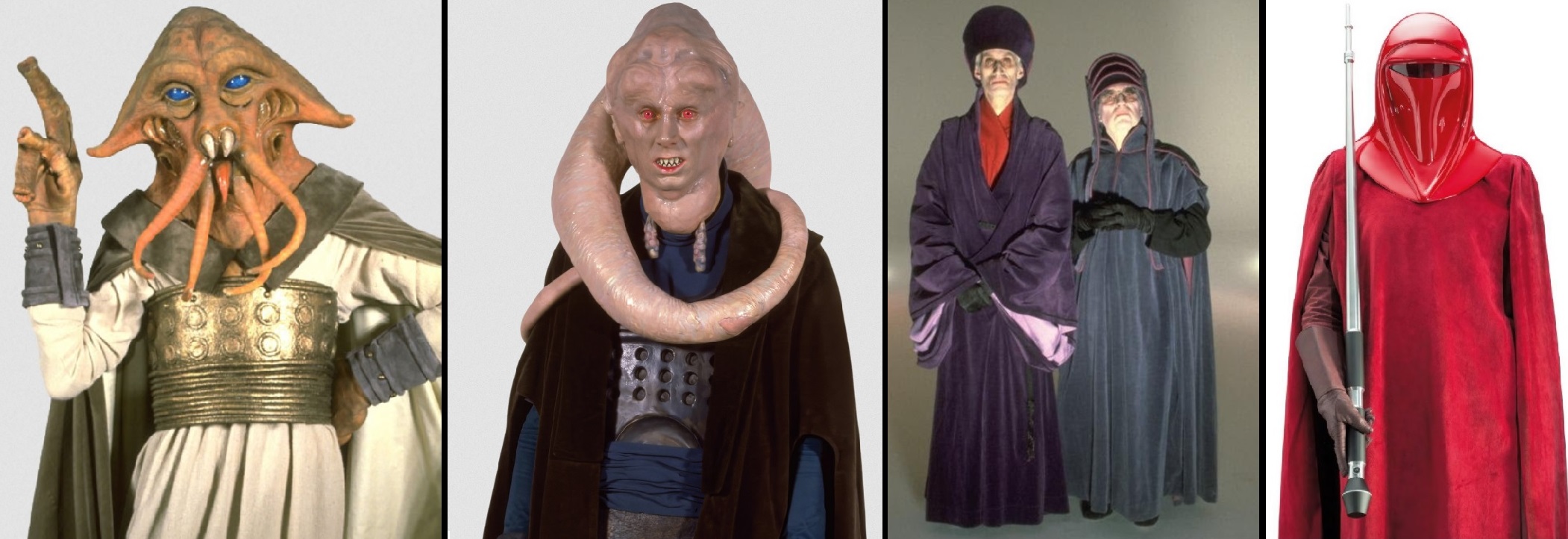
As we can see here, while it only appears in the OT worn by a small handful of characters (curiously, all in Episode VI), velvet got a big representational boost in the Prequels due to their focus on upstrata characters.

keep reading for more examples and analysis

Galactic Style Guide – Patterns

Welcome back to the Galactic Style Guide, the series where we break down the ‘Star Wars aesthetic’ in order to help you create a more authentic ‘outer persona’ for your denizen or OC! In this month’s ‘GSG Counterpoint’ entry, we’re looking at an element of visual character design that tends to fall by the wayside when we think about the foundations of galactic style. While the vast majority of characters in the Original Trilogy wear clothing made of solid-color material, there are a few rare places where patterned fabrics are used. As we’ll see, the Prequels introduce a statistically higher number of examples, though they are still the minority. The highest-quality post-Disney title includes several, but in a very specific context!
Note that in this entry, we are primarily dealing with ‘prints’, as opposed to textured fabrics (in which the apparent pattern is caused by the actual dimensional quality of the fabric itself).

In all three films of the OT, I think we can count the number of characters wearing (non-camouflage) patterned clothing on one hand. The first is pre-skeleton Beru Lars, whose innermost layer (of three!) is a collared shirt with a repeated design in a square pattern:

Next up, one of the patrons at the Mos Eisley Cantina sports a long tunic with a surprising pattern – but you’d never know it from onscreen:

keep reading to learn more!

Galactic Style Guide – Coats & Robes

Welcome back to the Galactic Style Guide, the series where we break down the ‘Star Wars aesthetic’ in order to help you create a more authentic ‘outer persona’! Somehow it’s been about a year since we’ve had a Style Guide entry dealing with soft kit, so this time around we’re diving into another category of somewhat ‘swishy’ garments – coats and robes!
As we ran into a similar semantic issue when we looked at capes and cloaks (distinct from today’s subject due to their lack of sleeves), before we get ahead of ourselves we should probably try to nail down the differences between these two.
So, how exactly does a coat differ from a robe? To be honest, it’s a blurred line. After collecting and scrutinizing the references for this entry, the answer seems to be a combination of 1) the amount of tailoring the garment has, 2) the wearer’s activity level, and 3) perhaps the degree of closure: thus Robes tend to be longer and flowier (less tailored), worn closed, and folks who wear them tend to do more standing around. Coats tend to be somewhat shorter, more tailored, worn open, and those wearing them do more while wearing them. Or perhaps robes are less utilitarian, while coats serve more functional purposes, like protecting the wearer (from cold, dirt, etc.)? As I say, it’s a complicated spectrum to navigate, and the boundaries are more than a little unclear, but I’ve done my best to group them here, hopefully to show the differences.

First up we have what I’m calling ‘true robes’:

continue reading

Galactic Style Guide – Luggage

Welcome back to another installment of the Galactic Style Guide, the series where we break down the ‘Star Wars aesthetic’ in order to help you create a more authentic ‘outer persona’! While the Galactic Starcruiser may no longer be taking on passengers and has instead been gathering dust for the last year, I’m long overdue to examine examples of in-universe LUGGAGE! Back in its heyday, many Starcruiser passengers considered a themed suitcase essential for voyage immersion, but most of the ones I saw went pretty far off the mark from what we actually see onscreen…but there’s never a bad time to do a little research and try to improve your authentic ‘Star Wars eye’!
(But first, a quick FYI/programming note before we begin: this entry and next month’s are fairly quick and dirty, but there’s a good reason: my wife and I just bought a house, and naturally, real life takes priority over hobbies! I fully expect to be knee-deep in renovations well into the New Year, but hopefully things go smoothly and I can get back to more regular and in-depth posting before too long. With that said, let’s get started!

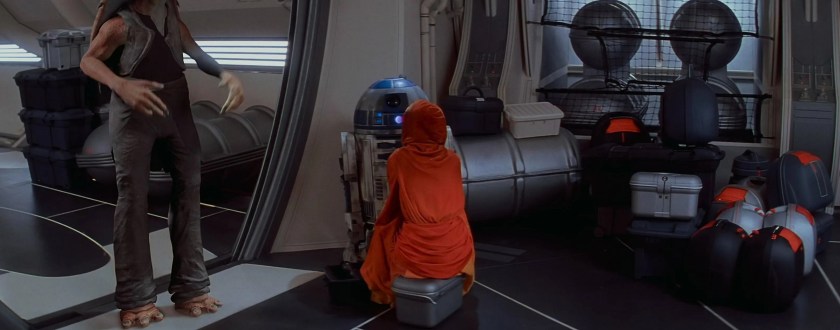
There aren’t many (if any?) examples of what we would recognize as luggage in the Original Trilogy. Luke has his blue backpack and a couple of trunks on Dagobah, but that’s about it – most everyone travels extremely light otherwise! It’s not until Episode I that we get a good look inside a ship’s cargo hold to see what traveling gear looks like in-universe.

The scene in which Padme cleans R2-D2 gives us our best look:

What does in-universe luggage have in common?

Galactic Style Guide – Binoculars

Welcome back to another installment of the Galactic Style Guide, the series where we break down the ‘Star Wars aesthetic’ in order to help you create a more authentic ‘outer persona’! It’s been a while since we’ve looked at any in-universe hardware, but in this installment, we’re digging deep into a specific type of gear used in the field across the galaxy: space binoculars!
A good set of binocs (whether macro- or electro-) are a great accessory to help add depth to an appropriate character impression, filling in for the collapsible brass telescope or ‘field glasses’ frequently carried by characters in various SW-influencing historical genres – whether that be swashbuckling pirates, Old West cowboys, or World War soldiers.
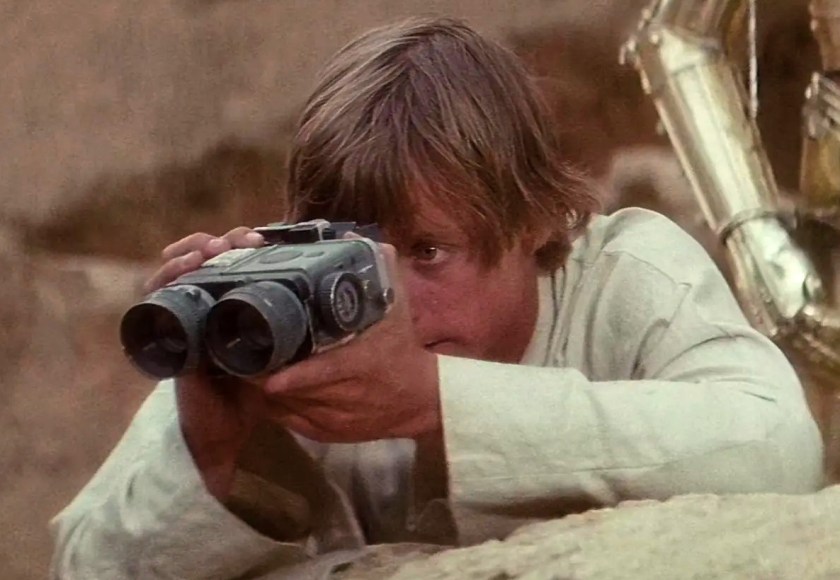
Let’s get started with our ur-example: the Lydree MB450 macrobinoculars carried by Luke back in SW’77:

keep reading to see TONS more examples!

Galactic Style Guide – Capes and Cloaks II

Happy Orthodox Star Wars Day!, and welcome back to another installment of the Galactic Style Guide – the series where we break down the ‘Star Wars aesthetic’ in order to help you create a more authentic ‘outer persona’! In this entry, we’re continuing our exploration of capes and cloaks by looking at those seen in Lucas’ Prequel Trilogy. Star Wars’ costume designs have always been a unique mixture of Spaghetti Western, 20th century military, Eastern/’exotic’, and medieval styles, and the use of capes/cloaks are largely responsible for the latter. Let’s get back to it, and see what we can learn!

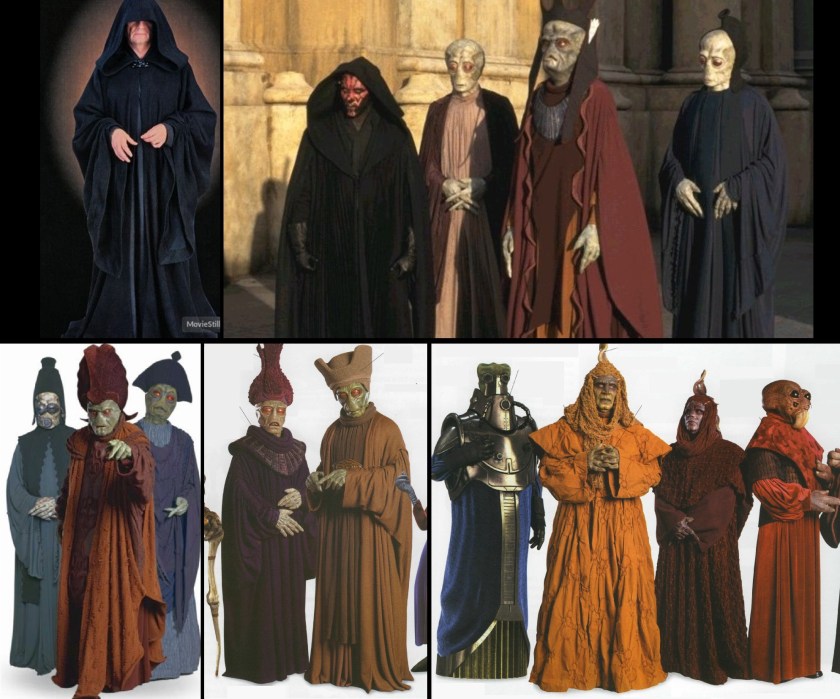
Seeing how the story revolves around a Republic becoming a dictatorship, it’s no surprise that one of our main Senator characters (Bail Organa) in Episode III is often seen wearing an asymmetrical toga-like cloak, as does his ship’s captain (Raymus Antilles). Here’s another set of cloaks I would love to get my hands on in the Lucas Archives and examine just how they are constructed (I have a suspicion that they’re simpler than they appear, and are likely just a multi-yard rectangle with stitched pleats and an offset neck hole). Note the leather(?) piping along the leading edge and around the neck hole, which is a low-impact way to add a bit of detail and structure without being distracting.

As we’ll soon see, while the folks wearing capes and cloaks in the Classic Trilogy were often of questionable repute, those in the Prequels are commonly upstrata, and often members of the Republic government.

our breakdown of Prequel Trilogy capes and cloaks continues

Galactic Style Guide – Ammo belts and Pouches III

Welcome back to another installment of the Galactic Style Guide, the series where we break down the ‘Star Wars aesthetic’ in order to help you create a more authentic ‘outer persona’! In this entry, we’re concluding our examination of the various styles of belt gear and pouches seen onscreen by looking at Original and Prequel examples together – let’s get started! In the first two entries, we focused on military-surplus (or milsurp style) gear, so this time we’re looking at the few non-milsurp examples.

Our two male heroes have belt gear which seems military but (as far as I know) isn’t – if you can’t swing actual milsurp, you can’t go wrong with real, unadorned leather in one color, and minimal hardware (snaps and brass studs, at most):

One of the ‘Pruneface’ commandos in Episode VI has an intriguing cylindrical belt pouch, which I believe was also borrowed for Wilford Brimley’s character a few years later:

What do we think it is? Optic case of some sort? Milsurp or not?

One of the places where we see a decidedly different style in action is among the ‘scum and villany’ at Jabba’s palace. Let’s break it down:

Continue reading “Galactic Style Guide – Ammo belts and Pouches III”

Galactic Style Guide – Ammo belts and Pouches II

Welcome back to another installment of the Galactic Style Guide, the bimonthly series where we break down the ‘Star Wars aesthetic’ in order to help you create a more authentic ‘outer persona’! In our second entry looking at the various styles of belt pouches and bandoliers seen onscreen, we’re focusing on military surplus (and milsurp-style) examples as seen in the Prequel Trilogy.
Let’s begin (again!) on Tatooine!

Throughout Episode I, we see young Anakin Skywalker wearing one half of an Italian Army ammo pouch for the Carcano rifle (plus another mystery pouch):


Several of the background characters in Mos Espa have belt gear with ‘Lift The Dot’ fasteners; these appear to be a dual-magazine pouch very similar to this WW1-era pouch for the Colt 1911. As I discussed previously, I feel that these kinds of pouches are acceptable for outfitting far-background characters like these, but I feel they toe the line of ‘visible fasteners’. However, they’re usually very sturdily made to stand up to the rigors of authentic use, so if you are reenacting or doing living history with an audience inside the 10-foot line, it’s probably worthwhile to take the extra effort to cover them behind some canvas or webbing.

Jedwar Seelah, Chokk, and the unnamed Nikto podrace mechanics.
keep reading for more examples!