Welcome back to another installment of the Galactic Style Guide, the series where we break down the ‘Star Wars aesthetic’ in order to help you create a more authentic ‘outer persona’! In this entry, we’re concluding our examination of the various styles of belt gear and pouches seen onscreen by looking at Original and Prequel examples together – let’s get started! In the first two entries, we focused on military-surplus (or milsurp style) gear, so this time we’re looking at the few non-milsurp examples.
Our two male heroes have belt gear which seems military but (as far as I know) isn’t – if you can’t swing actual milsurp, you can’t go wrong with real, unadorned leather in one color, and minimal hardware (snaps and brass studs, at most):
One of the ‘Pruneface’ commandos in Episode VI has an intriguing cylindrical belt pouch, which I believe was also borrowed for Wilford Brimley’s character a few years later:
What do we think it is? Optic case of some sort? Milsurp or not?
One of the places where we see a decidedly different style in action is among the ‘scum and villany’ at Jabba’s palace. Let’s break it down:
Welcome back to another installment of the Galactic Style Guide, the bimonthly series where we break down the ‘Star Wars aesthetic’ in order to help you create a more authentic ‘outer persona’! In our second entry looking at the various styles of belt pouches and bandoliers seen onscreen, we’re focusing on military surplus (and milsurp-style) examples as seen in the Prequel Trilogy. Let’s begin (again!) on Tatooine!
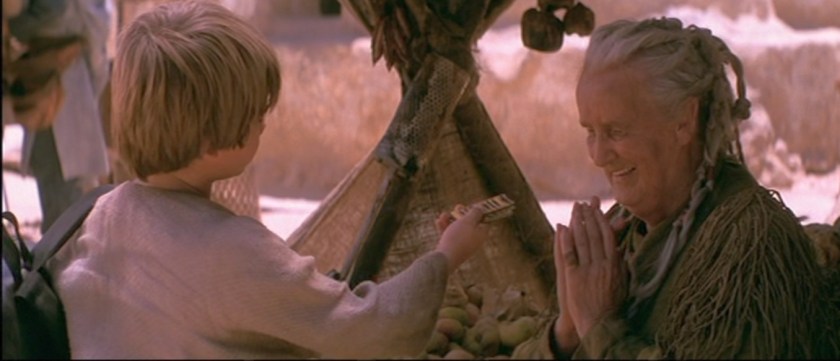
Throughout Episode I, we see young Anakin Skywalker wearing one half of an Italian Army ammo pouch for the Carcano rifle (plus another mystery pouch):
Several of the background characters in Mos Espa have belt gear with ‘Lift The Dot’ fasteners; these appear to be a dual-magazine pouch very similar to this WW1-era pouch for the Colt 1911. As I discussed previously, I feel that these kinds of pouches are acceptable for outfitting far-background characters like these, but I feel they toe the line of ‘visible fasteners’. However, they’re usually very sturdily made to stand up to the rigors of authentic use, so if you are reenacting or doing living history with an audience inside the 10-foot line, it’s probably worthwhile to take the extra effort to cover them behind some canvas or webbing.
Jedwar Seelah, Chokk, and the unnamed Nikto podrace mechanics.
Welcome to another installment of our ‘Galactic Style Guide counterpoint’ subseries, where we help you strengthen your ‘Star Wars eye’ by highlighting and remedying common faux pas that can make your kit look NotStar Warsy. As part of the GSG, the ultimate goal is still to help you create a more accurate ‘outer persona’ – but we approach the goal from the opposite direction! This month, we’re taking a look at one of the specific elements which George Lucas decided would have no place in his Star Wars aesthetic – zippers! (For our look at the other form of visible fastener Lucas specifically didn’t want to see, see this previous entry).
If I were to ask you when you first learned that Lucas didn’t want to see zippers and buttons onscreen, there’s a very good chance it was sometime after 2014 and the release of Brandon Alinger’s excellent SW Costumes – The Original Trilogy. However, the no-visible-fastener rule had already been in print for at least seven years: discussed in Rinzler’s The Making of Star Wars (2007), on page 125. What accounts for the delay before this fundamental GFFA costuming rule became truly widely known is, I think, social media; Facebook was still in its relative infancy in 2007. Since then however, the top-down Lucas directive has become frequently-cited in costuming circles, and yet cosplayers and Batuu-bounders still try to excuse visible zippers in their costumes; typically, this involves pointing to a screenshot of Luke Skywalker zipping up his flightsuit in Episode V:
Remember, per our sources, Lucas said he didn’t want to see such fasteners, not that they didn’t exist at all (many seem to have trouble with this distinction). Why Luke’s zipper (and presumably, those of all the other onscreen pilots and technicians) is perfectly permissible is simple: once worn, it isn’t visible – it’s hidden by a flap! (If you can think of a way to convey a pilot suiting up for battle by donning a one-piece flightsuit without showing them zipping it up, I am all ears!) However, there are a fair number of other characters whose costumes do include uncovered zippers: luckily for us, these tend to fall into one of two categories; unluckily for us, things seem to have taken a step backwards in the modern era…
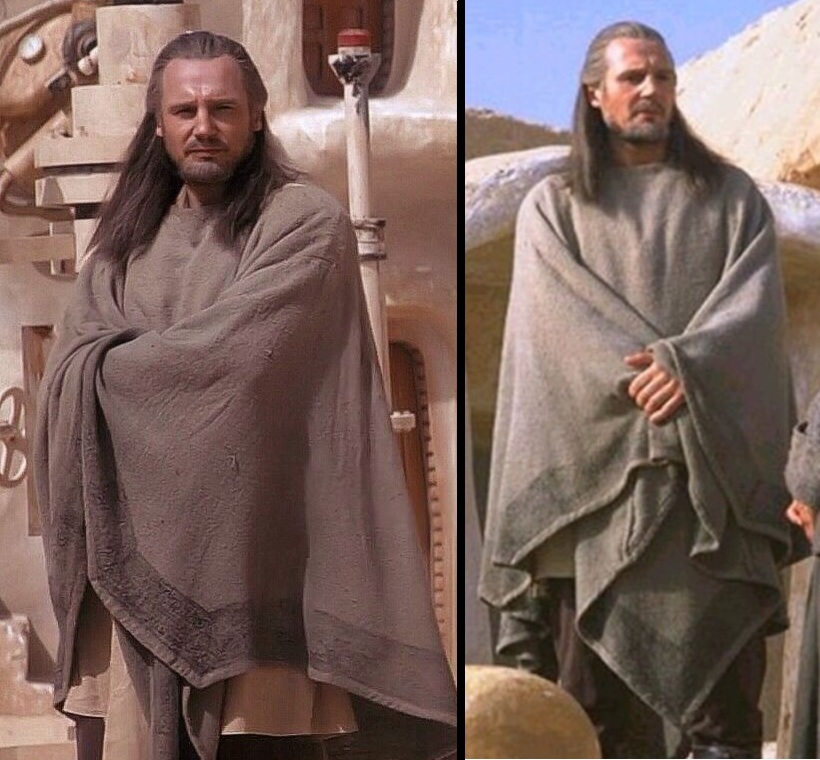
Welcome back to another installment of the Galactic Style Guide, the bimonthly series where we break down the ‘Star Wars aesthetic’ in order to help you create a more authentic ‘outer persona’! In this entry, we’re continuing our look at ponchos, focusing on examples from the prequel era! (As a reminder: for our purposes, we’re defining a poncho as a garment worn as an outer layer for protection from the elements, which covers the front of the body). Let’s keep things rolling with the poncho I think I would most want to curl up in:
Qui-Gon wears this poncho when venturing into Mos Espa in Episode I—the script specifying that he is “dressed as a moisture farmer”. Trisha Biggar notes that the coarse-weave is a silk/linen mix and that the border is “printed”—though I’m not sure what exactly that means (Dressing A Galaxy, p20).
Whenever I come across someone online showing off an original Star Wars costume, few things can make it feel out-of-universe faster than visible Earthly fasteners. This should come as no surprise, as the lack of visible fasteners (zippers, buttons, etc) was one of Lucas’ chief design points when creating the original film’s visual style (see Alinger’s SWCOT). While working on a future installment of Galactic Style Guide, I realized I should probably lead by example and make sure none of my own kit pieces broke this rule…and if any did, to fix them ASAP!
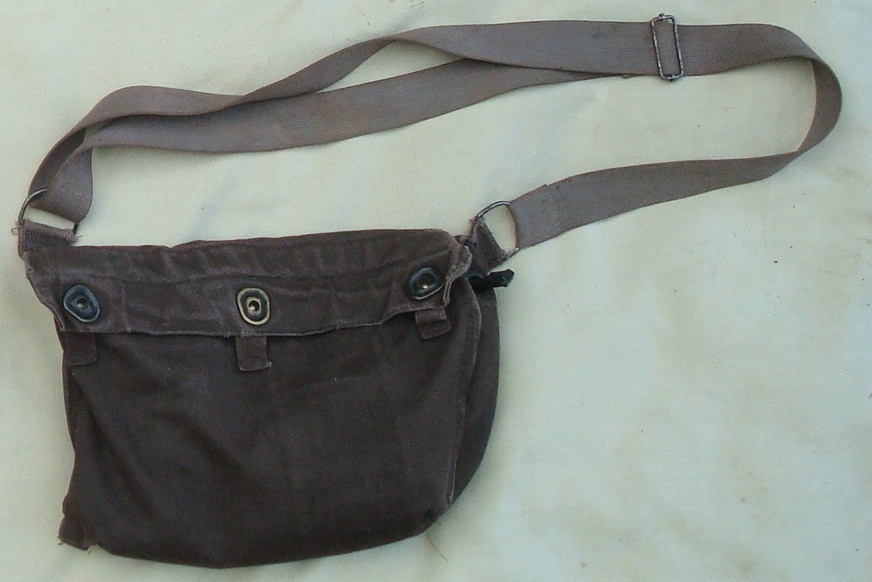
Since a lot of my gear has been purpose-built for GFFA living history, most of it is fastener-free. However, some of the milsurp pieces I use would need tweaking; the first of these was my satchel, originally an M9A1 gas mask bag:
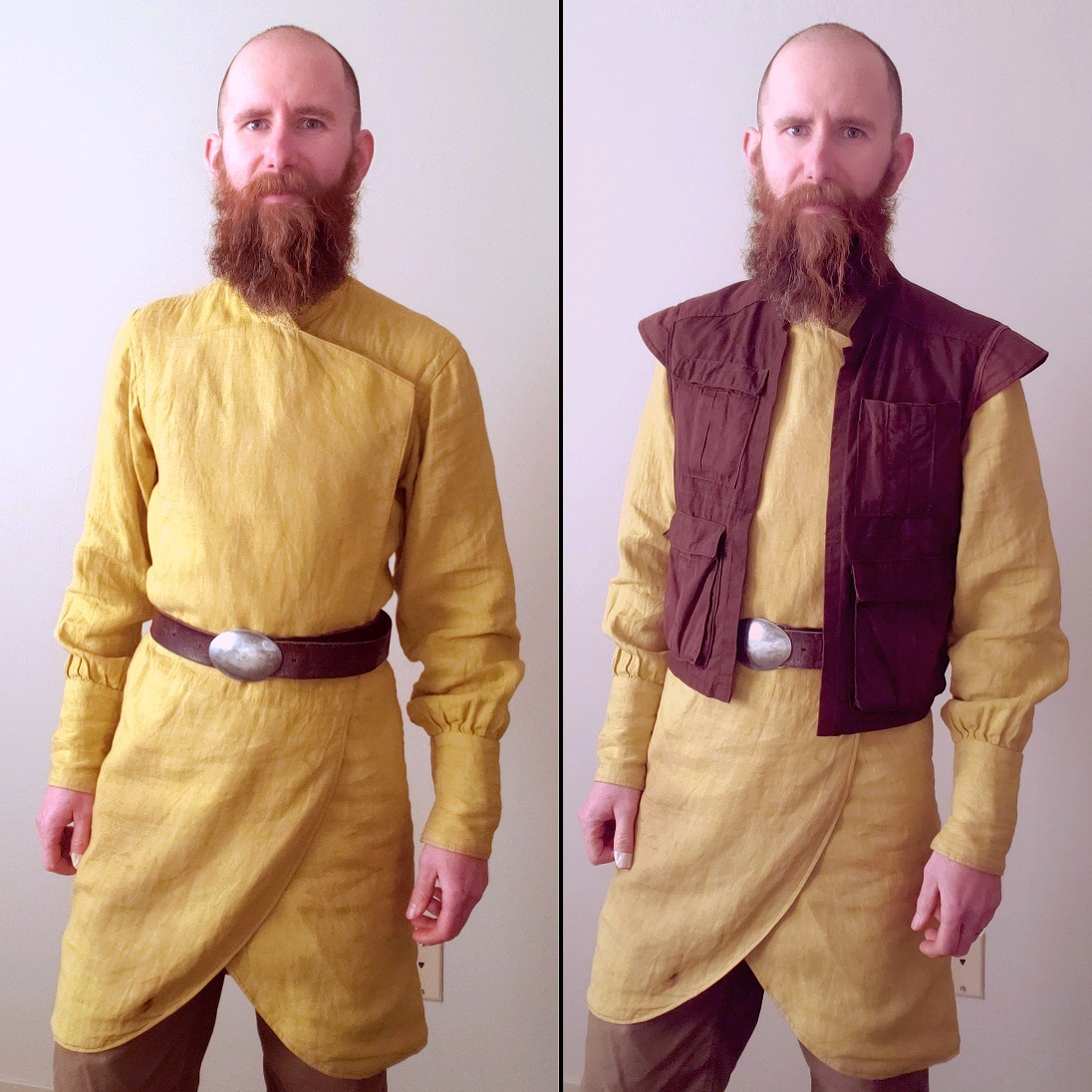
Since debuting my first draft Rebel-partizan-on-Naboo impression back in 2018, further research has caused me to continue to refine the kit. In addition to needing some more layering, the main thing that needed upgrading was the shirt. My ‘Mark I’ Naboo shirt was not (aside from the Mandarin collar and the color) based on any specific onscreen examples, and the use of a Vietnamese ao dai pattern was only inspired by costume designer Trisha Biggar’s comments re: the general use of Asian elements in Naboo fashion (and at the time I liked the asymmetry of the design). However, I realized that I should probably wear something that more clearly ‘read’ as Naboo in origin, and it should probably be constructed of a lighter material as well – the Mk I was sewn from a ‘rustic’ 7.1-ounce linen. Since this piece is intended for a Galactic Civil War era persona, I really wanted to try and move away from the traditional Naboo style seen in the Prequels, especially the Renaissance-heavy designs of 32 BBY:
“We had designed Naboo more or less around Art Nouveau (we called it “Space Nouveau”), which was based on organic, plantlike forms. The costume ideas looked gorgeous on the women, but when you put guys in them, they didn’t look very tough.” – Ian McCaig, Dressing A Galaxy, p.72.
Roughly inspired by the lines of the traditional Indian kameez, I pored over my reference library to see what Naboo male fashion stuck around through the years while noticing any common elements:
In Episode I, Anakin Skywalker wins the Boonta Eve Classic podrace, which we’ve discussed before. Following the race, he and Qui-Gon sell his podracer, go home to mom, and Ani exclaims, “look at all the money we have!” Here’s the thing – the money Anakin hands her appears to be a stack of Republic credits.
On his way out of town (in a deleted scene), he also gives his old friend Jira her own stack of Republic credits:
As I was preparing an upcoming post, I started wondering which characters in the Saga wore colors beyond earthtones, black, white, or shades of gray. I started leafing through my Visual Dictionaries and several hours later I had created the following rainbow of characters. These are presented in chronological order within each color band, and as we cans see, Trisha Biggar’s costumes for the Prequels are FAR more colorful than those of the Galactic Civil War period. If I do a third collection for all the blacks, whites, grays, and earthtone characters, I’m sure there will be many more OT characters represented.
Welcome back! This is the third and final part of my buildlog for attempting to scratchbuild an N1 starfighter pilot’s helmet. When we left off, I had the scaling figured out and patterns drafted, and the side pieces and earmuff details created. Now it’s time to craft the helmet’s shell itself. To get an idea of how the helmet would look, I transferred the patterns to lightweight cardboard and taped everything together to make a rough mockup of the whole assembly to check the general shape:
This was bonded along the seams (inside and outside) with brown paper bag and PVA glue (left) before brushing both exterior and interior with Bondo resin (center):
Hello there! Welcome back to my buildlog for recreating an N1 starfighter helmet – let’s not waste any time and get straight into the process! In my last post I determined how big the components of the helmet would be, and decided on a method for construction (Pepakura). While I originally wanted to make all parts of the helmet using Pep, I decided that the Y-shaped-part-that-holds-the-earmuff was complicated enough that I should make them out of something more substantial.
I first considered making a mold and casting them in resin, and when I want to feel like a real prototyper, that means carving a positive from amber ‘victory wax’. Well, after a few days I had built up the shape pretty close – I figured I would cast the pieces fairly roughly, and then do the fine shaping on the casts, since resin doesn’t heat up and deform in-hand. However…