Artifact ID: a ‘triple threat’

Visual Dictionary Disclaimer: it’s unknown what percentage of props in these books actually appeared on-screen, or were made from scratch to pad out the book. It’s entirely possible that someone with eagle eyes and a Blu-Ray might spot these items slung over the shoulder of some anonymous background extra on Coruscant, and I would normally say to take them with a grain of salt. However, I am inclined to view them as legitimate sources purely for their supreme usefulness in helping flesh out the in-universe material culture of the GFFA.
With that out of the way…

While leafing through my copy of DK’s Episode II Visual Dictionary, I noticed something vaguely similar about a few of the props.
AotC_3x.jpg
Can you see it? All three feature an encircling strap, and two of the three have the exact same shape. Hypothesis: these props are built on the same base item! Continue reading “Artifact ID: a ‘triple threat’”

Experimental Archeology: Rebel style!

After finishing the retool of my DH-17, I realized that I needed a way to carry the blaster on my person during workshops or presentations (because it’s part of a kit instead of a costume prop, I need be able to do more than stand around, look pretty, and get photographed—I need my hands when I’m teaching!) Continue reading “Experimental Archeology: Rebel style!”

Building the ‘Outer Persona’: Backpack

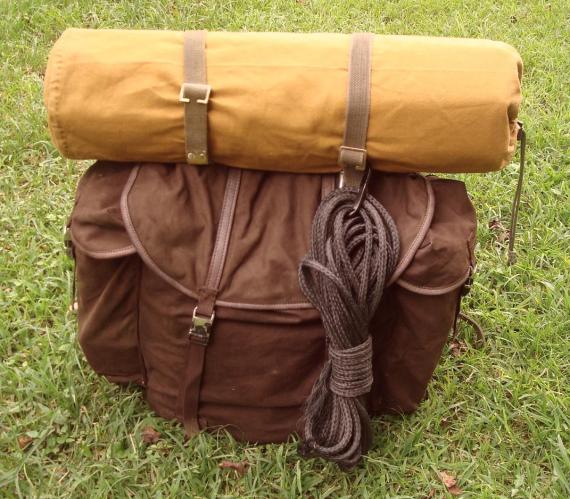
If you want to get some authentic ‘woods time’ in your GFFA pursuits,  you’re eventually going to need something to haul your gear around. I’ve had this trusty 1950 pack (made, as far as I can tell, by Bergan’s of Norway?) for seven years now, and I’ve been tweaking it here and there almost since I bought it.DSC05127I thought it would be a good idea to share all the various mods and justifications I’ve made over the years to make it roughly fit the GFFA commoner’s ‘aesthetic’. Continue reading “Building the ‘Outer Persona’: Backpack”
Building the Rebel Persona: 5.2 – Blaster rifle

20210113_124609
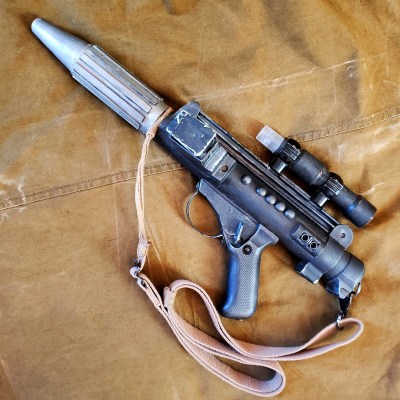
Once I had made enough progress on the research front to begin crafting the ‘outer persona’ for a Rebel impression, and had made plans to debut ‘Citizen Olis’ at a summer camp presentation on wilderness survival, I knew I’d need some kind of blaster. While I talk with my hands and demonstrate a fair amount during workshops, it’s still nice to have a blaster at your hip or on a sling, etc., as it underlines the always-armed attitude of a partisan guerilla: Continue reading “Building the Rebel Persona: 5.2 – Blaster rifle”

Building the Rebel Persona: 5.1 – Helmet

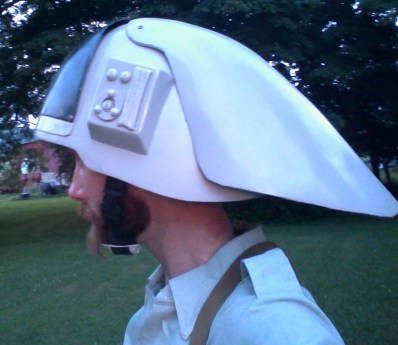
As I said in the previous Hard Kit overview, I opted to give ‘Citizen Olis’ a little armor in the form of a Rebel ‘swoop’ helmet.
“Rebel soldiers wear very little protective armor, typically a helmet at most, though some soldiers wear chest and abdomen plates. Alliance tacticians believe that complete freedom of movement is more useful than the dubious protection provided by armor—which rarely stops a blaster bolt anyway.” West End Games: Rebel Alliance Sourcebook p.99)

As my first serious foray into the world of Pepakura (cardstock + resin), while it’s not perfect, I am extremely pleased with how it turned out! (While researching construction techniques, I came across one fan’s attempt at making the helmet using the same files as I did…I was determined to have the final product come out better than his—a rather low bar—but I am still quite surprised how nice mine looks in the end).
olishelm DSC05064
The road from computer file to three-dimensional helmet, however, was long and winding. Continue reading “Building the Rebel Persona: 5.1 – Helmet”

Building the Rebel Persona – 5: Hard Kit

#1 Helmet:
This is my take on a standard Rebel ‘swoop’ helmet as featured in Episode IV, but which has been commonly depicted in various planetside conflicts in plenty of secondary materials. It is made using the Pepakura technique (cardstock hardened with fiberglass resin and Bondo putty).
(Full, detailed account of construction found here).
20170717_210859

Naturally, we have zero hard references to specific gear that local Rebel cells received from Alliance Ordnance and Supply, so I don’t know how appropriate the swoop helmet is for my context—versus something like the ‘Endor donut’ helmet. My main issue with the swoop helmet is that the light color clearly stands out in outdoor settings (although it’s still frequently shown worn in such settings), but I’m hesitant about painting it a light brown or something, which might deviate a bit too much from the accepted visual norm of what we’re used to seeing. Continue reading “Building the Rebel Persona – 5: Hard Kit”

Building the Jedi Persona – 4: Hard Kit

agribeltkit1The assembling of appropriate items of ‘hard kit’ is the point at which we move from only having a outfit to truly having a cohesive Kit. Using pieces of gear that are what they are (in the list below, only the comlink is a prop) makes a kit functional and brings it into the realm of living history. Let’s see what I mean: Continue reading “Building the Jedi Persona – 4: Hard Kit”
Step 5 – Craft It!

Now that you know what you want to do (as a reenactor or interpreter), who you’re going to portray (your persona), and (after careful research and/or use of the Galactic Style Guide) what you’re going to wear while doing it, the time has come to gear up and clothe your persona in appropriate ‘garb’. If you know how to sew, great! If not, it’s always a good time to learn! A simple websearch for ‘basic sewing stitches’ will yield plenty of tutorials. Even though we’re depicting a high-tech society, tailor droids break down now and then, so hand-sewing is fine too! (the first time I made my Jedi tunics, I opted to sew the main seams with a sewing machine, and then finish the seams by hand).

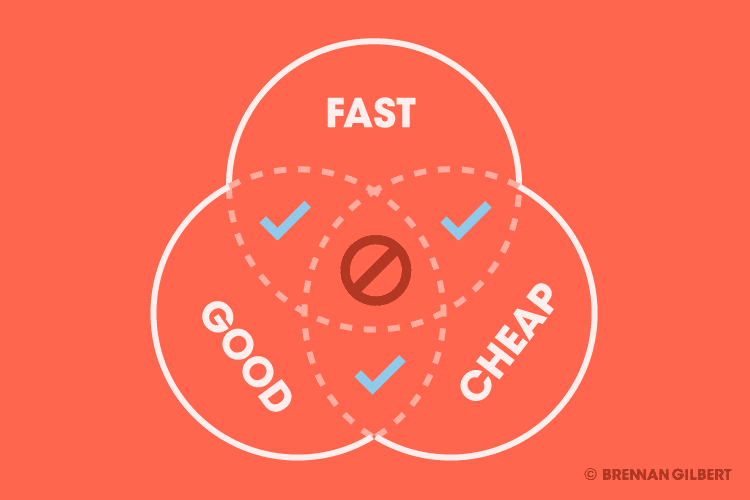
When it comes to making or buying elements of one’s kit, it always pays to remember The Designer’s Paradox:

fast-cheap-good-design-diagram
You can have it CHEAP, you can have it FAST, or you can have it GOOD.
Choose carefully, because you can only pick two!

In other words, getting something cheap and good takes time; fast and good costs money up-front, while cheap and fast will cost you in the long run.

Since there are plenty of how-to pages out there (costume tutorials abound on the internet), I will try to keep this short and sweet.
A quick primer on fabrics and their properties as they pertain to our purposes: Continue reading “Step 5 – Craft It!”

Step 2.5 – What Will You Do?

Before continuing, you should first decide what you are going to do when you are doing GFFA living-history. In other words, what form will it take?, and how involved will you be? When people are involved in these pursuits for non-fictional settings, we can usually group them in two types: ‘reenactors’, and ‘historical interpreters’. What’s the difference between these? As Master Townsend explains,

“A reenactor, in the truest sense of the word, is like a bit-role actor in a movie. They help fill out the set. Reenactors typically have no speaking role. They usually have limited direct public interaction.
Reenacting is a great entry point into Living History for beginners. You don’t have to develop a specific individual persona to reenact. While it can be the easiest method of Living History, it can be an expensive direction to go*, depending on the persona type one chooses to portray.”

*See the 501st for walking examples of this—a set of stormtrooper armor will set you back several paychecks, but once you assemble and put it on, all you have to do is walk around and you’re in business.

The analogy to background characters in a movie is especially apt in this case, as the background characters in Star Wars films are excellent inspirational examples. These extras don’t interact with the ‘public’—the film audience—but they really help sell the illusion that the Galaxy is a living, breathing, vibrant setting (now there’s a good homework assignment: pick a SW movie and pay attention only to the background characters! I’ve found this is easier with a foreign audio track turned on – if you’re not focused on the dialogue, you can use more ‘brain bandwidth’ for looking at details!).

Townsend’s explanation of a reenactor sounds very close to what a costumed fan already does at a convention—they are an appropriately-costumed warm body that stands around and gets photographed, and the depth of public interaction is shallow. When was the last time you asked a cosplayer what planet they were born on, or asked them what they’re carrying in their utility-belt pouches? Continue reading “Step 2.5 – What Will You Do?”