
Just in time for Halloween, I’m proud to finally be able to show off a project that’s downright skeletal!:
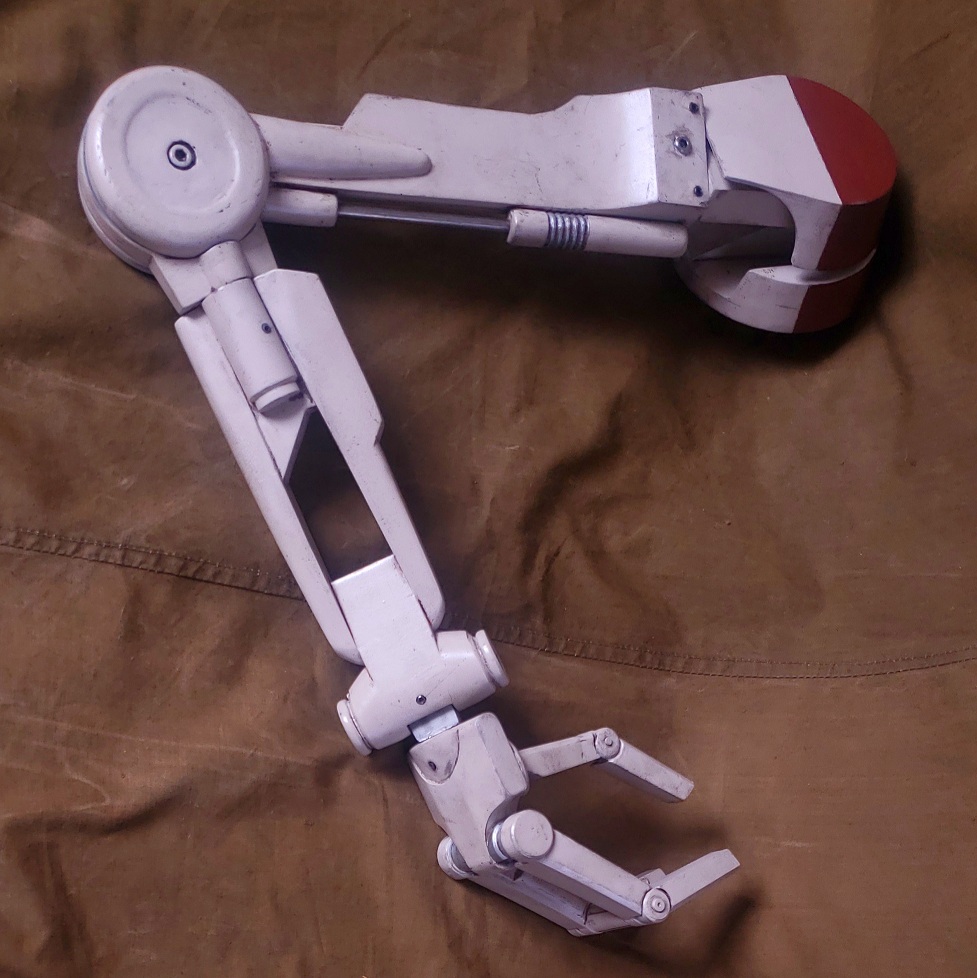
When we last checked in, my battle droid arm project had been printed, resin-filled, cleaned up and given a base coat of paint. Next came the fun part: assembly! To allow them the proper range of motion, the hand and forearm joints were articulated with turned pins and set screws, as it appears the original was made (although I have not yet added the tiny set screws in the fingers; my thumb can do more than just rotate in a circle, as it has an actual captive ball-and-socket):
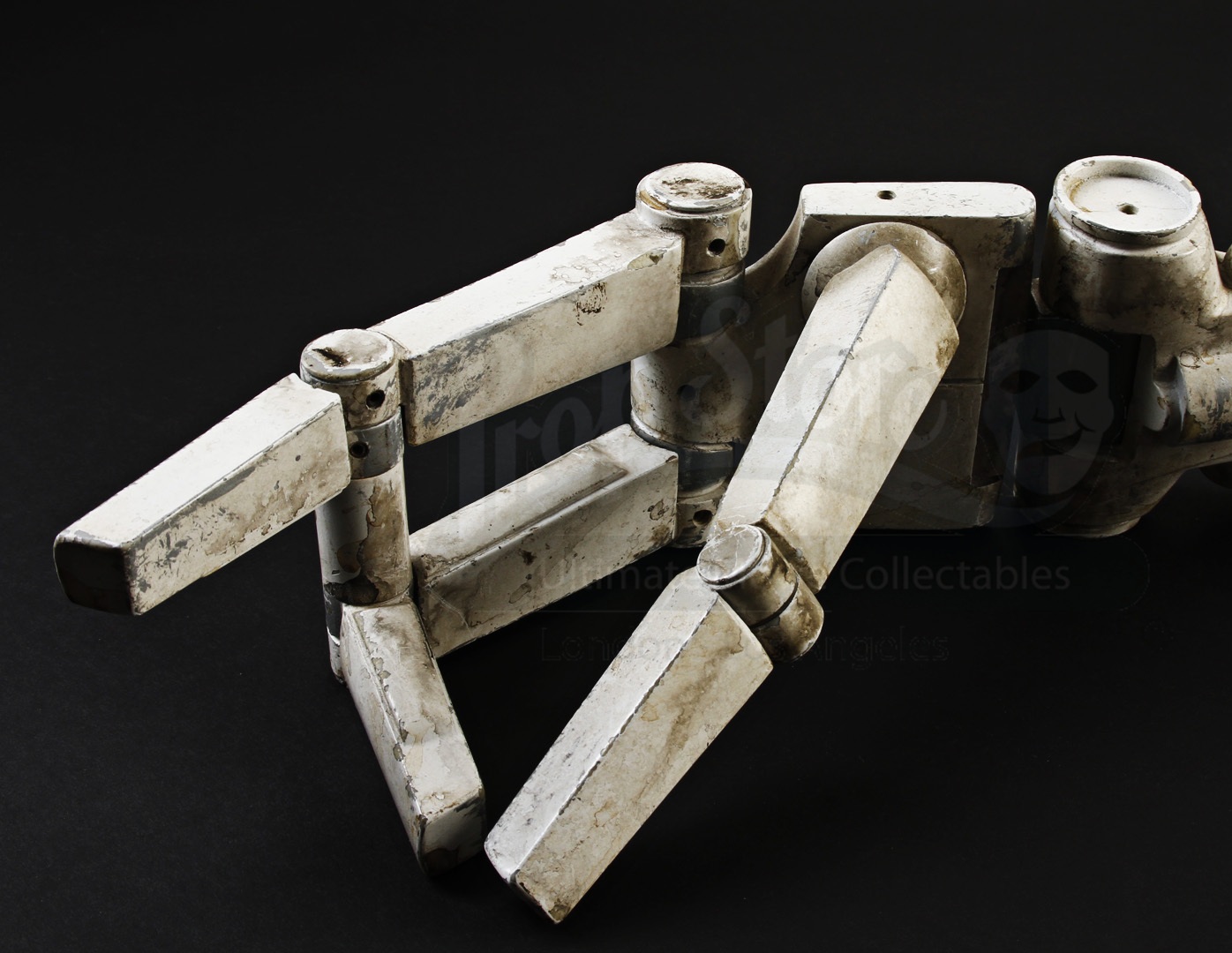

To really sell the artifact as a battlefield relic, I originally wanted to include some cables or wires poking out of the top of the shoulder, but my research turned up the surprising conclusion that such details wouldn’t be necessary.
This is because the B1’s various limbs were held together with electromagnets! Instead of cables and wires, I dug into my box of parts and found a suitably hi-tech-looking, tactile doodad that could believably be a electromagnetic shoulder connection: a hard drive hub! I drilled out a recess for it to fit into with a Forstner bit and screwed it into place

With construction finally completed (well over two years after placing the initial order), it was time to weather and prepare the piece for display. TIME TO OVERTHINK!
My original impetus for building the arm was to include it in an ‘archeological’ display, having been excavated from the battlefield of the Grassy Plains, in which case it needed to look like it had been not only taken part in the battle, but had also been buried for say, 20 or 30 years.

My idea was that Theed University’s archeology department—with a major battlefield right in its backyard—would use the site for ‘field schools’ allowing archeology students to get practical experience, and undergrad Olis had dug up the arm*. However, when I started thinking about the scenario, 20 years is really quite recent to be excavating a battlefield. And from what we see of the battle onscreen, it doesn’t seem as if there would be much to uncover—it’s not as if the Gungans and droids camped out in foxholes the night before the battle, or built fortifications which could be located by students later. And if, as we can logically assume, the Trade Fed’s hardware was removed from the site afterwards, then the plains would quickly return to their pre-battle state.
*Why then, we might ask, wouldn’t the excavated arm go straight to the museum? This issue often comes up in collecting circles when someone shows trepidation about cutting up an original item (firearm, grenade, airplane engine, etc) to make a lightsaber or whatever. The more pragmatic, less sentimental side of the argument contends that when something has been produced in the thousands (millions in the case of the B1), and plentiful examples are already preserved in museums, then it’s okay to own or modify an original.
So what other explanations could there be for Mr. Olis having a 32 BBY-vintage droid arm in his possession? Well, I thought, how do a lot of real people wind up with war relics? They get passed down as family heirlooms! After skimming through several different Naboo-focused sources, I was able to come up with three different possibilities to explain this:
1. What if Olis’ father or grandfather snagged it off a disabled B1 after the Droid Control Ship went kaput? He wouldn’t even need any tools, because according to my research,
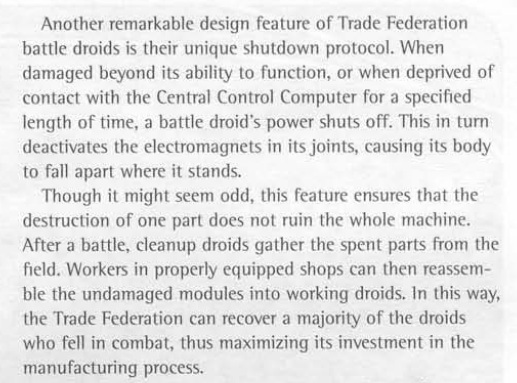
2. However, I also came across a reference to Naboo prisoners ripping droids apart with their bare hands—apparently before the DCS’s destruction! Surely that would make for a great piece of family lore! (source)
3. I started to wonder what happened to the droids following the Battle, and according to a recent young adult novel, “[After the battle] The droids were salvaged and melted down. They were made of high-quality materials. They would be remade into fence posts and garden trellises and art.” (Queen’s Peril, Ch25). This is a Disney!Canon source, but since it only fills in blanks and doesn’t contradict anything (at least in this case), I think I can conceivably use it as part of the backstory.
So with a few possible stories narrowed down to explain said arm (excavated from the Grassy Plains, picked it off a deactivated droid, tore it off a droid during liberation, or saved from being recycled), I realized that the arm by itself is pretty boring-looking since it’s just one color. That’s when I started thinking if I might be able to spice it up somehow. We know the B1s from this period were color-coded (yellow commanders, blue pilots, and red security droids), and a little color might really help things pop! However, I wanted to consider which ‘branch of service’ would be the more likely in-universe choice.
The commander droids were only marked on the heads, so we can throw that one right out. We only see security droids on Naboo escorting folks around Theed during the first stage of the invasion and then guarding the throne room, but presumably their more independent AI would make them the preferred guards for the internment camps we know existed. Conceivably then, a security droid could fit into any of the three scenarios above. (Even though I had the perfect can of blue paint, I decided against a pilot droid because I determined they would be less likely to be encountered by a civilian after deactivation.) I couldn’t find the right security droid color in spraycan form, so I wound up using acrylic craft paint and building up a smooth surface by alternating layers of it with acrylic clear coat, high-grit sanding between paintings. In the end I think it came out pretty good.
Still with me? Since this was going to be a family heirloom, and my NRAC impression is based c. 24 ABY, I needed to sell that this arm had been passed down in the Olis family for well over a half-century. Instead of blackwashing, I daubed the whole thing with diluted dark brown acrylic paint, then hand-rubbed all the surfaces to create an oily, grimy look. Thinned nutmeg brown was dripped into the exposed moving surfaces (thumb, knuckle, wrist joints) and then flexed to create rusted low areas. A bit of graywashing in some cracks helped suggest years of accumulated dust, but since the best weathering is authentic weathering, I spritzed the whole arm with water and let it sit among the dust-bunnies under my bed for a few days; repeating this every week and rubbing with a soft cloth in between kept the schmutz in all the cracks.

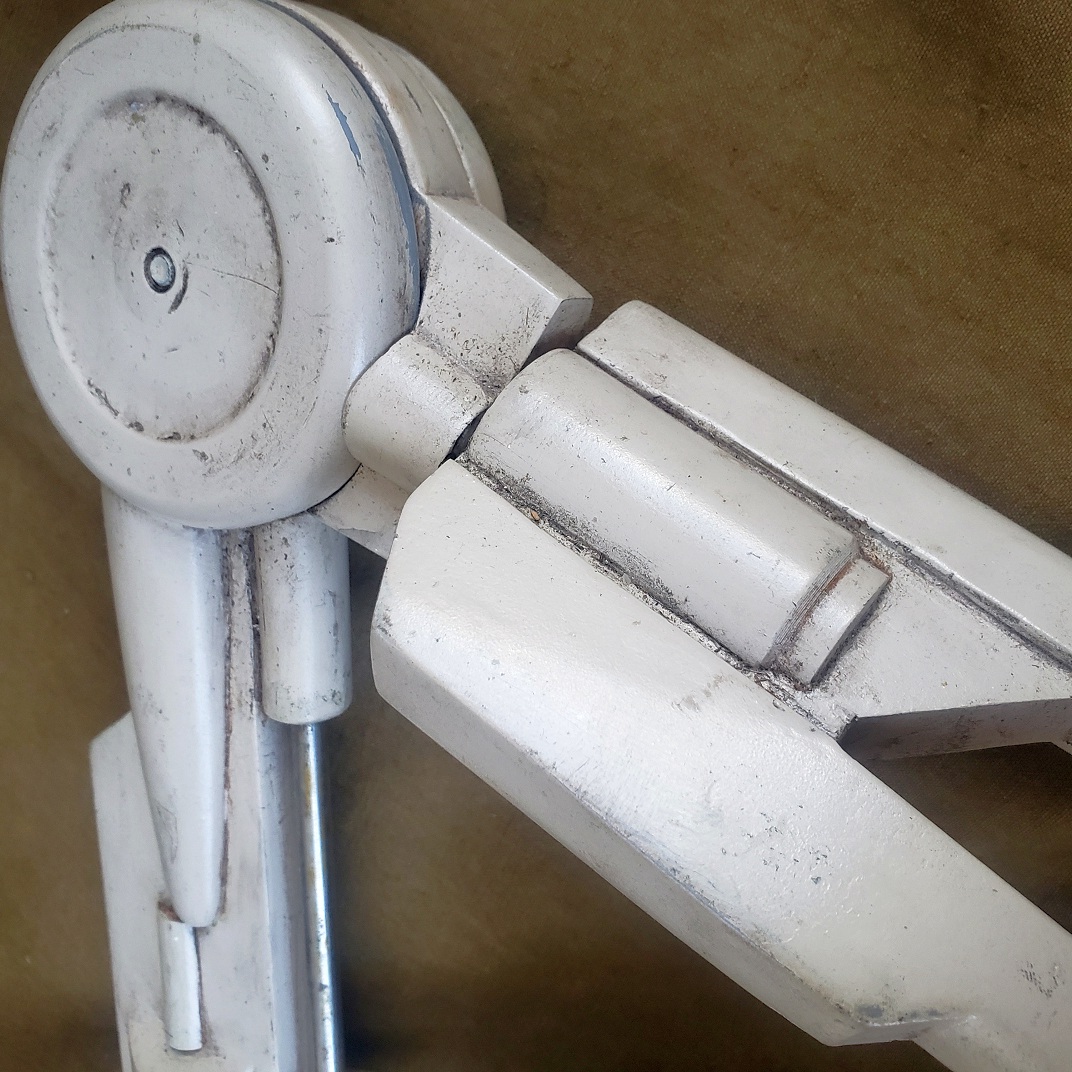
In the end, I think my patience and persistence has paid off – the arm looks—and feels—like a legitimate family heirloom passed down from the Battle of Naboo, and I look forward to being able to use it in potential interpretive talks in the future. Let me know what you think in a comment below, or come discuss larger-scale artifacts at the SWLH facebook group!
Researching, crafting, photographing and writing this site takes a lot of time and energy. If you’ve enjoyed reading, have learned something from this post, or will use it as inspiration for a future project of your own, please consider supporting my work with a small donation below! Thank you!
Make a one-time donation
Make a monthly donation
Choose an amount (US dollars only – unfortunately, I cannot currently accept Republic credits 😉
Your contribution is greatly appreciated and will help me continue to keep this blog ad-free!
(Alternately, you can support my work via ko-fi as well.)
Your contribution is greatly appreciated and will help me continue to keep this blog ad-free!
(Alternately, you can support my work via ko-fi as well.)


Great research and backstory. I didn’t know about the electromagnetic joints! I also totally agree that natural weathering is the best. However, it seems that your droid arm looks very white, in comparison with the tan color that appears on Naboo. Is it just the color settings of your camera?
LikeLike
Thanks! It’s closer to the latter. I used Rustoleum ‘Smoky Beige’ (same color I used on my medpac); it’s not quite as tan as the droids in the outdoor scene, but also not As white as the pictures make it seem. Maybe down the line I’ll repaint it with the perfect shades.
LikeLike