Avoiding the Perils of Reenactorisms!

As I closed a previous ‘prop philosophy’ post last year I said, “If research and authenticity aren’t kept at the forefront, it is all too easy to fall into the pit of reenactorisms…” However, I realized that while I refer to the concept here from time to time, the term reenactorism may not be well-known to the average reader, so I wanted to use a post to explore what reenactorisms are, their pitfalls, and a few examples from the history of Star Wars.
So: what does the word mean? F.L. Watkins, writing in The Reenactor’s Encyclopedia (2004), describes reenactorisms as practices or items which are “incorrect and have no documentation but are commonly believed to be correct and are widely used”. In other words, it’s when one reenactor copies another reenactor’s mistake—acting under the assumption it is accurate—and thereby perpetuates an inaccuracy. Almost always this is the result of not doing one’s own quality research and assuming others have. A reenactorism is the Costumed Arts version of the ‘telephone’ game, where one person whispers a phrase to their neighbor, who whispers what they (mis)heard down the line, usually mutating the phrase with each iteration and becoming unrecognizable by the end. Whereas those playing the game could easily check if the phrase being passed down is correct by asking the speaker, ‘What did you say?’; in reenacting, we can prevent reenactorisms by asking for evidence or documentation.

For example…quick: what color is a standard Rebel Fleet Trooper’s helmet? If you said ‘White’, consider this:

Continue reading “Avoiding the Perils of Reenactorisms!”

Improve your Mandalorian cosplay with one easy trick!

Familiarity breeds contempt as they say, and once I notice a trend, it starts to bug me and becomes hard to unsee. Each week, I see scores of ‘Custom Mandalorian’ costumes, and like the diehard Disney fans who hide an obligatory ‘hidden Mickey’ in their props, whenever I see a Mando come across my feed, I like to guess how quickly this standard cockeyed, off-kilter, cracked-skull Mythosaur will show up: “Is it hiding in the first photo? Second photo? Third photo?”

A kit which turns out to be sans mythosaur, on the other hand, is always a pleasant, refreshing surprise! (One of the things I really appreciated in The Mandalorian was that—so far as I can tell—none of the non-Boba Fett character designs included this stock symbol.)

Continue reading “Improve your Mandalorian cosplay with one easy trick!”

Galactic Style Guide – Hats II

Welcome back to another installment of the Galactic Style Guide, where we break down the ‘Star Wars aesthetic’ in order to help you create a more authentic ‘outer persona’! This month we’re continuing our survey of galactic headgear.

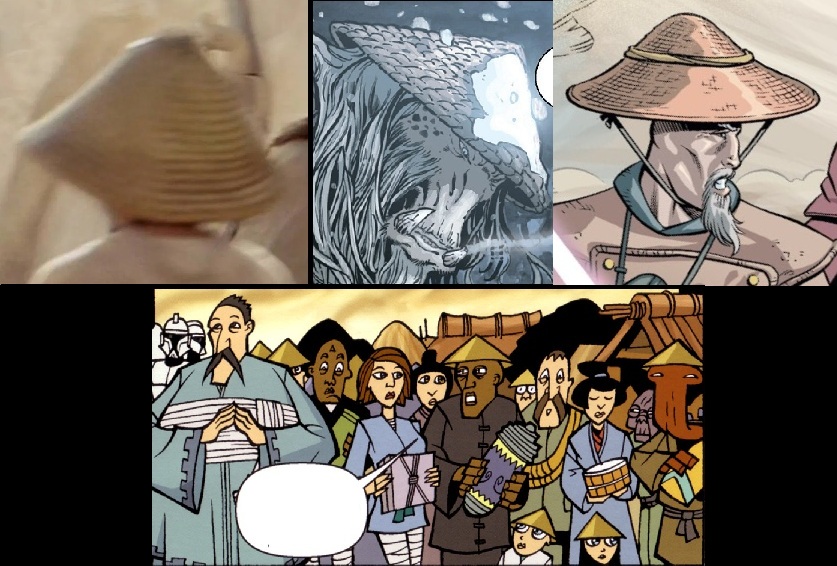
Conical ‘coolie’ hats might not be politically correct, but K’hkruk’s hat is still freaking sweet. The Mos Espa example appears to be a little more substantial (or maybe it’s just more broken-in) than the standard Asian rice hat, and looks tightly woven. Would probably be perfect sunshade on Tatooine (Ki-Adi Mundi wears his while tracking down Sharad Hett), and if paired with a fully GFFA-style outfit, you might be able to wear one without eliciting cries of “Cultural Appropriation!” As we see, this style was commonplace among the civilians of Nadiem during the Clone Wars (Hide in Plain Sight).

As I’ve found in my other ‘fictional anthropology’ pursuits, to make sure your audience knows you’re dealing with a fantastical, non-modern-Earth setting, throw in some Tall Hats…it works in BONE and Dinotopia, and the GFFA is no different!:

Continue reading “Galactic Style Guide – Hats II”

Back to Basics – How?

This is the second half of our Back to Basics miniseries, a primer on the whats, hows, and whys of living history in the Galaxy Far, Far Away setting.
Like cosplay, reenacting is fairly straightforward; it generally does not go beyond ‘looking good’ through the creation of an ‘outer persona’. Since contemporary life is noticeably lacking in FTL spacecraft, energy weapons, antigravity vehicles, etc., true Star Wars reenacting is well out of reach.
On the other hand, living historywhile requiring more diligent researchis actually much more achievable for the galactic setting. Because it usually involves educational interactions with the pubic, you should try to build your persona as accurately as possible, and whether you’re pursuing First-, Second-, or Third-Person interpretation, you’ll want to have at least a decent understanding of life in the Galaxy, as well as being familiar with your specific subject, trade, or activity.

So today, I want you to ask yourself two questions:
What am I good at? and What can I use those Skills to interpret or teach others?

17 ideas for in-universe interpretation after the jump!

Back to Basics-What and Why?

While I started this blog back in 2017, I spent the first few weeks detailing the basic ideas behind the ‘Advanced Costumed Arts’ of reenacting and living history. Over the intervening three+ years this blog has been plugging away merrily, and those early posts—while still collected at the ^FIRST STEPS page^—are effectively buried for those who might find their way here and don’t want to endlessly scroll or use the search bar or Categories >>. Therefore, I wanted to put together a miniseries to lay out the underlying foundations for what it is we aspire to do here, why we do living history specifically, and how You can do it too!

WHAT are reenacting and living history?
(For a short but very complete general introduction to these activities, I recommend downloading F.L. Watkins’ The Reenactor’s Encyclopedia, from which I’ll be quoting here and there.) At their most basic, both reenacting and living history are activities in which participants seek to learn about and experience life in a non-contemporary time period. These activities usually involve the participant assembling a ‘kit’ (what you’ll often see referred to here as ‘the outer persona’) of “possessions…that might have been owned by his impression”; this should start with clothing, and then might extend to include tools, food, camp gear, sundries, and weapons.

what do reenacting and living history look like?

Building the Inner Persona: Curses and Interjections

In this installment of the Inner Persona miniseries, we’ll continue to expand our mental ‘word-hoard’ by adding some words and phrases from the Star Wars galaxy you can use to spice up  your in-universe speech. If you’re portraying a character from the rougher side of the Galaxy, the saltier the better!

While we on modern Earth—depending on the decade—use words like swell, cool, awesome, or lit to express appreciation for something we like, the GFFA has “wizard” (Episode I), “rugged” (Rogue Planet), and “prime” (Galaxy of Fear)!

“As stars live and die!”
– “Blast!”, “Blast it!” (can’t go wrong with this classic)
“By all the souls of Alderaan!” (Rogue Squadron)
Chuba chips!”, “Chuba chunks!” and “Chuba lips” are all used by Ratts Tyerell in Jabba’s Game Galaxy
“Emperor’s bones!” (Rogue Squadron #2)
“Emperor’s black bones!”
Flaming: as in, “this flaming coastline is full of coves,” (Last of the Jedi #4: Death on Naboo)
“Force-forsaken” used as a replacement for Godforsaken; I’m not a fan.
Frell, frelling (Republic Commando)
Frip, fripping (often used in Death Star, all the way up to “un-fripping-believable!”

plenty more examples below!

On the subject of bounty hunting ‘trophies’

As I’ve talked about a few times before, when reenacting any setting (historic or fictional) one of the best ways to add depth to an impression is by including small details or items of ‘pocket trash’! One of the ideas I frequently see discussed in online Star Wars cosplay circles is the idea of ‘hunting trophies’, and a recent thread made me realize I definitely have some thoughts on the subject!

Whether it’s bones and claws from critters, crystals from Jedi lightsabers, battle droid fingers, or actual lightsabers, the notion that a bounty hunter or mercenary character should have a collection of tchotchkes taken from past kills dangling from their belt, blaster, or backpack is one of those trends that the costuming community has really latched onto. However, I submit that this type of decoration is A) actually an impediment to such work, and B) a fan reenactorism not seen in either primary or secondary sources. Be sure to stick around til the end for some ideas on how to more authentically portray these kinds of character in true ‘living history’ style!

continue reading

Galactic Style Guide – Shoulders II

Happy Boxing Day, and welcome back to the Galactic Style Guide, where we break down the ‘Star Wars aesthetic’ in order to create a more authentic ‘outer persona’! For our final installment of 2020, we’re wrapping up our look at the archetypal exotic space-fantasy ‘wide-shouldered’ look.

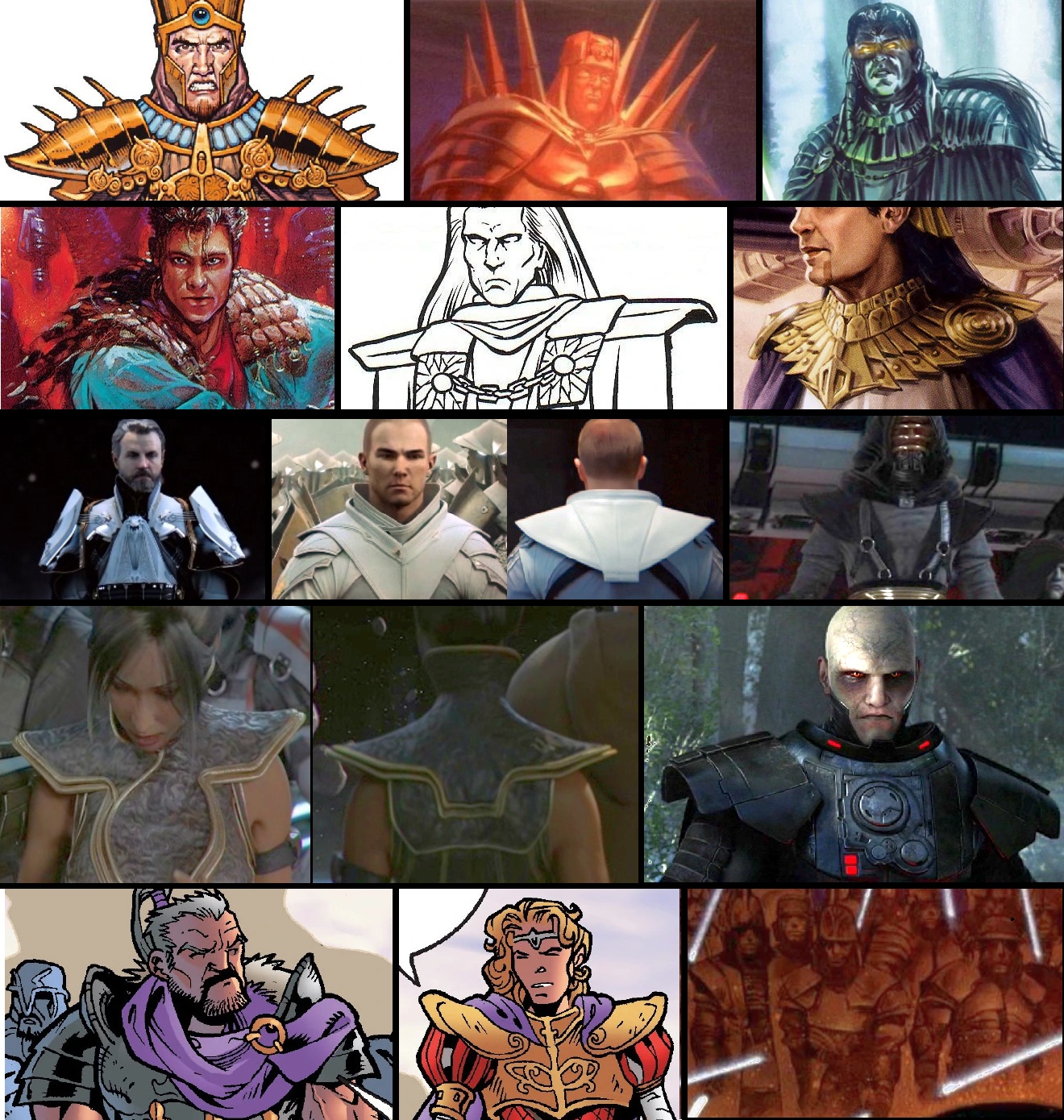
We’ll begin by teasing out some examples of armor-based wide shoulders from the earlier phases of galactic history (pre-1000 BBY):

shoulders-armor-Ancient
Naga Sadow, Freedon Nadd, Exar Kun Ulic Quel-Droma, Arca Jeth, Gav Daragon; Vitiate, Arcann, Darth Vindican Satele Shan, Darth Malgus; Lord Hoth, Valentyne Farfalla, Army of Light

I don’t have a ton of interest in (or access to) much material from this period, so it’s totally possible I’ve overlooked some key figure. Is there anyone I’ve missed? Please let me know!
As we’ll see, more modern characters from the Clone Wars all the way into the Legacy era have also worn armor that widens the upper body: Continue reading “Galactic Style Guide – Shoulders II”

Galactic Style Guide – Shoulders I

Welcome back to the Galactic Style Guide, where we break down the ‘Star Wars aesthetic’ in order to create a more authentic ‘outer persona’!
Ever since the days of Ming the Merciless, sci-fi designers have been using a wide-shouldered silhouette to let the audience know a setting is exotic or non-Earthy, and Star Wars has been no different. While I’ve found no specific mention of this design point in comments from costume designer John Mollo, his original designs for ‘girl Luke Starkiller’ show a mantled hood that may have planted the seed that eventually became this prevalent costume element:
DIGITAL CAMERAIt’s worth pointing out that even though the very first onscreen SW character (C-3PO) could be said to display a form of this style, it really didn’t kick into full gear until Return of the Jedi, and by the time the Prequels rolled around, giant collars, mantles, and shoulder pads were in full force!

shoulders Ep1 Naboo
Wide shoulders on pre-Clone Wars Naboo: Amidala, Sabe; NSF Palace guards, Sio Bibble, Phylo Gandish; Unidentified Theed civilian, unidentified advisor, Hugo Eckener, Horace Vacil, TC-14; civilian prisoners. Note that the entire Naboo Royal Advisory Council and Theed nobles dress pretty much alike.

Continue reading “Galactic Style Guide – Shoulders I”

In defense of ‘close enough’

Let’s talk about fish-lady sweaters for a second.
When a Mon Calamari showed up in The Mandalorian Chapter 11 wearing an off-the-rack fisherman’s sweater, the community lost no time in memeifying it before hopping on Amazon to snatch up one or two for themselves. I find it encouraging that people are interested in costuming a common civilian for once (instead of the rare-in-universe but over-represented-in-cosplay Jedi/Sith/Mando/bounty hunter ‘player classes’)…but if I was looking to put together a GFFA dockworker impression, I definitely wouldn’t go out and buy the exact onscreen sweater—and not just because they’re probably now very scarce! Here’s why.

Continue reading “In defense of ‘close enough’”