Galactic Style Guide – Mechanics and Technicians I

Welcome back to another installment of the Galactic Style Guide, the series where we break down the ‘Star Wars aesthetic’ in order to help you create a more authentic ‘outer persona’! By audience request, in this entry we’re trying something different! This time around, we’re not looking at a specific category of clothing or gear, but a specific “character class”! Just like with our regular Style Guide entries, the idea is still to analyze examples of a single theme to see what they share – and therefore see what the most common and representative elements are, hopefully to prevent the spread of reenactorisms! As always, there’s plenty of room in the Galactic Costumed-Arts Spectrum for fun and personal interpretations, but if (as I believe is entirely possible) the GFFA is to be seen as a legitimate setting for high-quality living history, it really pays to take a page from the reenacting playbook and try to represent the common galactic populace as faithfully as possible…which means sticking to the visual ‘rules’ of the setting. What are those rules for mechanic/technician characters? Let’s find out!

As the majority of SW titles continue to revolve around face characters from the more ‘exciting’ (i.e. typically martial) character classes (Jedi, fighter pilots, bounty hunters, troopers, etc.), we have a relatively small pool to draw from, at least when it comes to live-action. Our first look at this type of character comes from act three of SW’77, with our heroes’ arrival at the Rebel base on Yavin IV.
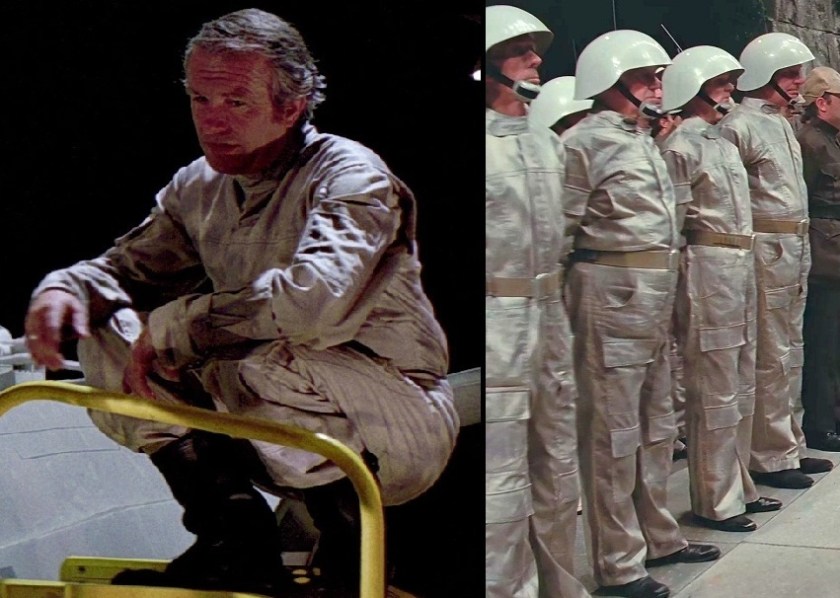
(We’ll see Rebel hangar crews continuing to dress like this before Endor as well)
Keep reading

Upgrading the Rebel persona – Naboo pilot’s helmet part 1

Before we get started, a quick scheduling note: the project that follows was a long and involved process, involving many different skillsets (including—but not limited to—pattern drafting, sculpting, casting, and woodcarving). Instead of trying to cram all that into one mega post, I’ve decided to split it up into three parts, and rather than dole them out separately across most of this month, I’ll be posting all three today (we’ll return to regular programming next week). With all that out of the way, let’s get started!

With little else to occupy my time while backpacking thousands of miles last year, I spent a large part of my AT thruhike thinking about ways I could improve my various Star Wars reenacting/living history kits when I got back home. Along the lines of adding a Q2 holdout blaster to my Rebel-on-Naboo impression, I wondered if there was anything else I could do to help anchor my kit to that specific planet. While the popular conception of Naboo is of a peaceful, pacifist culture, that’s not exactly the case. While they may not have a proper standing army, the Royal Naboo Security Forces are plenty prominent in the pre-Imperial period and have plenty of hardware to incorporate into a kit. Just as Earth military gear of past generations can trickle down to the civilian market as surplus and family heirlooms lay forgotten in attics, I figured something similar could happen on Naboo as well, especially following their effective demilitarization under the New Order.
While I was never really onboard with the ‘pearl hats’ of the Royal Guards or the Security Guards and Officers’ visored caps, the headgear of one RSF branch felt like it had more Star Wars-y pedigree than the others: the Naboo Starfighter Corps. Their flight helmet is so iconic yet has such a grounded design I thought it might be fun to add one to my kit…and after supper one night in our tent I made a quick doodle of what a Naboo partizan might look like wearing one:

And once I make a character sketch, it’s all over – I have to make it a reality!

Once we returned home, I was able to do some research and see what kinds of options I had. Somewhat unsurprisingly (?) it doesn’t seem as if many fan-makers have tackled the N1 helmet…as far as I could tell, only one other (rather exquisite) fanmade example existed, produced by one ‘Godzilla’ (of super-accurate Tusken Raider mask fame). Perhaps one reason for this dearth was because an official N1 helmet replica does exist…they pop up on eBay from time to time but are typical quality for Don Post – they’re basically just a cast plastic shell with a mediocre paintjob – and more than I want to pay for such a thing. After being away from my workshop for so long, I really needed a project to get back in the Maker groove, and thought a scratchbuilt Naboo pilot helmet would do the trick nicely! The obvious question was: HOW?

continue reading

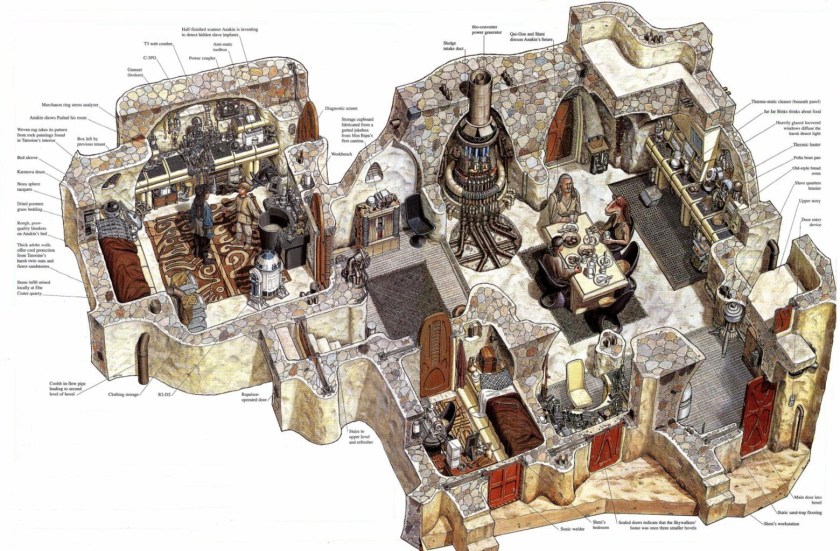
Is your studio apartment bigger than a slave hovel?

Happy new year and welcome to our first post of 2022! I apologize for the delay in new postings, but since getting off the Trail my wife and I moved to a new city, which is always stressful and takes priority from hobbies like running this blog. Since I’ve been thinking a lot about living spaces lately, I thought it would be a great time to share a great nugget I uncovered while doing some recent research.

art by Hans Jennsen (Inside the Worlds of Episode I)

Say what you will about the Prequels, but I always thought despite being slaves, Anakin and Shmi’s home in Mos Espa seemed downright cozy (it’s probably all the low ceilings, rounded corners, and warm, creamy colors – cob-style architecture for the win!). But can we know how big it really was?

Answer: yes, we can!

How long is a Podrace?

Before I went on Appalachian Trail thru-hiking blog-hiatus, some dedicated Star Wars ‘reenactors’ and I were kicking around ideas for some sort of asynchronous long-distance trek or ‘ruck’ challenge we might organize in the future. We started by brainstorming any known distances from the Saga materials, and one of the first things that came up was the Mos Espa Arena podrace circuit. We figured if the length of the racetrack could be determined, it might serve as a nice basis for some sort of virtual relay race. The question was…how long was it?

As has become disppointingly apparent in my attempts to apply the rigors of realism to the galactic setting, because 90% of stories told under the Star Wars banner are purely plot-driven, the mundane details of life are too often nonexistent. Or if they are included, it is done in the most minutiae-focused manner and overlooks the more relatable pieces of information. Or, to paraphrase Maw Installation Redditor FlavivsAetivs, “plot and visual aesthetics—not technical specifications or internal consistency—are the primary focus of Star Wars“.

Case in point: the Boonta Eve Classic podrace! I could easily tell you the names of all the formations or obstacles on the race course, the names, species, and homeworlds of each racer, which racers did not finish the race, which racers completed the course, how fast they did so, and their average speed. But I have thus far been unable to find any mention of the distance the race covered. Unfortunately for us, the Boonta is not like the Indy 500 (the distance is right there in the name). However, a little math does allow us to calculate the length of the race course!

Continue reading “How long is a Podrace?”

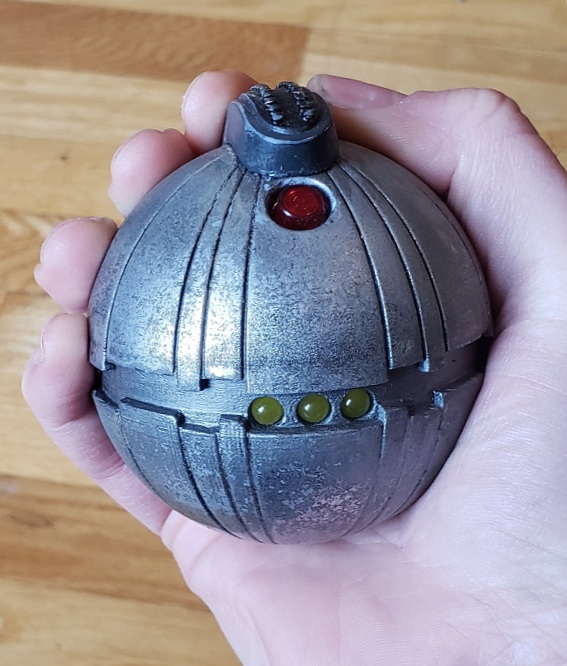
Project: Thermal Detonator facelift

In the course of my research on real-world historical partizan kits, I’ve found the most common items carried by WW2 guerrillas are binoculars, grenades, and knives or bayonets. Since I’m always trying to improve my Rebel partizan impression, I thought having a bit of ‘personal artillery’ (Rebel Alliance Sourcebook, p100) would be a fun way to add some authentic weight to a vest pocket, giving a better living-history understanding of what it would feel like to be equipped in-universe.  Around the same time, KR Sabers released an all-metal thermal detonator kit. It was a thing of beauty…but it also cost $200+…and I simply could not justify spending that much on something that was just for looking shiny on a display table or taking up space in a pocket. (Plus, for some reason, high-end propmakers always insist on including things like explosions or character voice soundclips in their electronics, which actually decreases the immersion for me. Anyone else feel the same way? Leave a comment and let me know your thoughts!). Since I couldn’t justify the cost for something that didn’t do anything besides look cool and flash lights, how could I add some authenticity to my kit without breaking the bank?

Continue reading “Project: Thermal Detonator facelift”

Boba Fett’s survival knife: Accuracy vs. Authenticity

bobaknifeSWVD
I’ve been thinking about this item a lot recently, as a possible easy project to bang out with the drill press and benchgrinder some weekend. We don’t have many references to non-vibro knives in the Star Wars galaxy, and its identification as a “survival” knife lends itself easily to my purposes of wilderness adventure and interpretation. With a beefy 5 or 6 mm spine, I can easily see it being perfect for batoning firewood and other tasks around camp (in GFFA style, of course).
The problem is, there are two versions of Boba Fett’s ‘survival knife’ out there – so which one is ‘right’? Continue reading “Boba Fett’s survival knife: Accuracy vs. Authenticity”

Project: Wookiee battle shield (part 1)

While (yet again) leafing through the Complete Visual Dictionary, looking at artifacts, I happened upon a particularly fascinating example. I was attracted to its vaguely Polynesian(?) design—kinda like a giant pouwhenua—as well as the stylized tiki-style iconography. I actually vaguely remember seeing the prop in person at Celebration 3 back in 2005(!), and being pretty impressed. As I’ve been building up my woodcarving skillset over the years, I thought it might be time for some large-scale work—and what’s larger scale than an heirloom Wookiee shield from the Battle of Kachirho?:
wookieeshield
Continue reading “Project: Wookiee battle shield (part 1)”

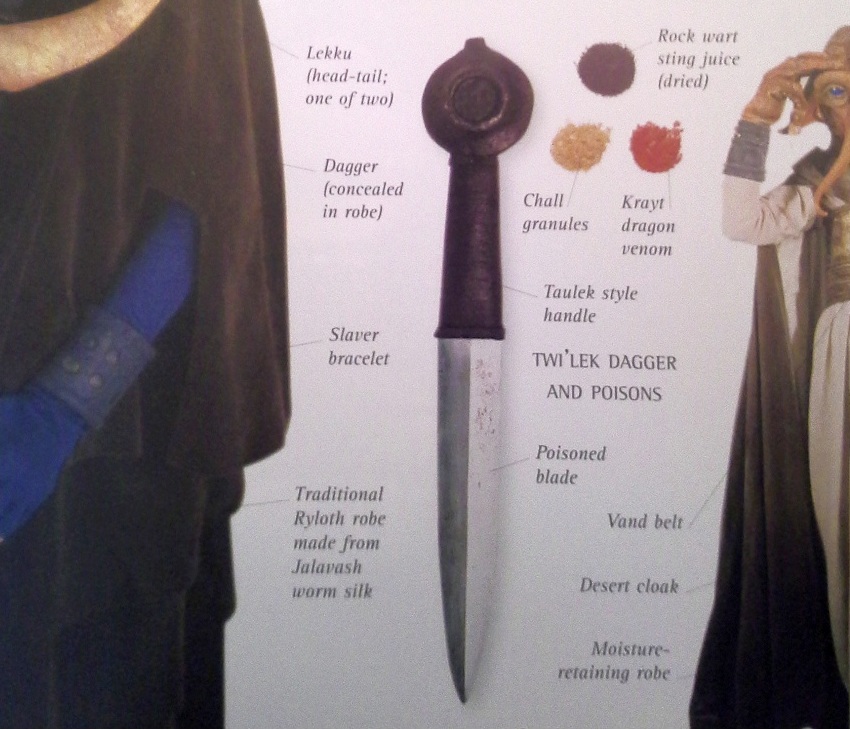
Project: Twi’lek dagger (part 1)

As I was leafing through my Star Wars Visual Dictionary—after looking up one thing I usually wind up flipping a few pages to see if anything new jumps out—a few months ago, I came across a particularly un-Star Wars-y looking knife: a Twi’lek dagger with a ‘Taulek -style handle’:
twi1 20180630Not only are there no extraneous greeblies, this would appear to not even be intended to be a vibroblade—just a run-of-the-mill, stabby, fighting knife along the lines of a Sykes-Fairbairn. This makes it the perfect candidate for authentic replication, as it requires no hand-waving or suspension of disbelief to explain. Continue reading “Project: Twi’lek dagger (part 1)”
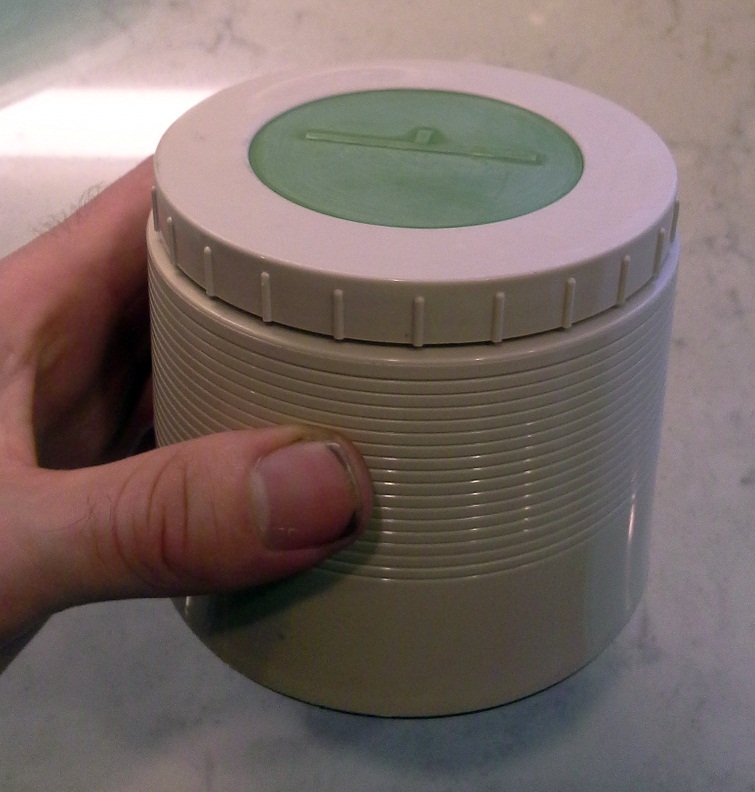
Applied geometry: Star Wars style

thermos1155-after4One of the largest stumbling blocks to getting a real-world-functional GFFA kit is the lack of references to everyday material culture in the Galaxy. We have little evidence, for example, of the kinds of containers your average galactic citizen has around the house—do the citizens of Bespin have Tupperware? And as someone with an interest in creating a realistic—but recognizably Star Wars-y—set of outdoor-adventure gear, this is a wall I have often run into. When we have so few resources to draw on, we instead have to get creative in our solutions. In this case, since we have little gear to draw aesthetic inspiration from, why not draw inspiration from the gear that influenced the aesthetic we aspire to?
Viewed through modern eyes, it’s pretty clear that the original Trilogy films are products of the 1970s and 80s…so let’s take a look at late 70s and early 80s Tupperware and Thermos products!
Continue reading “Applied geometry: Star Wars style”

Snagging a Speeder Bike (with Math!)

In Guerilla Warfare, that wonderful time capsule of 1940s partisanship, Burt ‘Yank’ Levy describes an excellent way of ambushing a rapidly-moving, mounted fascist:

“A good way to stop a motor-cyclist is by stretching a quarter-inch cable or wire across a roadway. If you are sure a motor-cyclist is coming, put it up beforehand. Otherwise, have a brick tied to one end of it and be ready to sling it across the road, where others will secure it, while the Nazi is a mile away. Attach the wire to trees or fence-posts at a height of from three to three and a half feet from the ground…preferably, string your line diagonally across the road, at an angle of about 30 degrees. The effect of this will be to make the motor-cyclist, when he hits it, slide along it and into the ditch…right near where you and your companions are waiting” (72).

Reading this the other night, I started to wonder: if I was a member of a Rebel cell needing to ambush a pursuing scout trooper, how much time would I have in which to throw my cable across the path before he appeared?

Snag1.jpg
Ewoks apparently prefer the first, pre-set system, as above.

Continue reading “Snagging a Speeder Bike (with Math!)”