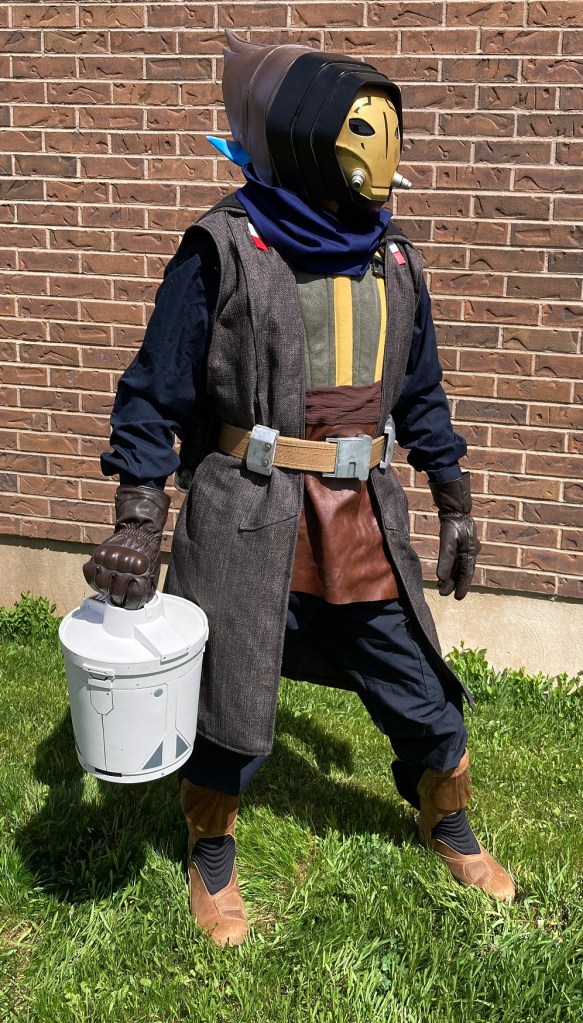
Welcome back to our monthly spotlight series, where we discuss Star Wars costumers who have ‘gone the distance’ and put in the effort to create solid, in-universe outfits or personas. This month’s entry comes from Keith Olsen, who has done his research to put together an excellent impression of a generic ‘Pyke Syndicate’ soldier.
As you can see, this build was initially inspired by the appearance of the Pykes as seen on ‘The Book of Boba Fett‘ (though as I’ll discuss in a bit, an animated-style Pyke would look quite different!), and as such is based at around 5 ABY.
Keith did a lot of old-school costume replication legwork – unless something goes on display for an exhibit, this typically involves very carefully scrutinizing screenshots – to determine the materials and types of clothing that could be bought off the shelf for this outfit. Let’s examine the elements one by one!
Welcome to another installment of our ‘Galactic Style Guide counterpoint’ subseries, where we help you strengthen your ‘Star Wars eye’ by highlighting and remedying common costuming faux pas that can make an outfit look NotStar Warsy. As part of the GSG, the ultimate goal is still to help you create a more accurate ‘outer persona’ – but we approach the goal from the opposite direction! In past entries, we’ve looked at things that aren’t really part of the typical ‘galactic aesthetic’: bright colors, visible fasteners, overly-designed patchwork clothing, etc. This month, we’re going to focus on an element of character design which is present in the visual record, but which has a very specific pattern of usage and which is far overrepresented in the fan-costuming community.
Good reenacting—fictional or historical—typically deals less with the elites of a given culture/period/setting, and more with accurately representing the experience of its common people. Since the current paradigm of Star Wars ‘Original Character’ costuming seems to entirely revolve around 3D printing, armor, and helmets, if you want to create an armored or helmeted ‘OC’ that will faithfully represent a typical galactic inhabitant, then listen up and read on!
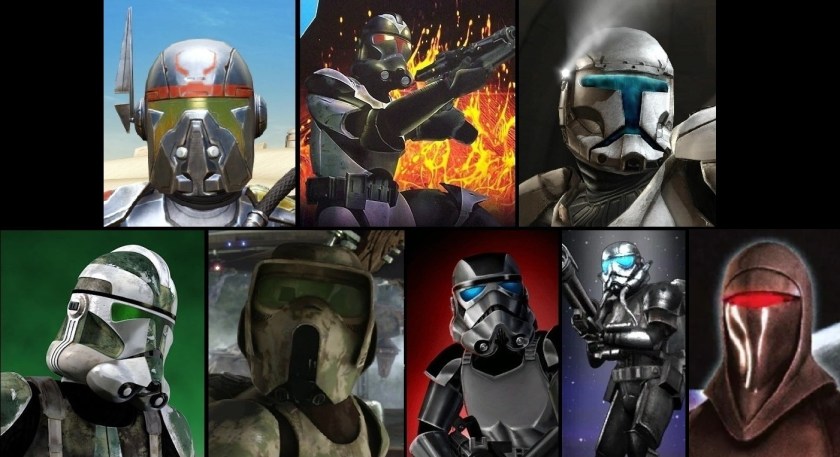
There’s one easy way to tell at a glance if an armored Star Wars character is somehow SPECIAL: just look at their helmet! If the lenses or visor are anything other than plain black*, you can bet money that they’re some sort of elite. Some examples from the good old EU:
Shae Visla (Mandalore the Avenger!), Utapau shadow scouts/Clone shadow trooper, clone commandos, Commander Gree and 41st scout trooper (Episode III), shadow trooper, shadow EVO trooper, and Emperor’s Shadow Guard (The Force Unleashed)
Welcome back to our monthly spotlight series, where we discuss Star Wars costumers who have ‘gone the distance’ and put in the effort to create solid, in-universe outfits or personas. This month’s entry is actually a bit of a carry-over from last month, because while building his own Mandalorian ‘Kryos’ kit, T.H. also created a simple but highly-effective outfit for his own youngling at home:
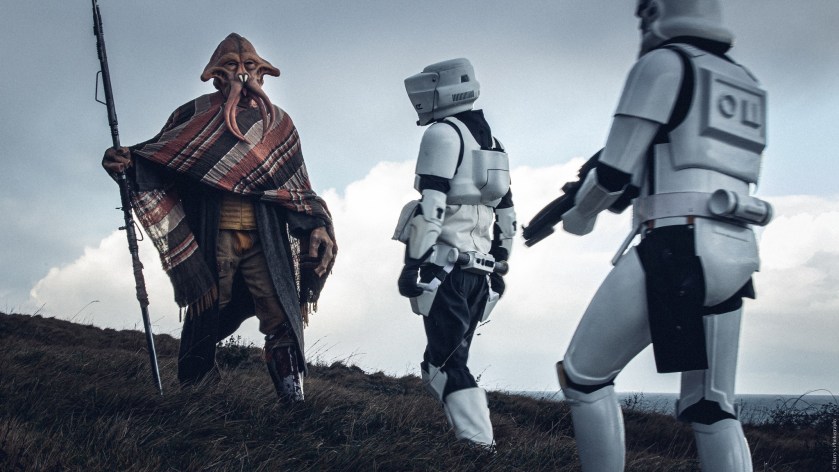
Welcome back to our monthly spotlight series! In this feature, I interview Star Wars costumers who have ‘gone the distance’ and put in the effort to create solid, in-universe outfits or personas. This month, we’re very fortunate to bring you a look inside the French organization Transfert à Ord Mantell. The group is made up of several traditional (historic) reenactors who have applied their skills at reenacting to the galactic setting. When the photoset from their recent Normandy beach shoot hit the interwebs last month, it made quite a splash, and I knew I just HAD to pick their brains and learn more!
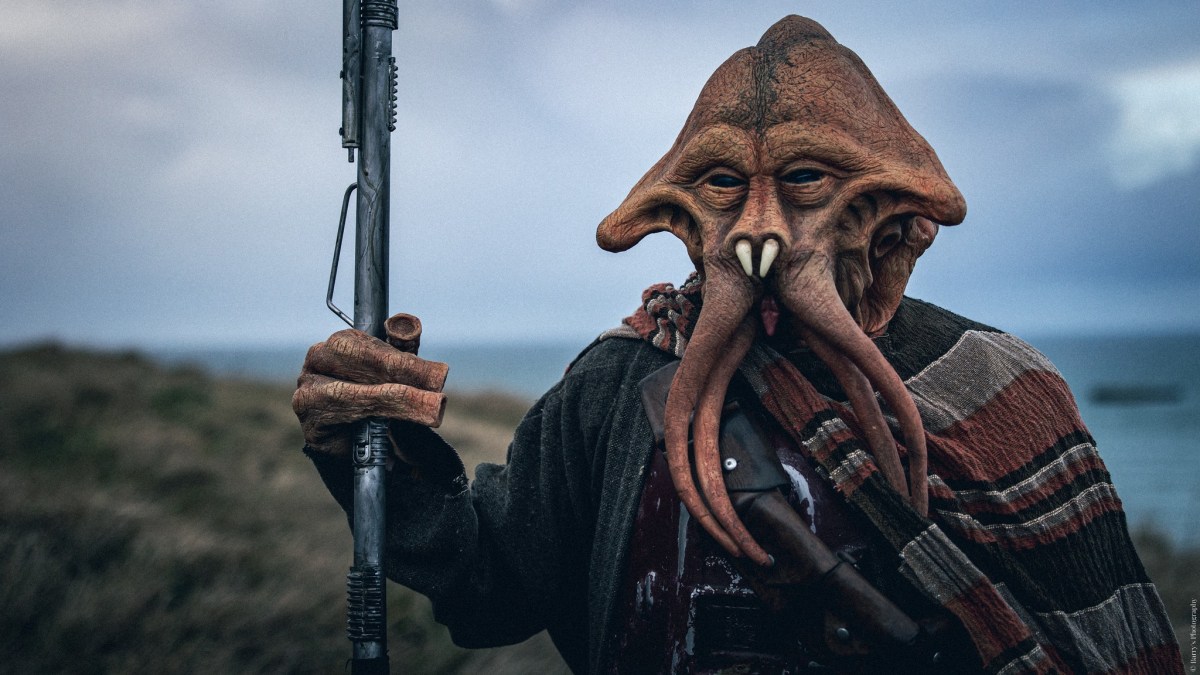
While there was obviously a lot of high-standard work on display, as the majority were existing character types (Imperial officer, stormtroopers, mudtrooper, scout trooper, a lowly rebel technician) or a known character (Boba Fett), the one that really caught my eye was their original Quarren character design:
Welcome to another installment of our ‘Galactic Style Guide counterpoint’ subseries, where we help you strengthen your ‘Star Wars eye’ by highlighting and addressing commonly-made costuming faux pas. As part of the GSG, the ultimate goal is still to help you create a more accurate ‘outer persona’ – but we approach the goal from the opposite direction!
Since the earliest designs of Star Wars ’77, one of the main signifiers of GFFA fashion is the absence of visible fasteners—as chief costume designer John Mollo said, “George didn’t want any fastenings to show, he didn’t want to see buttons, he didn’t want to see zips, so we used stuff like Velcro, and things were just wrapped over and tied with a belt…” – The Making of Star Wars (J.W. Rinzler), p. 125. Since this is one of the chief ‘rules’ of Star Wars fashion and comes straight from the top, something like 99% of the outfits seen onscreen abide by this rule. When visible fastenings do show up on screen, eagle-eyed costume-minded folks (or those who really want to cut corners) tend to make a big deal of it….although they really shouldn’t.
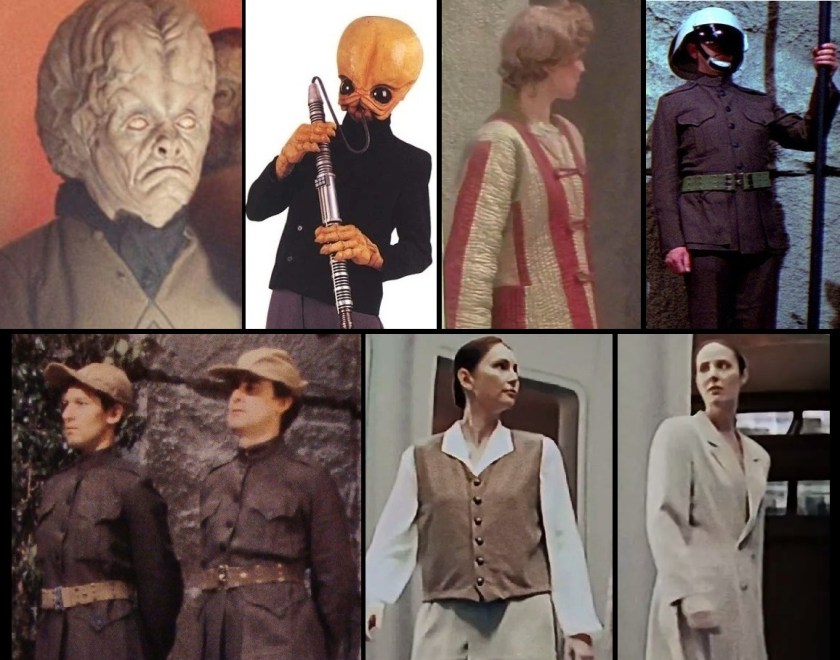
onscreen buttons in OT: Pons Limbic, Figrin D’an (and the rest of the Modal Nodes), ‘The Prophetess’, Rebel honor guard, Yavin ceremony backgrounders, Tian Chyler & unknown(?) Cloud City woman
Welcome to the first entry in our ‘Galactic Style Guide counterpoint’ subseries! Where the GSG could be summed up as ‘how to look Star Warsy’, these alternate posts are meant to highlight and remedy common mistakes that can make an outfit look NotStar Warsy! From the very beginning, the world of Star Wars has always had a very specific visual style. Unlike the matinee serials it was inspired by (in which heroes wore shiny, silver bodysuits and enemies wore bright gold and scarlet robes), the Galaxy Far Far Away was much more grounded in its visuals. While characters might fly starships across the galaxy and duel with swords made of pure energy, they didn’t dress futuristic. Chief costume designer John Mollo’s mix-and-matching of real world historical styles (Russian/Japanese peasantry, American cowboys, medieval gowns, World Wars military uniforms, etc) for inspiration provided the solid and believable foundation from which the series’ visuals would evolve. As part of this grounded approach, most characters tend to wear costumes in a very specific range of colors:
“The color scheme basically was the baddies would be black or gray, with the exception of the stormtroopers, and the goodies should be in earth colors—fawns and whites… Mollo tried to keep the colors muted wherever possible. Color is very, very difficult to use. Bright colors don’t work well on film, particularly reds and blues. George always goes for the authentic….and if it’s all garish color, it doesn’t work.” (Brandon Alinger. Star Wars Costumes – the Original Trilogy, 2014. p 15.)
This rule does not mean, however, that your outer persona need be limited to earth tones and shades of gray – as we saw a few weeks ago, there are tons of examples of characters wearing every color of the rainbow (especially in the pre-Imperial period)! However, if you noticed, almost all of them had something in common. As we read above, the main rule for creating authentic in-universe clothing is simple:Avoid. Garish. Color.: thus, if a garment is a fully-saturated hue, it is much less likely to ‘read’ as being authentic to the Star Wars setting. Let’s take a look at what I mean.
Whenever I go to the thrift store, I usually cruise the racks on the lookout for certain materials—chiefly linen, wool, and silk—to be cannibalized into items for my various reenacting kits. After years and years of doing this, I can often identify a piece’s fiber content just by walking or thumbing past it, with no need to check the tag. When I go thrift-shopping with my wife, she will often remark and wonder on how I’m able to do this, and the answer is simple: trial and error, reinforced by years of practice. It’s a kind of exercise, and I’ve simply trained my ‘fabric eye’ to recognize one cloth from another.
(This is the same type of practiced skillset that allows me to go into the woods with the Middle-earth Reenactment Society and confidently pick a stalk of nettle or milkweed out of a thicket of other dead, gray plant stalks when we’re in need of some wild cordage on a trek).
I talk a lot on this blog about the idea of ‘reenactorisms’ – inaccuracies that get unknowingly (or knowingly!) perpetuated because someone didn’t do their research. Usually when discussing these blunders we’re talking about individuals making them, but I wanted to point out two examples to day that prove the big players are not immune to making sloppy mistakes either! Following the release of Episode III in 2005, LA’s FIDM (Fashion Institute of Design and Merchandising) hosted the exhibit Dressing a Galaxy, which featured 100 screen-used costumes from Episodes I through VI. From the pictures I’ve seen online it was an absolutely incredible presentation. However, one tableau of costumes held a glaring mistake for all to see:
Anything seem ‘off’ about this?
If you can’t spot it, maybe we’d better check the references:
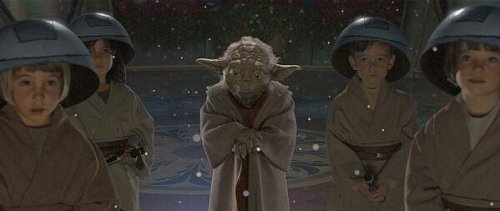
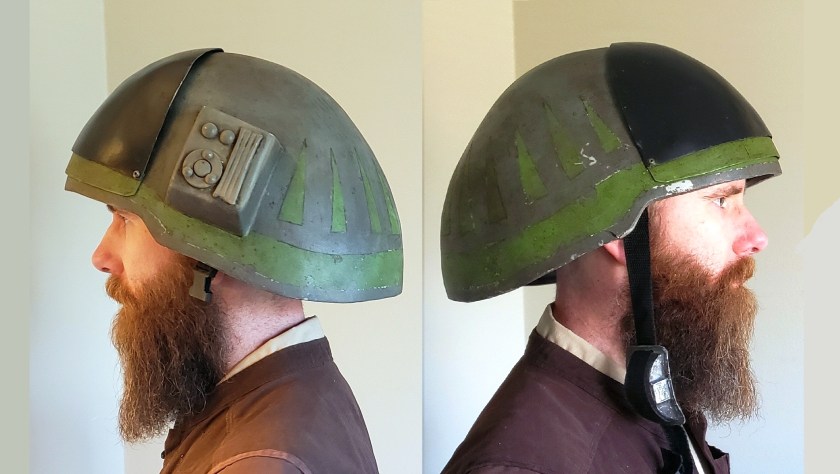
Ever since completing it back in the summer of 2017, I was never fully satisfied with my Rebel ‘swoop’ helmet. My dissatisfaction wasn’t necessarily with the construction—despite being my first serious foray into Pepakura, I think I pretty closely nailed the shape and paintjob (accurate light gray, not white!)—but rather with its usefulness to a Rebel fighter….
Welcome back to the Galactic Style Guide, the monthly series where we break down the ‘Star Wars aesthetic’ in order to help you create a more accurate ‘outer persona’! For this installment, we’re wrapping up a few upper-body stragglers which are both easy ways to add a little unconventional GFFA style to your own wardrobe.
Center closure: Dunlan, Astor (The Ahakista Gambit), Teesoo and Saya Ksi (Bounty Hunter’s Code); Biggs Darklighter (Dewback Attack-Hugh Fleming (SW Insider #35), Tag Rogaren (From the Ruins of Alderaan), colonist (FFG Far Horizons), Soontir Fel (Rogue Squadron #25)
Note that examples 1&2 both come from the planet Ahakista, and almost half of these use a right-over-left ‘womens’ closure! For the reenactor with some basic sewing know-how, this is a very easy style to replicate. Because of Western fashion’s silly gender-specific closure rules, if you buy a button-down shirt of the opposite gender, you can flip-flop the front sides and get a closure without buttonholes on top. Then just add a strip of Velcro down both fronts. If you want Fel’s Mandarin collar style, it’s likewise easy to remove the fall from a shirt’s collar to leave the stand (this will still have a buttonhole at the top, however; you may be able to cannibalize the removed material to make a new, buttonhole-less stand).







 Living History in the Star Wars Galaxy