Upgrading the Rebel persona: Naboo tunic, Mk II

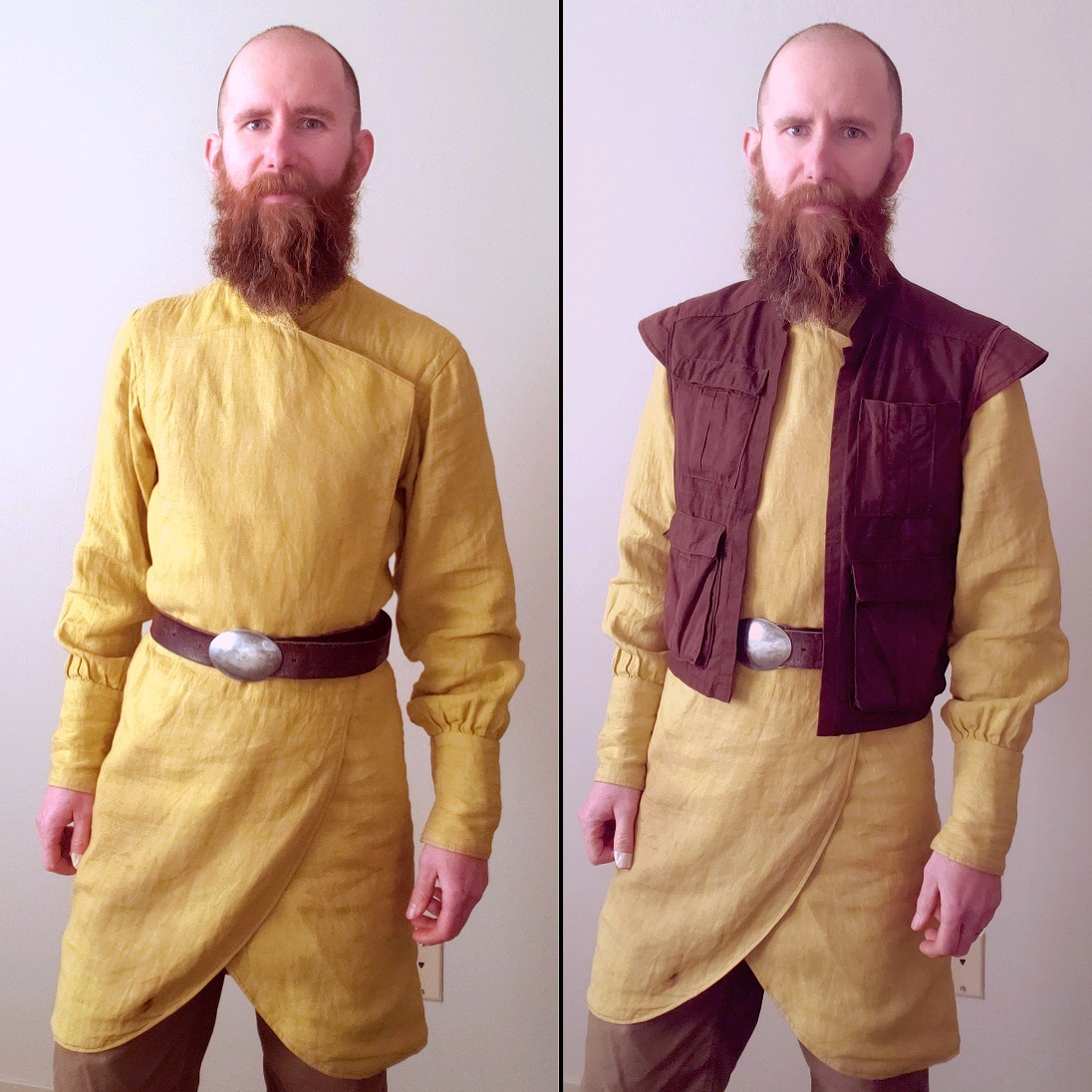
Since debuting my first draft Rebel-partizan-on-Naboo impression back in 2018, further research has caused me to continue to refine the kit. In addition to needing some more layering, the main thing that needed upgrading was the shirt. My ‘Mark I’ Naboo shirt was not (aside from the Mandarin collar and the color) based on any specific onscreen examples, and the use of a Vietnamese ao dai pattern was only inspired by costume designer Trisha Biggar’s comments re: the general use of Asian elements in Naboo fashion (and at the time I liked the asymmetry of the design). However, I realized that I should probably wear something that more clearly ‘read’ as Naboo in origin, and it should probably be constructed of a lighter material as well – the Mk I was sewn from a ‘rustic’ 7.1-ounce linen.
Since this piece is intended for a Galactic Civil War era persona, I really wanted to try and move away from the traditional Naboo style seen in the Prequels, especially the Renaissance-heavy designs of 32 BBY:

“We had designed Naboo more or less around Art Nouveau (we called it “Space Nouveau”), which was based on organic, plantlike forms. The costume ideas looked gorgeous on the women, but when you put guys in them, they didn’t look very tough.” – Ian McCaig, Dressing A Galaxy, p.72.

Roughly inspired by the lines of the traditional Indian kameez, I pored over my reference library to see what Naboo male fashion stuck around through the years while noticing any common elements:

sartorial synthesis and more, within!

Galactic Style Guide – Color I

Welcome to the first entry in our ‘Galactic Style Guide counterpoint’ subseries! Where the GSG could be summed up as ‘how to look Star Warsy’, these alternate posts are meant to highlight and remedy common mistakes that can make an outfit look Not Star Warsy!
From the very beginning, the world of Star Wars has always had a very specific visual style. Unlike the matinee serials it was inspired by (in which heroes wore shiny, silver bodysuits and enemies wore bright gold and scarlet robes), the Galaxy Far Far Away was much more grounded in its visuals. While characters might fly starships across the galaxy and duel with swords made of pure energy, they didn’t dress futuristic. Chief costume designer John Mollo’s mix-and-matching of real world historical styles (Russian/Japanese peasantry, American cowboys, medieval gowns, World Wars military uniforms, etc) for inspiration provided the solid and believable foundation from which the series’ visuals would evolve. As part of this grounded approach, most characters tend to wear costumes in a very specific range of colors:

“The color scheme basically was the baddies would be black or gray, with the exception of the stormtroopers, and the goodies should be in earth colors—fawns and whites… Mollo tried to keep the colors muted wherever possible. Color is very, very difficult to use. Bright colors don’t work well on film, particularly reds and blues. George always goes for the authentic….and if it’s all garish color, it doesn’t work.” (Brandon Alinger. Star Wars Costumes – the Original Trilogy, 2014. p 15.)

This rule does not mean, however, that your outer persona need be limited to earth tones and shades of gray – as we saw a few weeks ago, there are tons of examples of characters wearing every color of the rainbow (especially in the pre-Imperial period)! However, if you noticed, almost all of them had something in common. As we read above, the main rule for creating authentic in-universe clothing is simple: Avoid. Garish. Color.: thus, if a garment is a fully-saturated hue, it is much less likely to ‘read’ as being authentic to the Star Wars setting. Let’s take a look at what I mean.

unSWarzy colors fixed using digital wizardry, within!

Star Wars Color Theory

As I was preparing an upcoming post, I started wondering which characters in the Saga wore colors beyond earthtones, black, white, or shades of gray. I started leafing through my Visual Dictionaries and several hours later I had created the following rainbow of characters. These are presented in chronological order within each color band, and as we cans see, Trisha Biggar’s costumes for the Prequels are FAR more colorful than those of the Galactic Civil War period. If I do a third collection for all the blacks, whites, grays, and earthtone characters, I’m sure there will be many more OT characters represented.

Show me The cooler end of the spectrum!

Coming soon: a new way to exercise your ‘Star Wars eye’

Whenever I go to the thrift store, I usually cruise the racks on the lookout for certain materials—chiefly linen, wool, and silk—to be cannibalized into items for my various reenacting kits. After years and years of doing this, I can often identify a piece’s fiber content just by walking or thumbing past it, with no need to check the tag. When I go thrift-shopping with my wife, she will often remark and wonder on how I’m able to do this, and the answer is simple: trial and error, reinforced by years of practice. It’s a kind of exercise, and I’ve simply trained my ‘fabric eye’ to recognize one cloth from another.

(This is the same type of practiced skillset that allows me to go into the woods with the Middle-earth Reenactment Society and confidently pick a stalk of nettle or milkweed out of a thicket of other dead, gray plant stalks when we’re in need of some wild cordage on a trek).

What does this have to do with star wars, you ask?

Project: Naboo pilot’s helmet part 3

Welcome back! This is the third and final part of my buildlog for attempting to scratchbuild an N1 starfighter pilot’s helmet. When we left off, I had the scaling figured out and patterns drafted, and the side pieces and earmuff details created. Now it’s time to craft the helmet’s shell itself.
To get an idea of how the helmet would look, I transferred the patterns to lightweight cardboard and taped everything together to make a rough mockup of the whole assembly to check the general shape:

This was bonded along the seams (inside and outside) with brown paper bag and PVA glue (left) before brushing both exterior and interior with Bondo resin (center):

Continue reading to see the Step-by-step to completion!

Project: Naboo pilot’s helmet part 2

Hello there! Welcome back to my buildlog for recreating an N1 starfighter helmet – let’s not waste any time and get straight into the process!
In my last post I determined how big the components of the helmet would be, and decided on a method for construction (Pepakura). While I originally wanted to make all parts of the helmet using Pep, I decided that the Y-shaped-part-that-holds-the-earmuff was complicated enough that I should make them out of something more substantial.

I first considered making a mold and casting them in resin, and when I want to feel like a real prototyper, that means carving a positive from amber ‘victory wax’. Well, after a few days I had built up the shape pretty close – I figured I would cast the pieces fairly roughly, and then do the fine shaping on the casts, since resin doesn’t heat up and deform in-hand. However…

continue reading

Upgrading the Rebel persona – Naboo pilot’s helmet part 1

Before we get started, a quick scheduling note: the project that follows was a long and involved process, involving many different skillsets (including—but not limited to—pattern drafting, sculpting, casting, and woodcarving). Instead of trying to cram all that into one mega post, I’ve decided to split it up into three parts, and rather than dole them out separately across most of this month, I’ll be posting all three today (we’ll return to regular programming next week). With all that out of the way, let’s get started!

With little else to occupy my time while backpacking thousands of miles last year, I spent a large part of my AT thruhike thinking about ways I could improve my various Star Wars reenacting/living history kits when I got back home. Along the lines of adding a Q2 holdout blaster to my Rebel-on-Naboo impression, I wondered if there was anything else I could do to help anchor my kit to that specific planet. While the popular conception of Naboo is of a peaceful, pacifist culture, that’s not exactly the case. While they may not have a proper standing army, the Royal Naboo Security Forces are plenty prominent in the pre-Imperial period and have plenty of hardware to incorporate into a kit. Just as Earth military gear of past generations can trickle down to the civilian market as surplus and family heirlooms lay forgotten in attics, I figured something similar could happen on Naboo as well, especially following their effective demilitarization under the New Order.
While I was never really onboard with the ‘pearl hats’ of the Royal Guards or the Security Guards and Officers’ visored caps, the headgear of one RSF branch felt like it had more Star Wars-y pedigree than the others: the Naboo Starfighter Corps. Their flight helmet is so iconic yet has such a grounded design I thought it might be fun to add one to my kit…and after supper one night in our tent I made a quick doodle of what a Naboo partizan might look like wearing one:

And once I make a character sketch, it’s all over – I have to make it a reality!

Once we returned home, I was able to do some research and see what kinds of options I had. Somewhat unsurprisingly (?) it doesn’t seem as if many fan-makers have tackled the N1 helmet…as far as I could tell, only one other (rather exquisite) fanmade example existed, produced by one ‘Godzilla’ (of super-accurate Tusken Raider mask fame). Perhaps one reason for this dearth was because an official N1 helmet replica does exist…they pop up on eBay from time to time but are typical quality for Don Post – they’re basically just a cast plastic shell with a mediocre paintjob – and more than I want to pay for such a thing. After being away from my workshop for so long, I really needed a project to get back in the Maker groove, and thought a scratchbuilt Naboo pilot helmet would do the trick nicely! The obvious question was: HOW?

continue reading

Attention! Your input is needed!

Hello there, folks! We don’t have a regular post for you this week, but believe me that next week will more than make up for it (a triple-header, in fact)!

As I was reflecting recently, I’ve been a maker of Star Wars clothing, costumes, props, and gear for over 20 years! After building and growing my skills for so long, I’ve been thinking it might be time to try and turn my hobby into a small business. So…

To help identify my market and see what potential products people might be interested in, I’ve created a short, anonymous survey, which you can find HERE. Your participation will be greatly appreciated – thank you!

Galactic Style Guide – Children

Welcome back to another installment of the Galactic Style Guide, the monthly series where we break down the ‘Star Wars aesthetic’ to help you create a more authentic ‘outer persona’! This time we’re looking at a segment of the galactic population which we don’t tend to see much of: children younglings!
As it sounds like a major target market for Disney’s Galactic Starcruiser hotel is families with children—and because I’ve seen many would-be guests express uncertainty about how to dress their children in GFFA style—I thought it would be especially helpful to collect and share some examples of in-universe clothing worn by children. I’ve attempted to present them chronologically and grouped by planet.

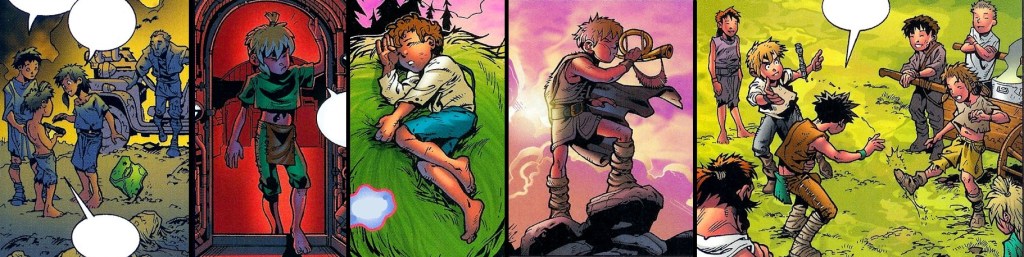
We begin in the distant past, on Ruusan during the New Sith Wars c. 1,000 BBY. Here we see the first appearance of a general trend of children wearing shorts and/or short sleeves (or no sleeves!):

from Jedi vs. Sith (2001)

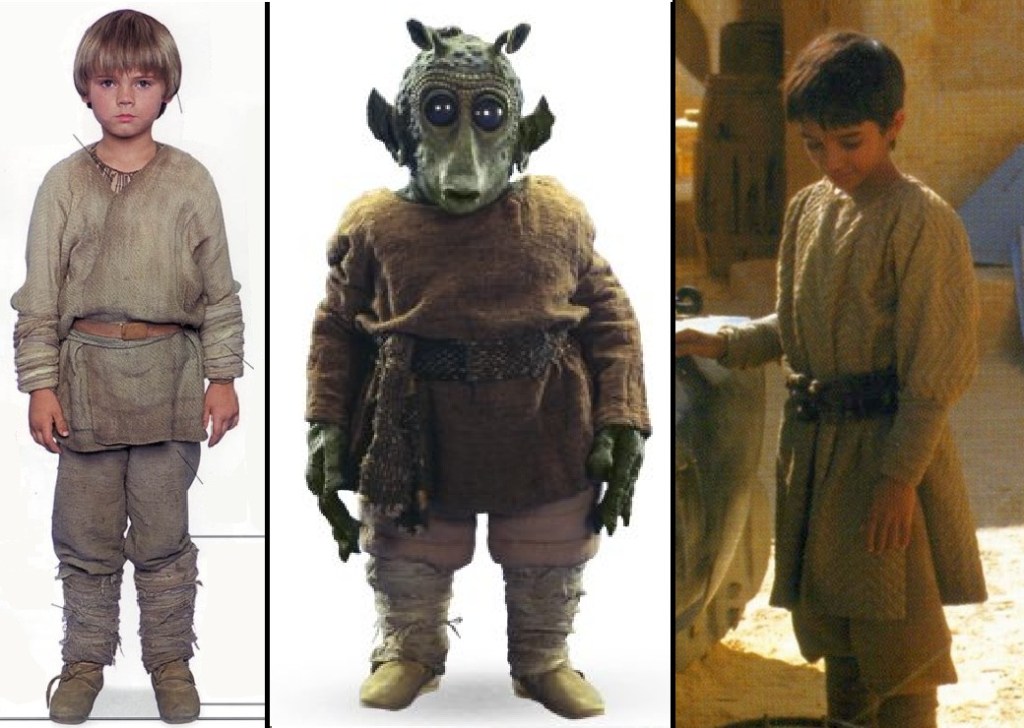
It’s worth noting that pretty much every youth we see on Tatooine is a slave, so I’m not sure how much their style of dress is indicative of childhood under the twin suns versus social status (would young Luke have worn something similar as a farmhand?). One thing is for sure, while the garments themselves are simple construction, the cloth they’re constructed from has a lot of texture! However, we know (Dressing a Galaxy, p11) that Anakin’s tunic was made of a silk/linen/hemp blend (presumably the others were something similar), which sounds pretty comfortable (well, except for all the sand).

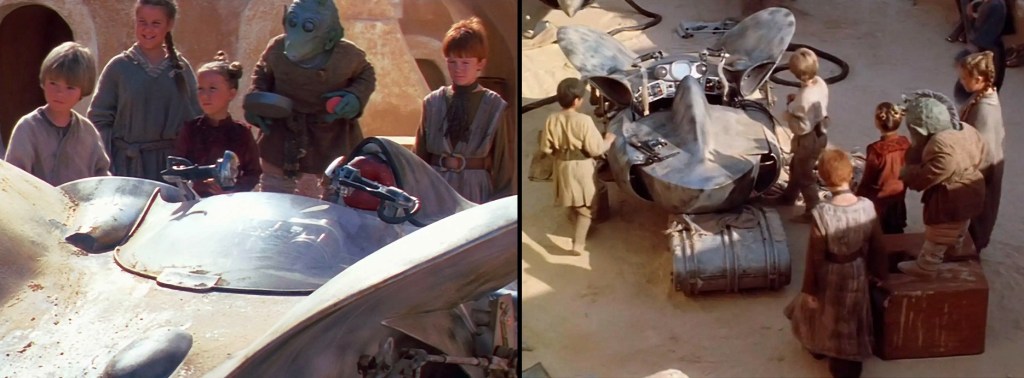
the Mos Espa junkyard gang: Anakin, Amee, Melee, Wald, Seek.
Click here for examples from Naboo, Dantooine, Alderaan, and more!

Doing right by (fictional) History

In historic reenacting circles online, rarely do I see anyone say, ‘Thinking about starting on a Fallschirmjager kit. Show me some FJ impressions for inspiration!. The best and most authentic ‘inspo’ is not other reenactors’ kits, it’s the primary sources themselves!: wartime photography or film, military manuals, soldiers’ diaries, etc.
Reenacting/living history in the Star Wars setting is no different – if you want to build an authentic impression of x, you don’t look for what others have done (that’s how reenactorisms get spread), you look at the media where that impression comes from – the film, TV, book, video game, or comic book.

If one takes a quick scroll-through of facebook’s largest general reenacting group, Living History~ show your impressions (currently 19,000+ members), a pattern quickly emerges:
“Roman auxiliary, Teutoberg, Germania, Autumn 9 CE”
“Loyalist rat catcher, Philadelphia summer of 1781”

“Confederate widow in mourning, Richmond Virginia, early 1865”
“LIFE Magazine photographer attached to C Troop, 82nd Armored Reconnaissance Battalion, 2nd Armored Division in Autumn 1944.”
“Cpl Bradshaw, Automatic Rifleman of Dog Company, 2nd Battalion, 5th Marines, 1st Provisional Marine Brigade, Pusan, Republic of Korea, August 3rd, 1950”

Continue reading “Doing right by (fictional) History”