HOW TO: Hide Your Buttons #2

In a previous post, I concluded by saying “when the flavor of the world is ‘no visible fasteners’, then cover up your darn buttons.” However, for some folks that may be easier said than done. If you like the idea of having an outfit be sans visible-fasteners but find the idea of how to actually make it happen a little overwhelming, then this post is for you!
Adding the ability to hide fasteners to your toolbox is a major level-up, especially for those outfitting an Original Character. Off-the-rack items can be great for dressing a ton of far-background characters, or creating a suggestive ‘everyday bounding’ look, but if you’re after a 100%-in-universe-legit look, these kinds of pieces can only take you so far. I hope you’ll note how our main characters almost always wear custom-designed garments, which may still be reminiscent or incorporate elements of familiar/off-the rack pieces, but usually tweaked just a little to give it that timeless GFFA flavor.
In this post, we’re going to show you a second method to create a button-free appearance on an upperbody garment by ‘genderswapping’ our garment, a version of which I’ve used before on this raw silk shirt retool project. How do you swap a piece of clothing’s gender, you ask? Keep reading to find out!

level up your costuming game with this handy skill

Galactic Style Guide – the Post-Disney era (part 2)

Welcome back to another installment of the Galactic Style Guide, the series where we break down the ‘Star Wars aesthetic’ in order to help you create a more authentic ‘outer persona’!
Like last time, this entry is a bit of a departure from our usual collection of references. This time we’re continuing to focus on elements which I’ve identified as either clear deviations from what existed in the Lucas days, or which originated firmly in the post-Disney era. Let’s keep it moving with #6!

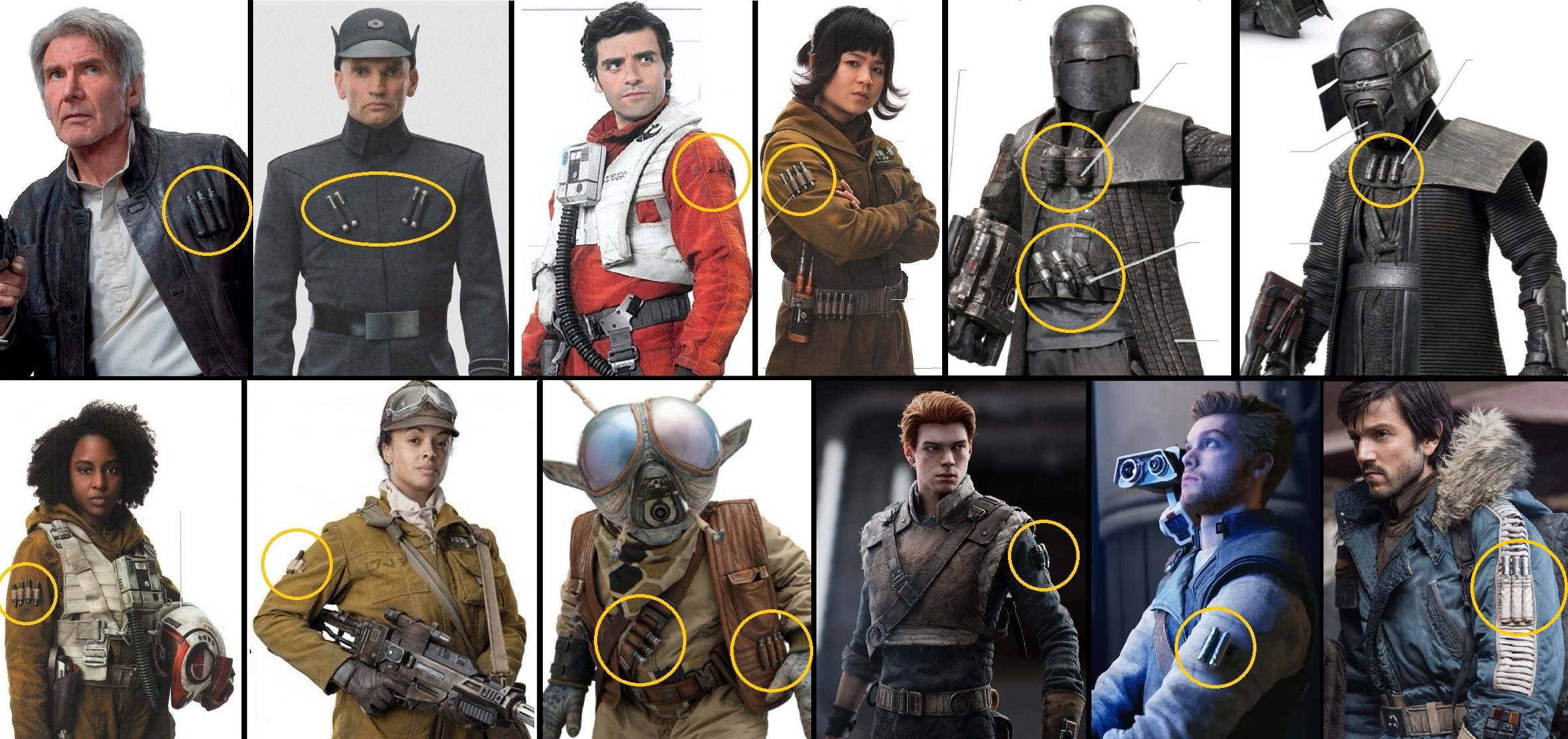
When it comes to soft kit, after perusing the various Visual Dictionaries one trend I noticed started appearing with the Sequels and subsequently latched onto by fan-makers is that of little discrete loops (instead of pockets) being used to hold various doodads on clothing – your code cylinders, ‘mini flares’, blaster ammo, etc.:

What I really want to know is why everyone in the new continuity seems to need so many of these little silver things anyway? In the OT, we’d see Rebel pilots and technicians with small ones on their belts, and big ones kept below the knee (Reb pilots and Bossk seemed to be just about it). But in the Disney era, they’re all over the place! In short, I think they’re a symptom of the new era costumings’ general reliance on overdesign, versus good design, which in the case of the Star Wars setting, usually boils down to Less is More. You don’t need to have every single visible surface sporting some sort of detail – it’s OKAY for costumes to have ‘blank space’! This is especially true in our crispy 4k UHD+ present, when it is all too easy for an overdesigned outfit to leave the viewers’ eyes overwhelmed.

Keep reading for more observed abberations!

HOW TO: Hide Your Buttons #1

In one of my previous entries, I concluded by saying “when the flavor of the world is ‘no visible fasteners’, then cover up your darn buttons.” However, for some folks that may be easier said than done; if you like the idea of having an outfit be sans visible-fasteners but find the idea of how to actually make it happen a little overwhelming, then the next couple posts are for you!
Adding the ability to hide zippers or buttons to your toolbox is a major level-up, especially for those outfitting an Original Character. Off-the-rack items can be great for dressing a ton of far-background characters, or creating a suggestive ‘everyday bounding’ look, but if you’re after a 100%-in-universe-legit look, off-the-rack can only take you so far. I hope you’ll note how our main characters almost always wear custom-designed garments, which may still be reminiscent or incorporate elements of familiar/off-the rack pieces, but usually tweaked just a little to give it that timeless GFFA flavor.
In this post, we’re going to show you one method to create a button-free appearance on an upperbody garment by sewing a very basic cover panel over our buttonholes. Then, in part two, we’ll learn to hide buttons by ‘genderswapping’ our garment. What’s that all about, you ask? You’ll just have to wait and see, but for now let’s get started!

level up your sewing game with this handy skill

Galactic Style Guide – the Post-Disney era (part 1)

Welcome back to another installment of the Galactic Style Guide, the series where we break down the ‘Star Wars aesthetic’ in order to help you create a more authentic ‘outer persona’!
And now, for something completely different. If you’ve been following this site, you may have noticed that the majority of my references come from live-action sources of the Lucas era. However, as we inexorably continue further from the boundary between that period and the current one, it becomes clear that not only did this modern era come with a new continuity, but a noticeable shift in visual aesthetics as well, and I want to explore elements of this shift as they relate to our pursuits here (recreating the Star Wars galaxy in ‘reenacting’ form!). In this post (and at least one more!), we’re looking specifically at some elements which I (coming from a relatively outside perspective) have identified as either clear deviations from what existed before, or which originate firmly in the post-Disney era. You’ll see what I mean.
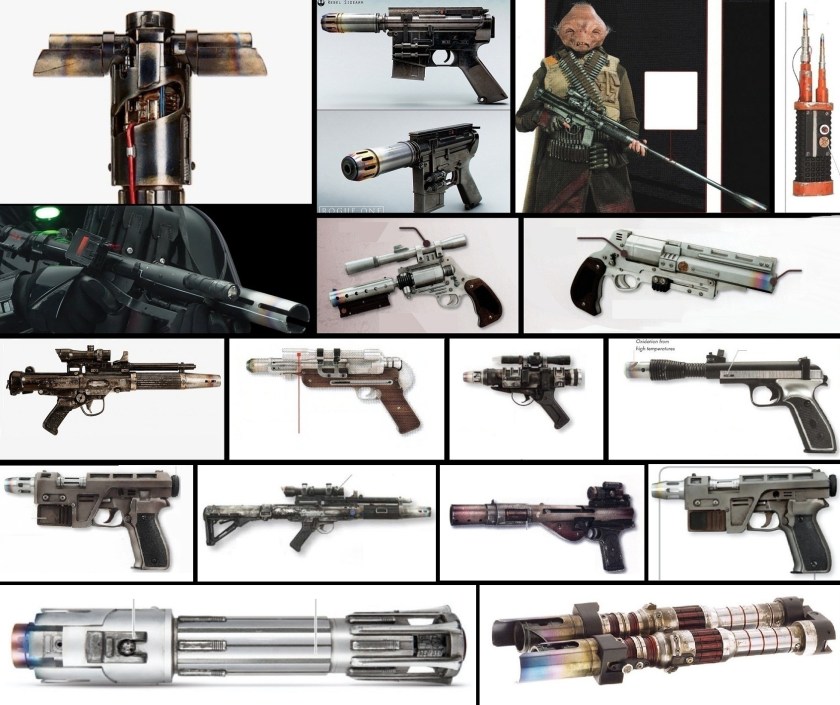
I’m not doing this ‘countdown’ style, but when it comes to something we got along without perfectly fine and was unequivocally not present in the pre-Disney days, #1 at the top of the list has to be the presence of the tempering rainbow on the muzzles, emitters, or tips of blasters, lightsabers, or tools:

I read somewhere that all the Remnant TKs in Mandalorian also feature this, but the scenes are so dark it’s hard to tell.
Keep reading for more observed abberations!

HOW TO: Collar conversion

Even if you’re fairly keyed into the intricacies of clothing in the Galaxy Far, Far Away, there’s one easily-overlooked element that plays a major role in helping separate our own modern fashion from that of the Star Wars galaxy: collars!

When he first began designing his world, we read how Lucas “made pronouncements of a general nature” and that he wanted “the rebels, the goodies, to look like something out of a Western” (Rinzler: The Making of Star Wars, p.130; quoted slightly modified in Alinger’s SWCOT, p15). This is an important distinction, as it was one of the broad styles John Mollo used to sort his character designs : “peasant costumes; Western/U.S. cavalry/motorcycle looks; Nazi-style uniforms/armor/cloaks; space technology-type outfits”, etc. (Alinger, p16). More on these categories later!

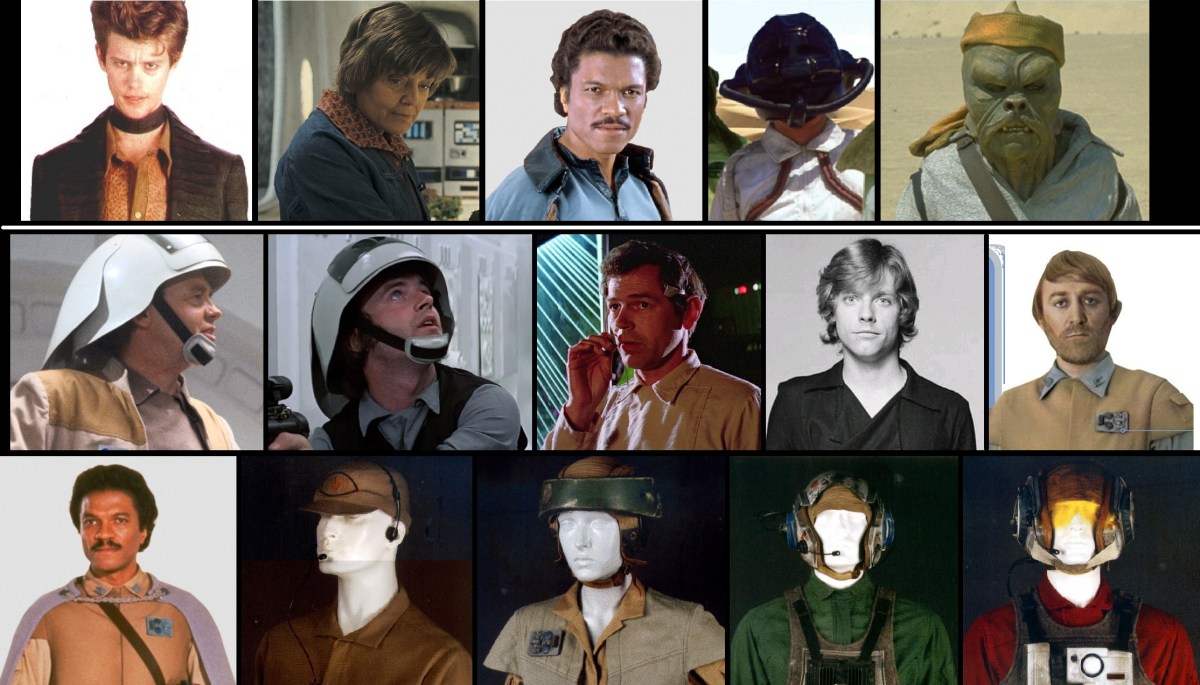
As something so mundane as the collar on a shirt or jacket, it’s likely you may not have noticed the fact that fairly few characters in Star Wars actually wear shirts with modern-style ‘fall collars’. Of course, we do have a few examples, but by-and-large, most characters who wear collared garments wear ones with some form of ‘stand collar’, and quite often these are full-on Mandarin collars.
After thumbing through my reference library, if I had to spitball some numbers, I would say that well over 50% incorporate some form of upright collar, perhaps 20% are collarless, and less than 5% are fall collars – really, the characters above are pretty much all I came up with.

I hope you’ll note that of our samples, the majority of them are Rebel Alliance ranks or ‘character classes’ (officer, fighter pilot, fleet trooper, communications tech, etc.)! Ergo, judging by our samples, the fall collar is generally a good way to give ones’ impression a touch of Rebel Alliance-style militarism, but if you’re portraying an unaffiliated galactic citizen, something that says ‘slightly exotic’ like some flavor of stand collar may be the way to go.
Luckily, most modern shirts with two-piece fall collars are readily adaptable to a more upright style with one easy tweak!

learn an easy minimal-sewing hack to upgrade your outfit!

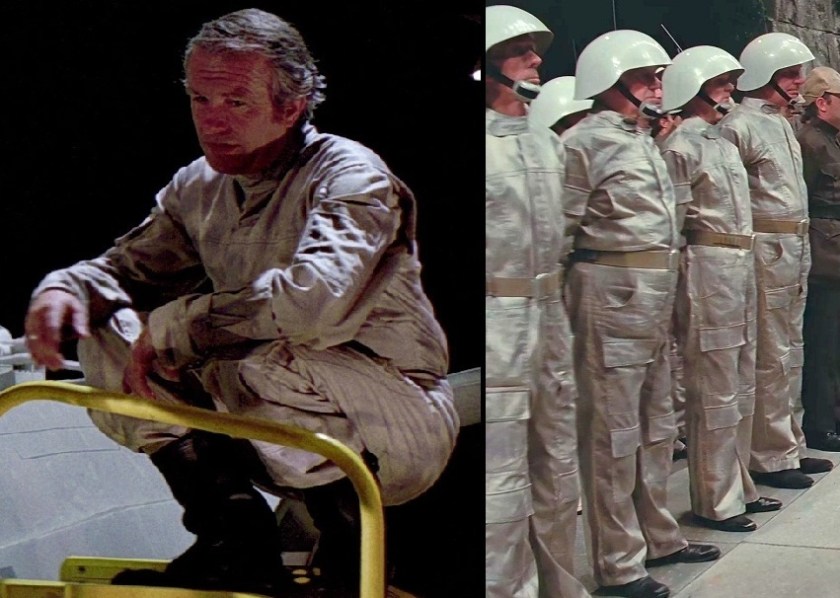
Galactic Style Guide – Mechanics and Technicians I

Welcome back to another installment of the Galactic Style Guide, the series where we break down the ‘Star Wars aesthetic’ in order to help you create a more authentic ‘outer persona’! By audience request, in this entry we’re trying something different! This time around, we’re not looking at a specific category of clothing or gear, but a specific “character class”! Just like with our regular Style Guide entries, the idea is still to analyze examples of a single theme to see what they share – and therefore see what the most common and representative elements are, hopefully to prevent the spread of reenactorisms! As always, there’s plenty of room in the Galactic Costumed-Arts Spectrum for fun and personal interpretations, but if (as I believe is entirely possible) the GFFA is to be seen as a legitimate setting for high-quality living history, it really pays to take a page from the reenacting playbook and try to represent the common galactic populace as faithfully as possible…which means sticking to the visual ‘rules’ of the setting. What are those rules for mechanic/technician characters? Let’s find out!

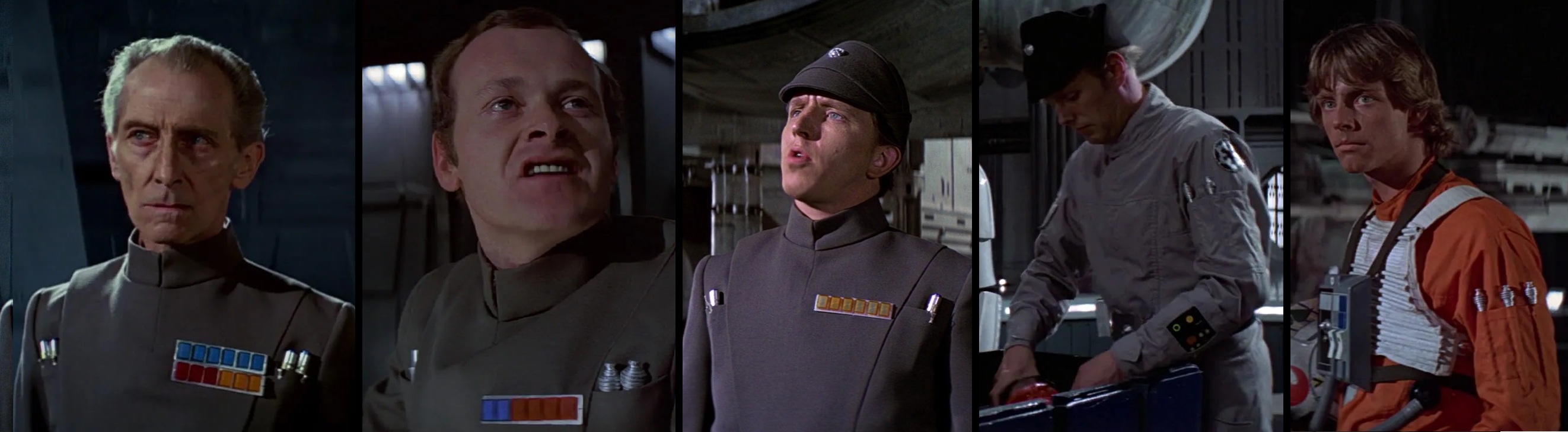
As the majority of SW titles continue to revolve around face characters from the more ‘exciting’ (i.e. typically martial) character classes (Jedi, fighter pilots, bounty hunters, troopers, etc.), we have a relatively small pool to draw from, at least when it comes to live-action. Our first look at this type of character comes from act three of SW’77, with our heroes’ arrival at the Rebel base on Yavin IV.

(We’ll see Rebel hangar crews continuing to dress like this before Endor as well)
Keep reading

Building the Alliance Pilot – Part 3: Hard Kit

The pilot build is coming right along, and now we’re in the final stretch: with clothing (aka ‘soft kit’) items out of the way, this time we’re adding on the various accessories that really help sell the snubfighter pilot look! First up is (per the Rogue One visual guide) a “Novaldex Diagnostech life support unit”, aka chestbox!

When I started this pilot project, I was still working commission-to-commission, and for a starving artist, shelling out $100+ for a vacformed or 3D printed chestbox was something I wasn’t comfortable doing. Now that I have a more regular source of income, I can see that it’s not that much to pay, but I still wanted to do my part and keep the DIY-craftsman ethic alive. Never one to turn down a good problem-solving challenge, I decided to scratchbuild my own. I knew this element would be the most involved, so I started work on it last August. From a measured diagram I produced a foldable pattern, which I turned into a ‘Mark 1’ pepakura using shoebox cardboard in about a week:

Despite the resin/rondo coatings, it was still too flexible and the sides wouldn’t stay quite square; it simply wasn’t worth the effort it was going to take to make it work, so I decided to cut my losses and start over, thus avoiding the ‘sunk cost fallacy’ (i.e. believing something is worthwhile just because you’ve invested a lot of time or money into it). I was still a little dispirited all the same, so I had to bide my time until the right material appeared. Come early December, I found some small sheets of Masonite for another couple bucks at my local secondhand craft shop and laid out my Pep pattern on these. This time, the material was rigid enough to not flex or require much post-processing.

let’s add some details, pilot-style!

Galactic Style Guide – Capes and Cloaks II

Happy Orthodox Star Wars Day!, and welcome back to another installment of the Galactic Style Guide – the series where we break down the ‘Star Wars aesthetic’ in order to help you create a more authentic ‘outer persona’! In this entry, we’re continuing our exploration of capes and cloaks by looking at those seen in Lucas’ Prequel Trilogy. Star Wars’ costume designs have always been a unique mixture of Spaghetti Western, 20th century military, Eastern/’exotic’, and medieval styles, and the use of capes/cloaks are largely responsible for the latter. Let’s get back to it, and see what we can learn!

Seeing how the story revolves around a Republic becoming a dictatorship, it’s no surprise that one of our main Senator characters (Bail Organa) in Episode III is often seen wearing an asymmetrical toga-like cloak, as does his ship’s captain (Raymus Antilles). Here’s another set of cloaks I would love to get my hands on in the Lucas Archives and examine just how they are constructed (I have a suspicion that they’re simpler than they appear, and are likely just a multi-yard rectangle with stitched pleats and an offset neck hole). Note the leather(?) piping along the leading edge and around the neck hole, which is a low-impact way to add a bit of detail and structure without being distracting.

As we’ll soon see, while the folks wearing capes and cloaks in the Classic Trilogy were often of questionable repute, those in the Prequels are commonly upstrata, and often members of the Republic government.

our breakdown of Prequel Trilogy capes and cloaks continues

Building the Alliance pilot – Part 1: Concept

It may certainly have been a while since I had a new kit built to break down, but I think I finally picked a real winner with this one! As I mentioned recently, I’d apparently been toying with the idea of assembling a proper Rebel Alliance Pilot kit for a while now: at the end of last April it was an idle fancy, by May, I was highly considering it, and by the end of June I had actively started pricing and sourcing the components!

When I was first entertaining the idea, I experienced a funny, unfamiliar feeling. I’ve become SO used to having to do actual research/work—decide on a home planet, find references to extrapolate the local style, draft patterns, create garments, etc.—for my typical ‘Original Character’ impression/persona that an Alliance pilot (made up of specific elements without much room for customization) feels like just a series of boxes to check off. However, I figured I had already acquired three of the biggest elements (flightsuit, boots, and vest) over the years for use in other kits (because they’re no-nonsense, commonly-seen-in-universe pieces that naturally lend themselves to mix-and-matching!), so why not take the next step and create a kit that would actually be recognizable to John Q Public with minimal explanation? Plus, since opportunities for doing SW living history continue to be pretty much non-existent in my sector, a pilot outfit might actually finally allow me to join up with the Rebel Legion – because none of my previous kits1 quite jive with their current model!

Usually, whenever I see someone online who has put together a ‘custom pilot’ costume, it’s been prefaced by some variation of “I put my own spin on it!” and leans more on the OC’s go-to “wouldn’t it be cool if ___?”…. and thus the final result rarely ‘reads’ as “pilot”.
As should be clear by now, I have a really hard time going along with the crowd; however, as I hope I’ve also made clear, I believe a valid ‘middle way’ exists between the two extremes of the dogmatic “on-screen assemblages only!” Legion, and more casual, “anything goes, let your imagination run wild!”-type cosplay.
I don’t know how many hundred OT-era pilot cosplayers there are out there (easily 95% of these are X-wings), but I’ve yet to see one that didn’t follow these same old onscreen combinations of flightsuit color and helmet style:

As someone really interested in the early Rebellion period, I think switching things up to be a little less uniform helps underline the ‘ragtag’ nature of the Alliance. I’m sure there had to be pilots who joined up and brought their own personal flightsuits with them – I definitely remember some climate ‘direct actions’ where we street medics were literally told, “Sorry we don’t have any supplies for you, you’ll have to requisition your own or use what you have” and can easily imagine similar situations in the pilots’ ranks.
Obviously, I can’t resist pushing the boundaries of OT-era pilot style at least a little bit, but I’m not going to go so far outside the bounds that I no longer look like an OT-era pilot! (Now there’s a nice summary of the ‘middle way’ approach for you: do your research, push the boundaries, but stay within the guardrails!)
Luckily for me, I don’t have to feel like I’m sticking my neck out too far because an often-overlooked EU source did it first!

Channeling The starfighter game that time forgot!

Galactic Style Guide – Capes and Cloaks I

Welcome back to another installment of the Galactic Style Guide, the series where we break down the ‘Star Wars aesthetic’ in order to help you create a more authentic ‘outer persona’! In this entry, we’re examining examples of capes and cloaks. (Robes—like those worn by the Jedi or Emperor Palpatine—have sleeves and will be covered in a future post!) Traditionally, a Cape will be shorter in length and made of more fashionable materials compared to the longer, more utilitarian Cloak, but I use them fairly interchangeably here.

Star Wars’ costume designs have always been a unique mixture of Spaghetti Western, 20th century militaria, Eastern/’exotic’, and medieval styles, and the use of capes/cloaks are largely responsible for the latter. With many cosplayers eager to add a little ‘swish’ to their outfits, I hope these posts will be of some use: because when inspiration is needed, it is best to go right to the source instead of to what others have done!

Let’s dive right in with the only guy (IMHO) who can compete with Han Solo in terms of style!

Biggs Darklighter shows up to his desert hometown rocking a solid black knee-length wool cape with a short standing collar (and no visible fasteners, naturally!). It doesn’t appear to be lined, so that great drape is due to it being a really solid weight of fabric. If it is lined, it’s in a pretty similar color or material (note also that this is a rare example of a ‘good guy’ character wearing a ‘bad guy’ color).
However, with the Anchorhead scenes on the cutting room floor, we have few major characters wearing these kinds of garments in the rest of the film.
The only one who really comes to mind is the Mos Eisley spy Garindan who wears a most interesting hooded cloak:

Unlike the rest of our examples, old Long-snoot’s hooded cloak is a one-piece, and I’d love to see what the overall shape of it is! Visually, we can deduce that he’s an antagonist (because the cloak is black!), and as we will come to expect, it’s made of wool in a nice weight, is a solid color, and unadorned.
Aside from Garindan, It’s not until we make it to Cloud City in the next installment that we find another cape in the foreground:

Breaking down lots more In-universe caped characters after the jump