
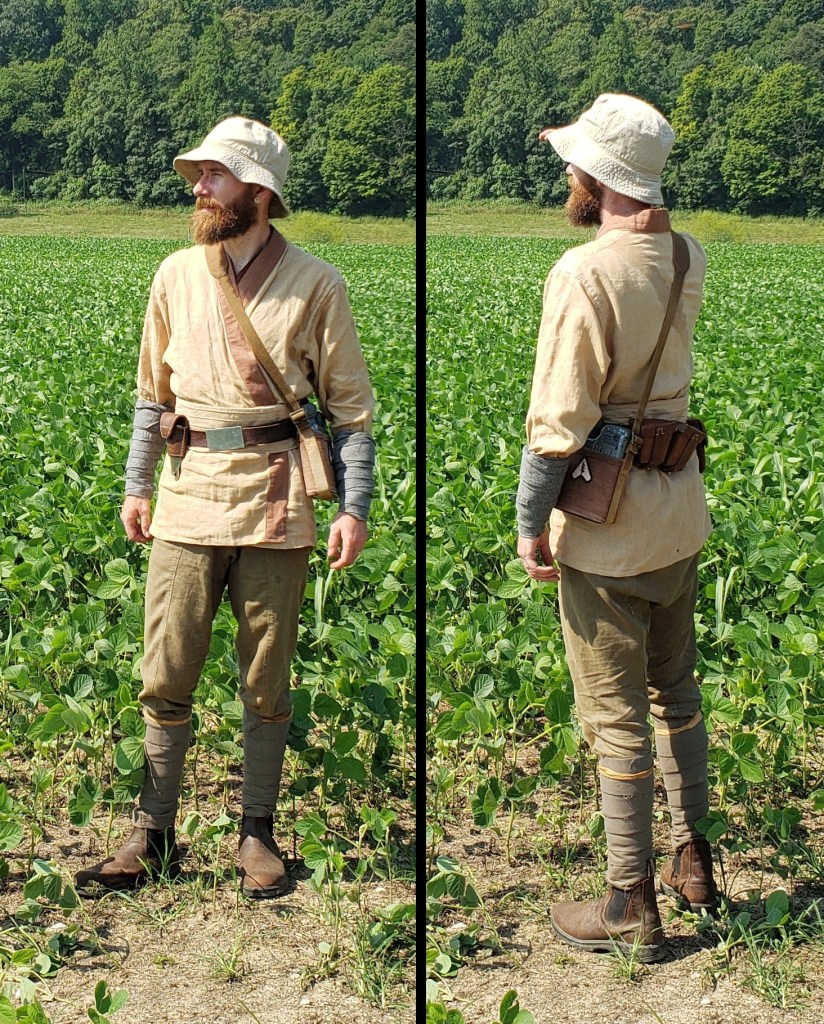
This is the impression that first got me thinking about ‘doing Star Wars‘ in a reenacting/living history sense – a ‘washout Jedi’ member of the Agricultural Service Corps.

When I first started pursuing my interest in the AgriCorps, I went back and forth on how much ‘Jedi’ this kit should really have. As you can see above, what I came up with for ‘Mark 1’ was basically ‘Prequel Jedi + hat, satchel, and simpler leathergoods’. Over the years, my go-to kit shifted away from the AgriCorps proper as I decided on a ‘realistic Jedi survivor’ persona and a dating scheme that put the ‘present’ in the early Rebellion period – meaning it should appear more of a generic galactic farmer.
However, I still felt that the AgriCorps was such an obscure but necessary aspect of EU Jedi culture that I didn’t want to completely abandon the kit, especially when further research helped me clarify just what an accurate ‘Jedi gardener’ would look like. While I didn’t plan on using this kit for workshops or first-person interpretation, the AgriCorps ‘uniform’ is so mundanely cool that I just had to create a dedicated Service Corps kit just for kicks…and maybe to be worn during some environmental-cleanup community service projects? Like Adam Savage says, “You have to make what you can’t not make.”
Outer tunic:
material: 6-7 oz. 100% linen, RIT-dyed ‘Tan’. Collar RIT-dyed ‘Cocoa Brown’.
construction: based on McCall’s #2940; machine-sewn.
At the same time these ideas were kicking around in my head, I realized that in the decade since I originally sewed my linen Jedi tunics (one lined and one single-layer), my sewing game had significantly leveled up. Embarrassed by my previous efforts, I decided to rework both tunics and resew them properly. Since I was going to be completely deconstructing them, I figured it was high time to pull the trigger and tweak my unlined ‘summer tunic’ into a dedicated Service Corps uniform.
Conversion was pretty simple—modify the sleeves and recolor the collar—but definitely worth it. Since I would be wrapping my forearms and wearing large sleeves would create unnecessary bulk when wrapped, I cut the sleeve down by about half, creating a narrower opening of about 4″. Even though several AgriCorps members can be seen wearing blue tunics with black collars, I still felt that was too far outside the standard Prequel-era Jedi color scheme to ‘read’ as Jedi (even if it’s technically accurate…I hate to do it but concessions to recognizability must sometimes be made).
Inner tunic:
These are made of dark brown (I seem to remember the color was named ‘potting soil’?) crinkle-textured cotton gauze, which it is believed was used to make Obi-Wan’s various outfits in the Prequels. I originally made two of these inner tunics, so for Service Corps use I opted to remove the sleeves of one of them. Having waist and wrists sealed off by belt and armwraps limits ventilation, so removing the sleeves helps to prevent overheating a bit.
The second (sleeved) tunic acts as a spare packed in a drybag (since wearing damp or wet cotton—even thin as this material is—can be miserable and/or dangerous depending on conditions.) However…I mistakenly ordered a few yards of open-weave linen that are still kicking around, which might wind up as a new sleeveless inner tunic with better wicking properties.
Arm wraps/forearm puttees:
I did some maths and found I could create two rolls from some gray 100% wool trouser scraps leftover from a 2019 Skoldehamm-type hood project. I may wind up dunking them in black walnut dye to give a brown tint later on.
Hat:
This is just a simple beige, cotton-twill bucket hat I found on Amazon. I wore it for the first 1,330 miles of the Appalachian Trail on my 2021 thruhike, so it got good and authentically weatherbeaten and sunbleached (as we would expect a Jedi gardener’s clothing to be!). For examples of bucket hats worn in-universe, see here.
Belt:
Nothing fancy here either, just an oil-tanned, full-grain leather belt with a plain Tandy buckle; much more economical and less ostentatious than the typical Prequel two-part Jedi belt.
Trousers:
On my lower half, I’m wearing a pair of my Thorsbjerg-pattern trousers in olive drab 100% linen. They have no fly (drawstring waist) but they dry fast, are breathable, and are designed for active use. These were made by cannibalizing an extra-large pair of linen dress slacks for the material.
Boots:
Footwear has always been very ambiguous in depictions of the Service Corps, but my research suggested that leg wraps were also worn, which aligns with my original hunch that resource-intensive boots and belts would be reserved for successful Padawans, Knights, and Masters. Since high boots were inappropriate and all my old ankle boots had laces, I decided to wear Chelsea-style boots (Blundstones) with this kit. This style of boot has a long pedigree in Star Wars costuming, and as we can see, they pair nicely with wool puttees.
Legwraps:
I originally purchased these secondhand for Soviet reenacting, but I’ve used them in countless periods and impressions over the years. They’re 100% wool with braintan ties. Puttees are frequently seen in-universe: not only in a specifically AgriCorps context (The Jedi Path) but also worn by many live-action examples.

Ideas for future improvements:
-one downside to this tunic is the length – when I first put these pieces together, the tabards really helped disguise the fact that without them, the tunic is just a few inches too short. My new rule of thumb is “if it doesn’t come down to at least your fingertips and/or cover the crotch of your pants, it’s just a long shirt!”.
-I really need to find some comfy trousers with a zipper fly. Drawstring Tbjergs don’t really cut it when you’ve gotta go!
 Living History in the Star Wars Galaxy