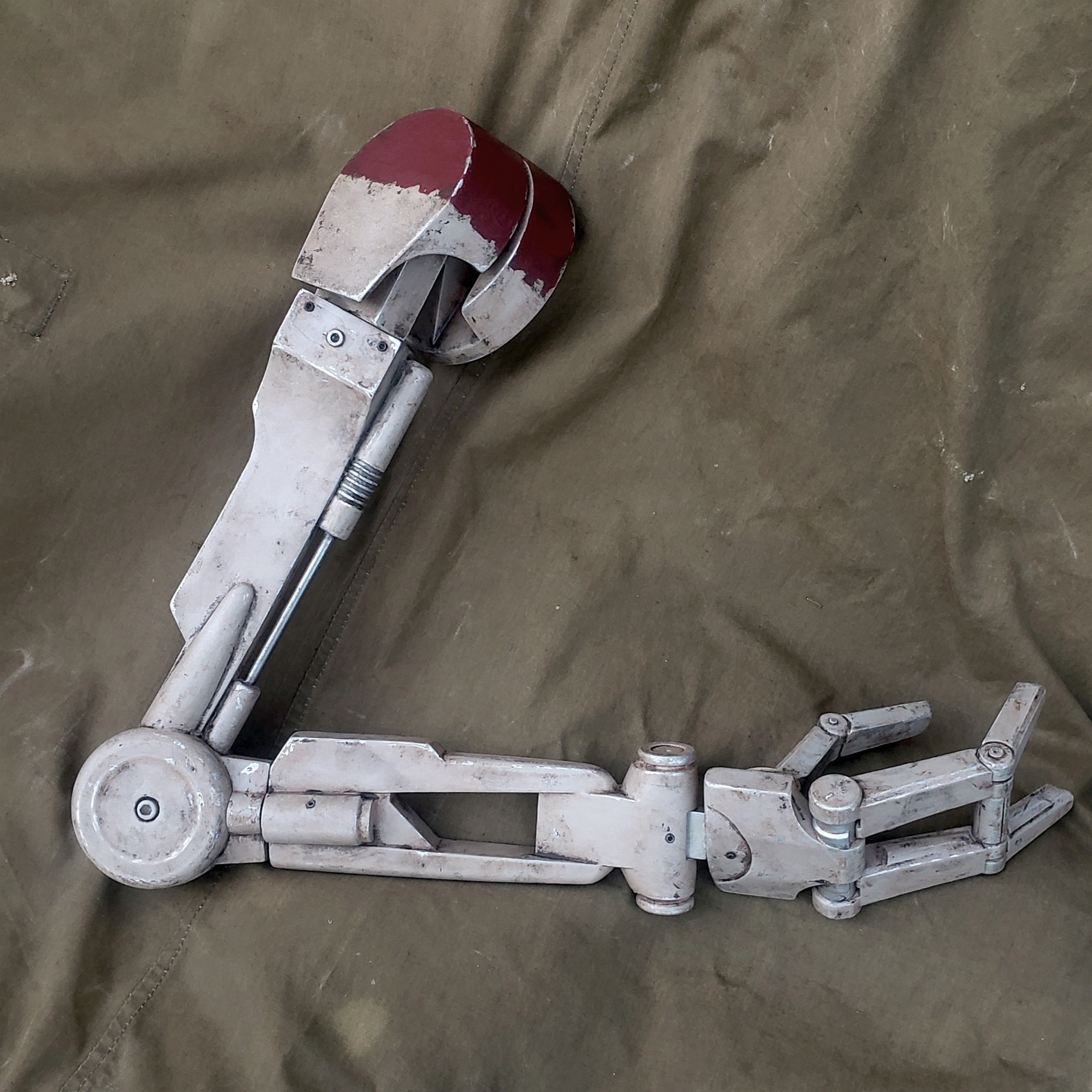
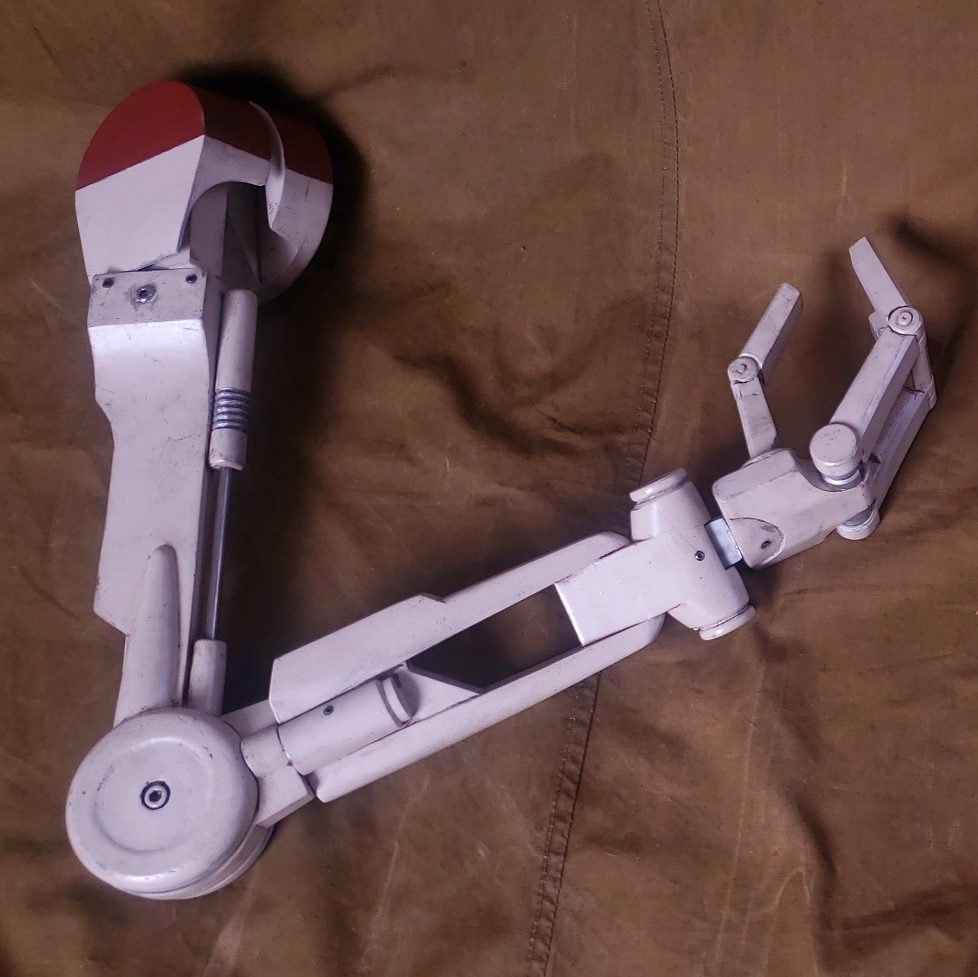
Project – Belt Bottle

As is becoming my usual tendency, this project began as a quick burst of creative energy, only to be followed by months of hiatus until some right material is found, and then another hiatus until my craft docket or mental bandwidth could catch up.
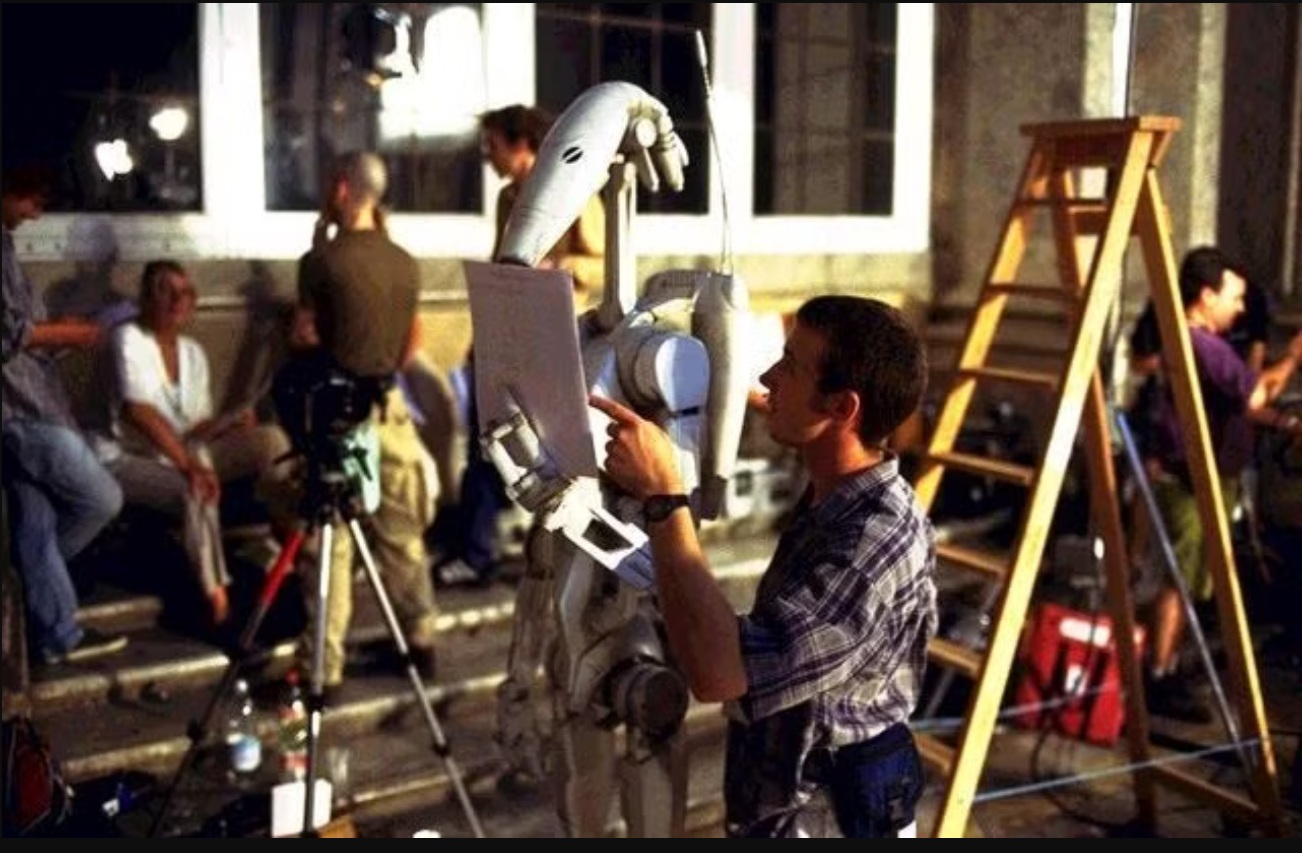
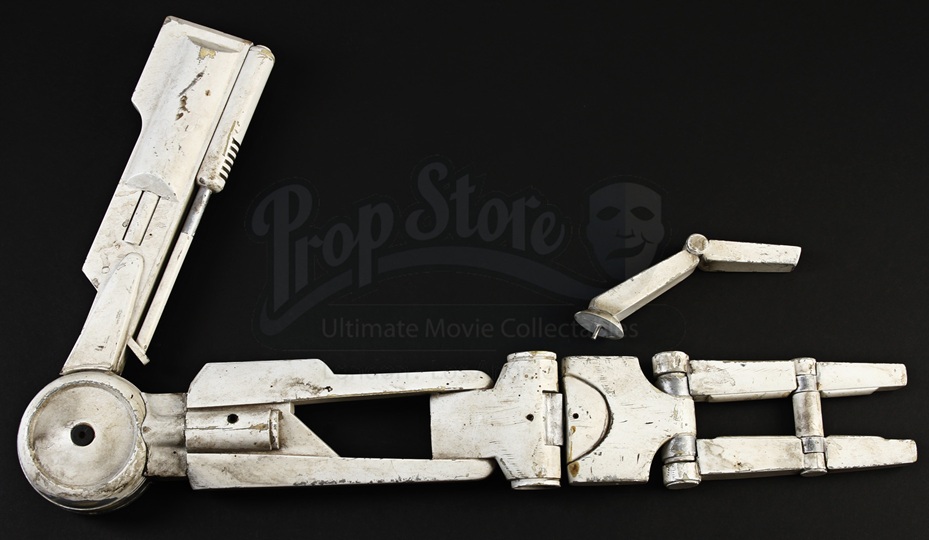
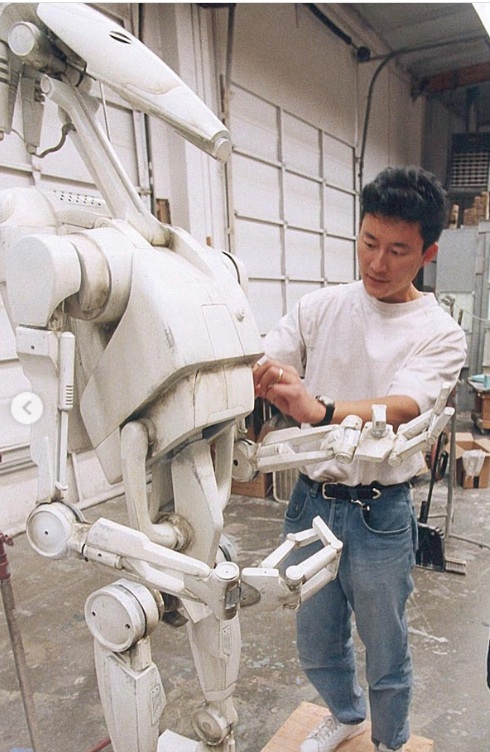
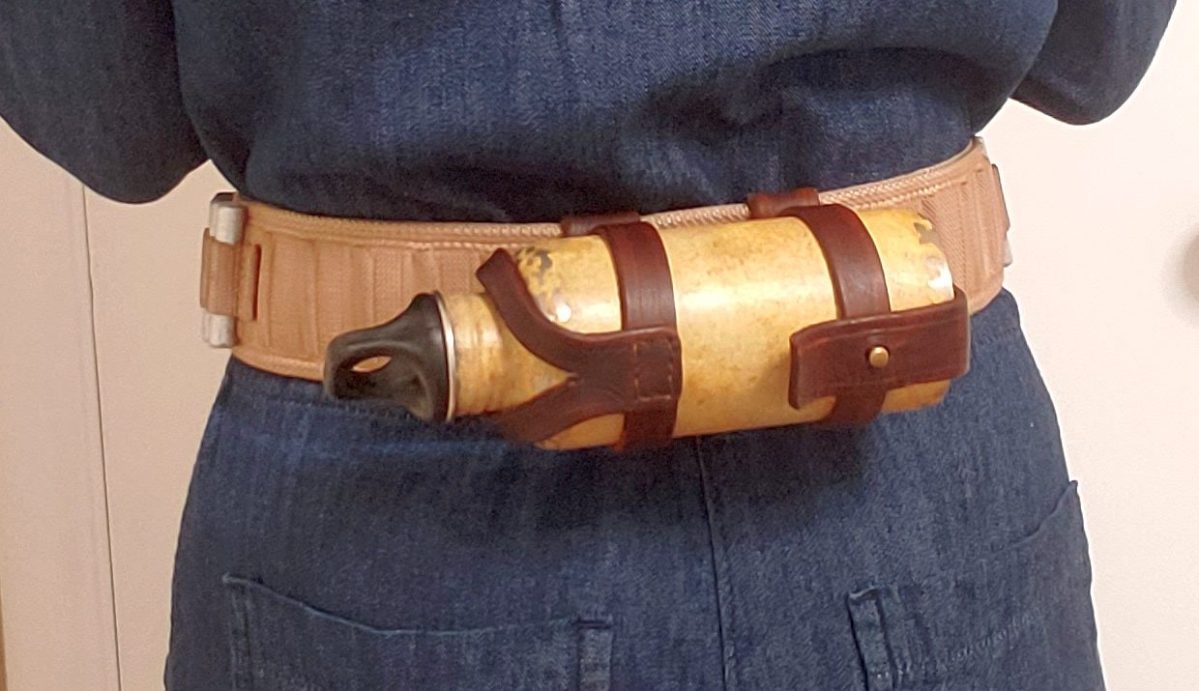
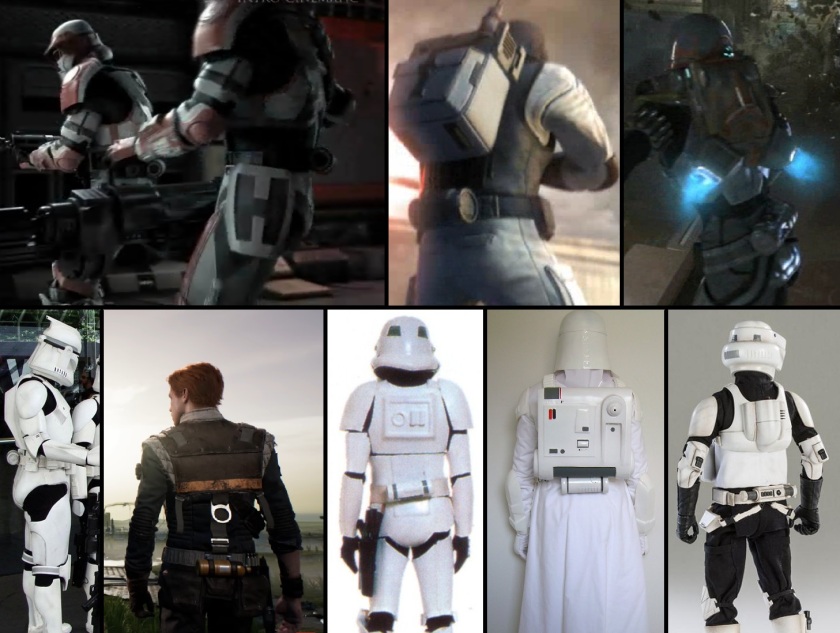
This project in particular is also the result of a curious local quirk: the area of town where I live has a very strong culture of ‘curb crawling’, in that neighbors frequently put unwanted items on their curbs free for the taking! One day last summer I was biking around town when I came upon one of these treasure caches and pulled over to take a look. Among the knick-knacks and a cool bell beaker-shaped glass vase was a plain stainless water bottle (of the sort I had spotted onscreen in Episode II several years back), so I took it home and cleaned it up. The size was actually smaller than the onscreen one – holding only a pint or so – but I thought it might be a useful bit of hydration kit. Since I already have some great in-universe canteens, and this bottle was too small to be a proper canteen, I thought it might be useful for holding some other fluid (electrolyte concentrate? Corellian whisky?), and began brainstorming how I might carry it in a pack or on my person. One way the Star Wars galaxy has always felt like a real setting is the use of repeated visual elements which give a sense of cultural continuity and cohesion. Among my favorite of these is the ubiquitous cylinder carried at the rear of the wearer’s belt:

Let’s get crafting!

Project: Sweater retool 2025

What’s this? Another sewing retool project?? Yes!
What can I say? Maybe it’s just my local shop, but while the offerings at Goodwill seem to be getting worse lately (thanks largely to the influx in garbage-quality fast fashion from places like SHEIN), I still manage to find good (i.e. with Swarzy potential!) pieces now and then. Case in point: this odd women’s sweater-thing made by Kenar – I guess when worn open, it might be considered a cardigan?

At this point in my scavenging career, the initial attribute I scan for is texture (and by extension, fabric content) more than anything like color or design, so considering its fuzzy nap, I instantly had this sweater pegged as wool. As I’m always working towards the goal of GFFA-ifying my modern hiking kit, I thought this could be a good replacement for my current midlayer (an Earth-y, crewneck cashmere sweater) – but not without a little retooling!

tell me this doesn’t look cozy!

The material itself is great – it’s actually a knit, but since it’s 100% wool there’s enough felting going on that it both looks woven and doesn’t unravel when cut! Color-wise, it’s a bit brighter than simply Navy blue and a bit lighter than Royal blue, which is fine for GFFA uses. Obviously I’d prefer something a little lighter or less saturated, but it otherwise checked most of my boxes… except one.

how to swarzify this ugly sweater?

Project: Coat Retool 2024

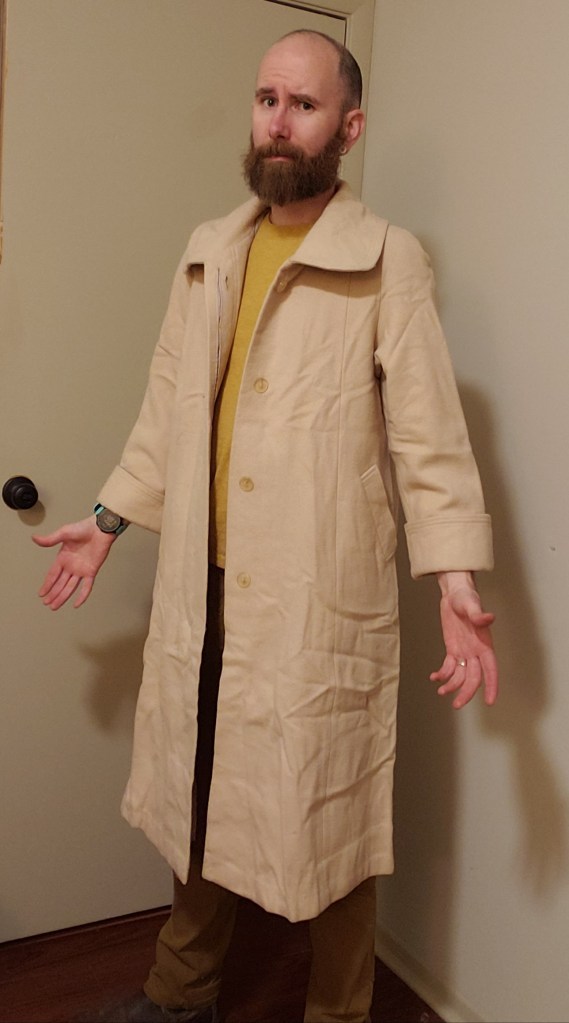
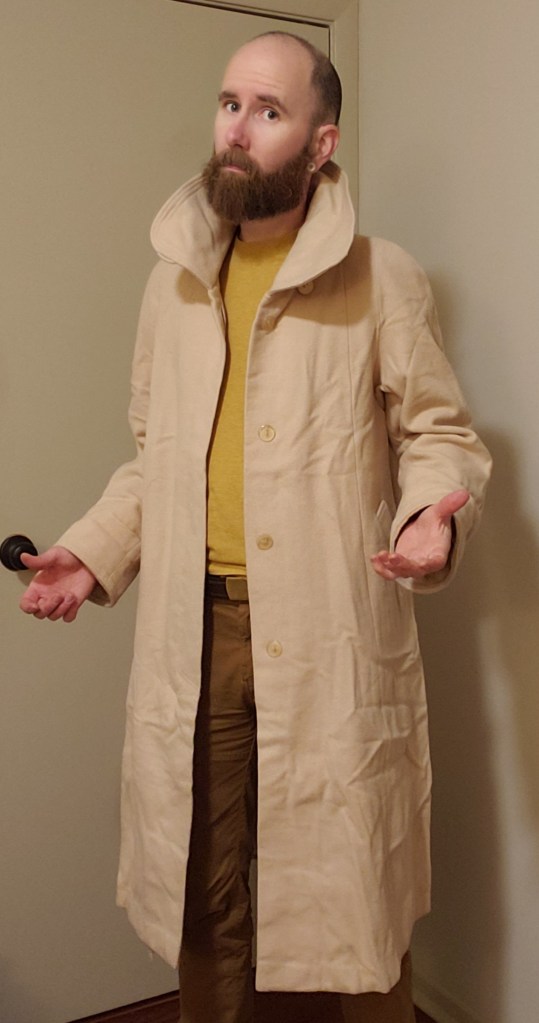
If it feels like it’s been forever since I’ve had a finished project to unveil, you would be right – turns out it’s been nearly a year! The funny thing is, this one has been finished since Christmas, but I’ve been so busy with, y’know, gutting a house and renovating it literally from the ground up to be able to work on nearly anything else (like taking pictures of the final product!) We may have moved in right after the New Year, but it’s only been in the last two weeks that I’ve got my sewing space in a more-or-less workable condition! Anyway, this particular project started last January when I was (as ever) browsing the racks at my local Goodwill, not looking for anything in particular, only to find something in a solid material with great potential Swarziness…if I could just manage to rework it to be less hideous.

In this case, a camel-colored 100% wool coat with a massive collar and weirdly rounded shoulders…major Asian granny vibes. However, I’m always up for a challenge (especially at a price point of just $7!) and was in the market for a lighter-weight coat (my only other option at the time was a Soviet behemoth meant for the Eastern Front!) so I got it home and started making my plan of attack.

what all goes into such a transformation?

HOW TO: Hide Your Buttons #2

In a previous post, I concluded by saying “when the flavor of the world is ‘no visible fasteners’, then cover up your darn buttons.” However, for some folks that may be easier said than done. If you like the idea of having an outfit be sans visible-fasteners but find the idea of how to actually make it happen a little overwhelming, then this post is for you!
Adding the ability to hide fasteners to your toolbox is a major level-up, especially for those outfitting an Original Character. Off-the-rack items can be great for dressing a ton of far-background characters, or creating a suggestive ‘everyday bounding’ look, but if you’re after a 100%-in-universe-legit look, these kinds of pieces can only take you so far. I hope you’ll note how our main characters almost always wear custom-designed garments, which may still be reminiscent or incorporate elements of familiar/off-the rack pieces, but usually tweaked just a little to give it that timeless GFFA flavor.
In this post, we’re going to show you a second method to create a button-free appearance on an upperbody garment by ‘genderswapping’ our garment, a version of which I’ve used before on this raw silk shirt retool project. How do you swap a piece of clothing’s gender, you ask? Keep reading to find out!

level up your costuming game with this handy skill

HOW TO: Hide Your Buttons #1

In one of my previous entries, I concluded by saying “when the flavor of the world is ‘no visible fasteners’, then cover up your darn buttons.” However, for some folks that may be easier said than done; if you like the idea of having an outfit be sans visible-fasteners but find the idea of how to actually make it happen a little overwhelming, then the next couple posts are for you!
Adding the ability to hide zippers or buttons to your toolbox is a major level-up, especially for those outfitting an Original Character. Off-the-rack items can be great for dressing a ton of far-background characters, or creating a suggestive ‘everyday bounding’ look, but if you’re after a 100%-in-universe-legit look, off-the-rack can only take you so far. I hope you’ll note how our main characters almost always wear custom-designed garments, which may still be reminiscent or incorporate elements of familiar/off-the rack pieces, but usually tweaked just a little to give it that timeless GFFA flavor.
In this post, we’re going to show you one method to create a button-free appearance on an upperbody garment by sewing a very basic cover panel over our buttonholes. Then, in part two, we’ll learn to hide buttons by ‘genderswapping’ our garment. What’s that all about, you ask? You’ll just have to wait and see, but for now let’s get started!

level up your sewing game with this handy skill

HOW TO: Collar conversion

Even if you’re fairly keyed into the intricacies of clothing in the Galaxy Far, Far Away, there’s one easily-overlooked element that plays a major role in helping separate our own modern fashion from that of the Star Wars galaxy: collars!

When he first began designing his world, we read how Lucas “made pronouncements of a general nature” and that he wanted “the rebels, the goodies, to look like something out of a Western” (Rinzler: The Making of Star Wars, p.130; quoted slightly modified in Alinger’s SWCOT, p15). This is an important distinction, as it was one of the broad styles John Mollo used to sort his character designs : “peasant costumes; Western/U.S. cavalry/motorcycle looks; Nazi-style uniforms/armor/cloaks; space technology-type outfits”, etc. (Alinger, p16). More on these categories later!

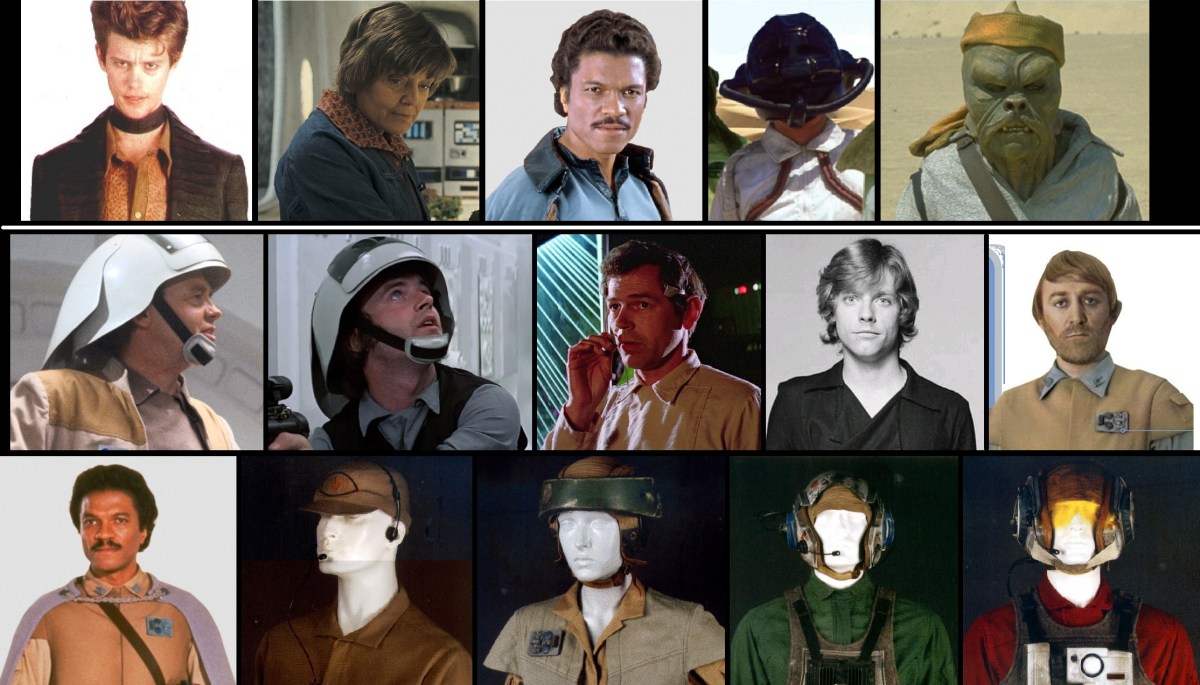
As something so mundane as the collar on a shirt or jacket, it’s likely you may not have noticed the fact that fairly few characters in Star Wars actually wear shirts with modern-style ‘fall collars’. Of course, we do have a few examples, but by-and-large, most characters who wear collared garments wear ones with some form of ‘stand collar’, and quite often these are full-on Mandarin collars.
After thumbing through my reference library, if I had to spitball some numbers, I would say that well over 50% incorporate some form of upright collar, perhaps 20% are collarless, and less than 5% are fall collars – really, the characters above are pretty much all I came up with.

I hope you’ll note that of our samples, the majority of them are Rebel Alliance ranks or ‘character classes’ (officer, fighter pilot, fleet trooper, communications tech, etc.)! Ergo, judging by our samples, the fall collar is generally a good way to give ones’ impression a touch of Rebel Alliance-style militarism, but if you’re portraying an unaffiliated galactic citizen, something that says ‘slightly exotic’ like some flavor of stand collar may be the way to go.
Luckily, most modern shirts with two-piece fall collars are readily adaptable to a more upright style with one easy tweak!

learn an easy minimal-sewing hack to upgrade your outfit!

Building the Alliance Pilot – Part 3: Hard Kit

The pilot build is coming right along, and now we’re in the final stretch: with clothing (aka ‘soft kit’) items out of the way, this time we’re adding on the various accessories that really help sell the snubfighter pilot look! First up is (per the Rogue One visual guide) a “Novaldex Diagnostech life support unit”, aka chestbox!

When I started this pilot project, I was still working commission-to-commission, and for a starving artist, shelling out $100+ for a vacformed or 3D printed chestbox was something I wasn’t comfortable doing. Now that I have a more regular source of income, I can see that it’s not that much to pay, but I still wanted to do my part and keep the DIY-craftsman ethic alive. Never one to turn down a good problem-solving challenge, I decided to scratchbuild my own. I knew this element would be the most involved, so I started work on it last August. From a measured diagram I produced a foldable pattern, which I turned into a ‘Mark 1’ pepakura using shoebox cardboard in about a week:

Despite the resin/rondo coatings, it was still too flexible and the sides wouldn’t stay quite square; it simply wasn’t worth the effort it was going to take to make it work, so I decided to cut my losses and start over, thus avoiding the ‘sunk cost fallacy’ (i.e. believing something is worthwhile just because you’ve invested a lot of time or money into it). I was still a little dispirited all the same, so I had to bide my time until the right material appeared. Come early December, I found some small sheets of Masonite for another couple bucks at my local secondhand craft shop and laid out my Pep pattern on these. This time, the material was rigid enough to not flex or require much post-processing.

let’s add some details, pilot-style!

Building the Alliance pilot – Part 2: Soft Kit

In our last post, I laid out my plan to push the boundaries of Original Trilogy pilot style in a simple, believable way: take the iconic ANH look and swap the orange flightsuit for a tan one. It may be a minor change, but it’s also an effective one – let’s get started and break it down layer by layer!

The flightsuit in question is my old tan standby from Wampawear – originally purchased for a hypothetical New Republic Archeological Corps shovel bum impression. That may have fizzled out, but the elements I initially gathered for it are as solid as ever. All the weathering you see is 100% honest and natural: every time over the last 4 or 5 years when I’ve had to work on my car (oil changes, brakes, pushing out dents, lug stud swaps, etc.) I’ve worn this flightsuit, and in the process have built up a really impressive pattern of real wear in authentic places. In person it’s absolutely filthy looking, but on camera it just reads as extra well-used. I hesitate to wash it because I’m so pleased with the patina but I’m also aware that doing so would probably be good for the garment. If I do, it will likely just be handwashed with little (if any) detergent.
(Boots are Finnish military jackboots I snagged from Varusteleka years ago.)

From the beginning, the ejection harness was one component I really wanted to do in as authentic or realistic a manner as possible. While it’s an obvious stylistic homage to the parachute harnesses of WW2, it doesn’t quite make much sense—there’s just not that much to it, comparably. Apparently, Rebel Legion folks just safety pin or Velcro the naked top end of their harness webbing to the flak vest or flight suit, which I find completely un-immersive! I wanted this to really feel like a piece of in-universe military gear – one I wouldn’t be afraid to be seen suiting up in – so I came up with a simple over-the-shoulder design that would still remain unseen under the shoulders of the flak vest.

Continue getting dressed, pilot-style!

Project: Thermos canister facelift

If it seems like a long time since we’ve had a standalone project to show off, you’re not wrong! We haven’t been idle lately, it’s just that everything we’ve been working on has been towards one specific, very detailed goal. Every now and then, however, something comes along and begs our attention for a week or two.

A funny observation I’ve made lately: whenever I go out shopping (ever on the lookout for gear or materials I can use for reenacting), every time I grumble to myself, “This place never has anything good!”, then something tends to comes up! Last November I popped into my local Goodwill having just complained that such a civilized thrift shop would be a terrible place to find pieces for my Middle-earth kits……only to score a gorgeous maroon 100% wool blanket for just $2 (!!!). Then a few months ago, while accompanying my wife on an outing to TJMaxx, I found myself was grumbling how the clothes there are all made of polyester and any ‘hard kit’ type items are always so ‘consumer-grade’ and never made for rigorous galactic use. Well, wouldn’t you know it, in among the reusable water bottles I found this double-thermos canister…thing:

“[It] may not look like much, but [it’s] got it where it counts”

This Hydraflow POD measures up at about 9.5 inches tall; the top section holds about a pint, and the lower section holds nearly a liter! There’s a spot under the lid for a folding spoon, which turned out to be pretty terrible. However, it’s triple insulated, is pretty much a blank canvas for retooling with in-universe style, and best of all, is made of steel (90% recycled!). Unlike the last Thermos I reworked, this one is watertight, tough, and ready for real use in the field!

In keeping with the authentic aesthetic seen on screen, I knew it wouldn’t take much to SWarz this up – a more neutral color and some weathering would be about it. The first step would be to tackle the screw-on lid.

Continue reading “Project: Thermos canister facelift”

Upgrading the Rebel persona: flak vest

As the name of the game in rigorous reenacting is ‘continual improvement’, I’m always on the lookout for things to help add some depth or otherwise level-up my impressions. While Rebel characters typically steer away from the plastoid armor side of things, I realized that the ribbed vests worn by various characters were probably meant to protect the vital organs and so would be perfect for a partisan persona as well!

Rebel pilots, BoShek, Bossk; 1313 mercenaries, Ruusan rebel (Dave Dorman)


A few months ago, my buddy Anders (of DT Blasterworks) sent me a link to a lower-priced rebel pilot-style flak vest he was thinking about buying. Since my initial impetus for building a SectorForces partisan/guerilla kit was to pair Alliance-issued materiel with local planetary style, I had initially considered including one of these vests. The only one I had looked into was produced by Wampa Wear; at $125, while it’s probably—if anything like their flightsuits—extremely well-made and screen-accurate, I couldn’t justify paying that much for a purely costume piece…so the idea returned to the back burner.

However, Anders’ link (and his report that it was decent quality) renewed my interest, so at about 1/3rd the price of a Wampa Wear vest, I pulled the trigger. Out of the package, I could tell the vest fell in the category of “close enough”, about which I’ve written before: presumably, there are variations on the flak vest throughout the galaxy, and they’re not all produced identically. All the same, I still wanted to try my hand at ‘accuratizing’ the cheapo vest to see if I couldn’t get it a little closer to Alliance specs, as a few things stood out to me that could use tweaking:

The to-do list:
-fix the diameter and spacing of the sewn channels
-bind the curved edges with twill tape
-replace the rear buckle
-replace the large side clasps (down the line)
continue reading