Welcome back to another installment of the Galactic Style Guide, the series where we break down the ‘Star Wars aesthetic’ in order to help you create a more authentic ‘outer persona’! By audience request, in this entry we’re trying something different! This time around, we’re not looking at a specific category of clothing or gear, but a specific “character class”! Just like with our regular Style Guide entries, the idea is still to analyze examples of a single theme to see what they share – and therefore see what the most common and representative elements are, hopefully to prevent the spread of reenactorisms! As always, there’s plenty of room in the Galactic Costumed-Arts Spectrum for fun and personal interpretations, but if (as I believe is entirely possible) the GFFA is to be seen as a legitimate setting for high-quality living history, it really pays to take a page from the reenacting playbook and try to represent the common galactic populace as faithfully as possible…which means sticking to the visual ‘rules’ of the setting. What are those rules for mechanic/technician characters? Let’s find out!
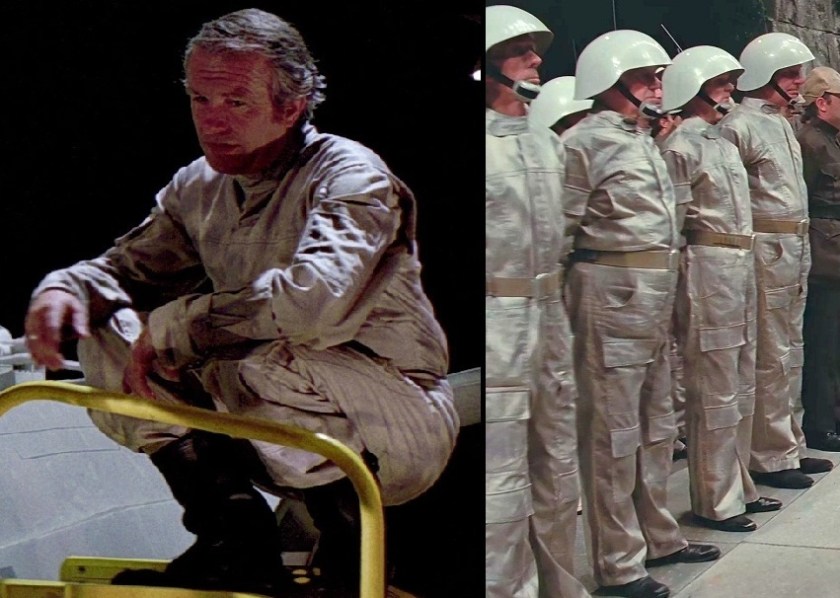
As the majority of SW titles continue to revolve around face characters from the more ‘exciting’ (i.e. typically martial) character classes (Jedi, fighter pilots, bounty hunters, troopers, etc.), we have a relatively small pool to draw from, at least when it comes to live-action. Our first look at this type of character comes from act three of SW’77, with our heroes’ arrival at the Rebel base on Yavin IV.
(We’ll see Rebel hangar crews continuing to dress like this before Endor as well)
The pilot build is coming right along, and now we’re in the final stretch: with clothing (aka ‘soft kit’) items out of the way, this time we’re adding on the various accessories that really help sell the snubfighter pilot look! First up is (per the Rogue One visual guide) a “Novaldex Diagnostech life support unit”, aka chestbox!
When I started this pilot project, I was still working commission-to-commission, and for a starving artist, shelling out $100+ for a vacformed or 3D printed chestbox was something I wasn’t comfortable doing. Now that I have a more regular source of income, I can see that it’s not that much to pay, but I still wanted to do my part and keep the DIY-craftsman ethic alive. Never one to turn down a good problem-solving challenge, I decided to scratchbuild my own. I knew this element would be the most involved, so I started work on it last August. From a measured diagram I produced a foldable pattern, which I turned into a ‘Mark 1’ pepakura using shoebox cardboard in about a week:
It might not look like it, but this thing is noticeably warped/skewed and far from square.
Despite the resin/rondo coatings, it was still too flexible and the sides wouldn’t stay quite square; it simply wasn’t worth the effort it was going to take to make it work, so I decided to cut my losses and start over, thus avoiding the ‘sunk cost fallacy’ (i.e. believing something is worthwhile just because you’ve invested a lot of time or money into it). I was still a little dispirited all the same, so I had to bide my time until the right material appeared. Come early December, I found some small sheets of Masonite for another couple bucks at my local secondhand craft shop and laid out my Pep pattern on these. This time, the material was rigid enough to not flex or require much post-processing.
In our last post, I laid out my plan to push the boundaries of Original Trilogy pilot style in a simple, believable way: take the iconic ANH look and swap the orange flightsuit for a tan one. It may be a minor change, but it’s also an effective one – let’s get started and break it down layer by layer!
The flightsuit in question is my old tan standby from Wampawear – originally purchased for a hypothetical New Republic Archeological Corps shovel bum impression. That may have fizzled out, but the elements I initially gathered for it are as solid as ever. All the weathering you see is 100% honest and natural: every time over the last 4 or 5 years when I’ve had to work on my car (oil changes, brakes, pushing out dents, lug stud swaps, etc.) I’ve worn this flightsuit, and in the process have built up a really impressive pattern of real wear in authentic places. In person it’s absolutely filthy looking, but on camera it just reads as extra well-used. I hesitate to wash it because I’m so pleased with the patina but I’m also aware that doing so would probably be good for the garment. If I do, it will likely just be handwashed with little (if any) detergent. (Boots are Finnish military jackboots I snagged from Varusteleka years ago.)
From the beginning, the ejection harness was one component I really wanted to do in as authentic or realistic a manner as possible. While it’s an obvious stylistic homage to the parachute harnesses of WW2, it doesn’t quite make much sense—there’s just not that much to it, comparably. Apparently, Rebel Legion folks just safety pin or Velcro the naked top end of their harness webbing to the flak vest or flight suit, which I find completely un-immersive! I wanted this to really feel like a piece of in-universe military gear – one I wouldn’t be afraid to be seen suiting up in – so I came up with a simple over-the-shoulder design that would still remain unseen under the shoulders of the flak vest.
Happy Orthodox Star Wars Day!, and welcome back to another installment of the Galactic Style Guide – the series where we break down the ‘Star Wars aesthetic’ in order to help you create a more authentic ‘outer persona’! In this entry, we’re continuing our exploration of capes and cloaks by looking at those seen in Lucas’ Prequel Trilogy. Star Wars’ costume designs have always been a unique mixture of Spaghetti Western, 20th century military, Eastern/’exotic’, and medieval styles, and the use of capes/cloaks are largely responsible for the latter. Let’s get back to it, and see what we can learn!
Seeing how the story revolves around a Republic becoming a dictatorship, it’s no surprise that one of our main Senator characters (Bail Organa) in Episode III is often seen wearing an asymmetrical toga-like cloak, as does his ship’s captain (Raymus Antilles). Here’s another set of cloaks I would love to get my hands on in the Lucas Archives and examine just how they are constructed (I have a suspicion that they’re simpler than they appear, and are likely just a multi-yard rectangle with stitched pleats and an offset neck hole). Note the leather(?) piping along the leading edge and around the neck hole, which is a low-impact way to add a bit of detail and structure without being distracting.
As we’ll soon see, while the folks wearing capes and cloaks in the Classic Trilogy were often of questionable repute, those in the Prequels are commonly upstrata, and often members of the Republic government.
It may certainly have been a while since I had a new kit built to break down, but I think I finally picked a real winner with this one! As I mentioned recently, I’d apparently been toying with the idea of assembling a proper Rebel Alliance Pilot kit for a while now: at the end of last April it was an idle fancy, by May, I was highly considering it, and by the end of June I had actively started pricing and sourcing the components!
When I was first entertaining the idea, I experienced a funny, unfamiliar feeling. I’ve become SO used to having to doactual research/work—decide on a home planet, find references to extrapolate the local style, draft patterns, create garments, etc.—for my typical ‘Original Character’ impression/persona that an Alliance pilot (made up of specific elements without much room for customization) feels like just a series of boxes to check off. However, I figured I had already acquired three of the biggest elements (flightsuit, boots, and vest) over the years for use in other kits (because they’re no-nonsense, commonly-seen-in-universe pieces that naturally lend themselves to mix-and-matching!), so why not take the next step and create a kit that would actually be recognizable to John Q Public with minimal explanation? Plus, since opportunities for doing SW living history continue to be pretty much non-existent in my sector, a pilot outfit might actually finally allow me to join up with the Rebel Legion – because none of my previous kits1 quite jive with their current model!
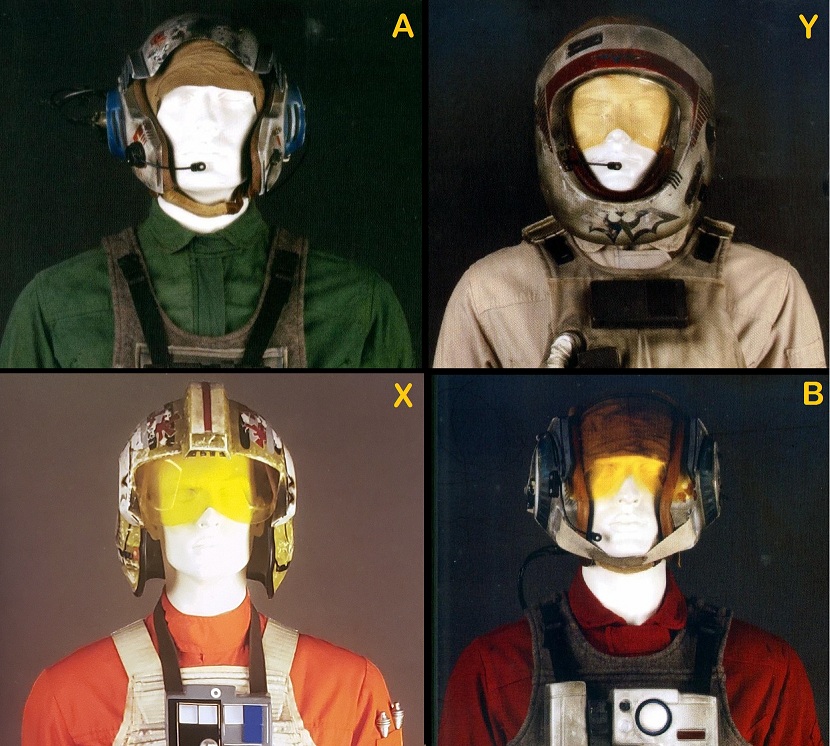
Usually, whenever I see someone online who has put together a ‘custom pilot’ costume, it’s been prefaced by some variation of “I put my own spin on it!” and leans more on the OC’s go-to “wouldn’t it be cool if ___?”…. and thus the final result rarely ‘reads’ as “pilot”. As should be clear by now, I have a really hard time going along with the crowd; however, as I hope I’ve also made clear, I believe a valid ‘middle way’ exists between the two extremes of the dogmatic “on-screen assemblages only!” Legion, and more casual, “anything goes, let your imagination run wild!”-type cosplay. I don’t know how many hundred OT-era pilot cosplayers there are out there (easily 95% of these are X-wings), but I’ve yet to see one that didn’t follow these same old onscreen combinations of flightsuit color and helmet style:
As someone really interested in the early Rebellion period, I think switching things up to be a little less uniform helps underline the ‘ragtag’ nature of the Alliance. I’m sure there had to be pilots who joined up and brought their own personal flightsuits with them – I definitely remember some climate ‘direct actions’ where we street medics were literally told, “Sorry we don’t have any supplies for you, you’ll have to requisition your own or use what you have” and can easily imagine similar situations in the pilots’ ranks. Obviously, I can’t resist pushing the boundaries of OT-era pilot style at least a little bit, but I’m not going to go so far outside the bounds that I no longer look like an OT-era pilot! (Now there’s a nice summary of the ‘middle way’ approach for you: do your research, push the boundaries, but stay within the guardrails!) Luckily for me, I don’t have to feel like I’m sticking my neck out too far because an often-overlooked EU source did it first!
If it seems like a long time since we’ve had a standalone project to show off, you’re not wrong! We haven’t been idle lately, it’s just that everything we’ve been working on has been towards one specific, very detailed goal. Every now and then, however, something comes along and begs our attention for a week or two.
A funny observation I’ve made lately: whenever I go out shopping (ever on the lookout for gear or materials I can use for reenacting), every time I grumble to myself, “This place never has anything good!”, then something tends to comes up! Last November I popped into my local Goodwill having just complained that such a civilized thrift shop would be a terrible place to find pieces for my Middle-earth kits……only to score a gorgeous maroon 100% wool blanket for just $2 (!!!). Then a few months ago, while accompanying my wife on an outing to TJMaxx, I found myself was grumbling how the clothes there are all made of polyester and any ‘hard kit’ type items are always so ‘consumer-grade’ and never made for rigorous galactic use. Well, wouldn’t you know it, in among the reusable water bottles I found this double-thermos canister…thing:
“[It] may not look like much, but [it’s] got it where it counts”
This Hydraflow POD measures up at about 9.5 inches tall; the top section holds about a pint, and the lower section holds nearly a liter! There’s a spot under the lid for a folding spoon, which turned out to be pretty terrible. However, it’s triple insulated, is pretty much a blank canvas for retooling with in-universe style, and best of all, is made of steel (90% recycled!). Unlike the last Thermos I reworked, this one is watertight, tough, and ready for real use in the field!
In keeping with the authentic aesthetic seen on screen, I knew it wouldn’t take much to SWarz this up – a more neutral color and some weathering would be about it. The first step would be to tackle the screw-on lid.
Hello there and ‘May the Fourth be with you’! It’s been a while since we’ve had one of these ‘in-universe vocab’ entries, but in the course of my recent work on a pilot impression, I was reminded of this excellent set of terms, as found in The Essential Guide to Warfare, (p. 141):
3-9 line: A line across a fighter’s wings, based on an imaginary clock in which 12 is ahead of a fighter and 6 is behind. The goal of dogfighting is to keep bandits in front of one’s 3-9 line.
ACM: Aerial combat maneuvering, better known as dogfighting.
Welcome back to another installment of the Galactic Style Guide, the series where we break down the ‘Star Wars aesthetic’ in order to help you create a more authentic ‘outer persona’! In this entry, we’re examining examples of capes and cloaks. (Robes—like those worn by the Jedi or Emperor Palpatine—have sleeves and will be covered in a future post!) Traditionally, a Cape will be shorter in length and made of more fashionable materials compared to the longer, more utilitarian Cloak, but I use them fairly interchangeably here.
Star Wars’ costume designs have always been a unique mixture of Spaghetti Western, 20th century militaria, Eastern/’exotic’, and medieval styles, and the use of capes/cloaks are largely responsible for the latter. With many cosplayers eager to add a little ‘swish’ to their outfits, I hope these posts will be of some use: because when inspiration is needed, it is best to go right to the sourceinstead of to what others have done!
Let’s dive right in with the only guy (IMHO) who can compete with Han Solo in terms of style!
Biggs Darklighter shows up to his desert hometown rocking a solid black knee-length wool cape with a short standing collar (and no visible fasteners, naturally!). It doesn’t appear to be lined, so that great drape is due to it being a really solid weight of fabric. If it is lined, it’s in a pretty similar color or material (note also that this is a rare example of a ‘good guy’ character wearing a ‘bad guy’ color). However, with the Anchorhead scenes on the cutting room floor, we have few major characters wearing these kinds of garments in the rest of the film. The only one who really comes to mind is the Mos Eisley spy Garindan who wears a most interesting hooded cloak:
Unlike the rest of our examples, old Long-snoot’s hooded cloak is a one-piece, and I’d love to see what the overall shape of it is! Visually, we can deduce that he’s an antagonist (because the cloak is black!), and as we will come to expect, it’s made of wool in a nice weight, is a solid color, and unadorned. Aside from Garindan, It’s not until we make it to Cloud City in the next installment that we find another cape in the foreground:
Welcome back to another installment of the Galactic Style Guide, the series where we break down the ‘Star Wars aesthetic’ in order to help you create a more authentic ‘outer persona’! In this entry, we’re concluding our examination of the various styles of belt gear and pouches seen onscreen by looking at Original and Prequel examples together – let’s get started! In the first two entries, we focused on military-surplus (or milsurp style) gear, so this time we’re looking at the few non-milsurp examples.
Our two male heroes have belt gear which seems military but (as far as I know) isn’t – if you can’t swing actual milsurp, you can’t go wrong with real, unadorned leather in one color, and minimal hardware (snaps and brass studs, at most):
One of the ‘Pruneface’ commandos in Episode VI has an intriguing cylindrical belt pouch, which I believe was also borrowed for Wilford Brimley’s character a few years later:
What do we think it is? Optic case of some sort? Milsurp or not?
One of the places where we see a decidedly different style in action is among the ‘scum and villany’ at Jabba’s palace. Let’s break it down:
Welcome back to another installment of the Galactic Style Guide, the bimonthly series where we break down the ‘Star Wars aesthetic’ in order to help you create a more authentic ‘outer persona’! In our second entry looking at the various styles of belt pouches and bandoliers seen onscreen, we’re focusing on military surplus (and milsurp-style) examples as seen in the Prequel Trilogy. Let’s begin (again!) on Tatooine!
Throughout Episode I, we see young Anakin Skywalker wearing one half of an Italian Army ammo pouch for the Carcano rifle (plus another mystery pouch):
Several of the background characters in Mos Espa have belt gear with ‘Lift The Dot’ fasteners; these appear to be a dual-magazine pouch very similar to this WW1-era pouch for the Colt 1911. As I discussed previously, I feel that these kinds of pouches are acceptable for outfitting far-background characters like these, but I feel they toe the line of ‘visible fasteners’. However, they’re usually very sturdily made to stand up to the rigors of authentic use, so if you are reenacting or doing living history with an audience inside the 10-foot line, it’s probably worthwhile to take the extra effort to cover them behind some canvas or webbing.
Jedwar Seelah, Chokk, and the unnamed Nikto podrace mechanics.