
Welcome back to the Galactic Style Guide, the series where we break down the ‘Star Wars aesthetic’ in order to help you create a more authentic ‘outer persona’ for your denizen or OC! For my northern hemisphere readers it’s late summer and still probably plenty hot. One key factor that helps determine how comfortable an in-universe outfit will be is the materials it’s made from, so in this month’s entry, we’re concluding our close look at onscreen fabrics! Let’s get back into it with a fabric which is much-used onscreen but underutilized by fan costumers: silk!
Made from unspooled cocoons of the mulberry silkmoth, as we can see here silk can be appropriate for everything from high-class politicians to desert hermits, depending on the quality and amount of processing! Throughout Episodes IV and V, Leia Organa spends much of her screentime wearing this material in the form of crêpe de chine, a lightweight silk with lovely drape:

When most of us think of silk, the form that comes to mind is probably the highly-finished, satiny variety. Aside from Lando’s silk brocade cape lining and Padme’s Ep III nightgown, I haven’t found any specific mentions of its use for onscreen costumes in my research, however, ‘shimmersilk’ worn by highstatus characters shows up in reference books fairly often:

As we can see here, rough-spun silk variations (such as silk noil/raw silk) are often worn by Jedi characters, which aligns with their humble, earthy philosphy: Luke’s black outfit uses it for his tabard, vest, & sash, Qui-Gon gets an undertunic of jersey silk bourette and a raw silk outer tunic; save his shirt, Ben Kenobi’s whole outfit was made of an unknown “expensive” silk; Yoda’s outer tunic, and Anakin’s refugee undertunic is open-weave raw silk; I don’t know for certain, but Jocasta Nu’s outer tunic looks suspiciously like silk noil. I would also be willing to bet that peasant folks like Shmi, Wald, and young Owen & Beru Lars’ outfits involved some rustic raw silk with plenty of slubs as well.

We also have a number of examples of blended fabrics, such as young Anakin’s tunic (silk/linen/hemp); Qui-Gon’s poncho (silk/linen); Darth Maul’s cloak (ditto); Han’s Endor duster (linen/polyester); Lando/Madine/Rebel generals shirt (and probably vest too – cotton/poly); Han’s EpIV shirt (Viyella – 55/45% merino wool/cotton); Hans’s EpV jacket (wool/cotton). Palpatine’s various Prequel robes (not pictured) were also made using a variety of silk/linen/wool velvets. It’s also quite likely that the many Imperial and Rebel jumpsuits made by Costas were a blend of cotton and nylon or poly.
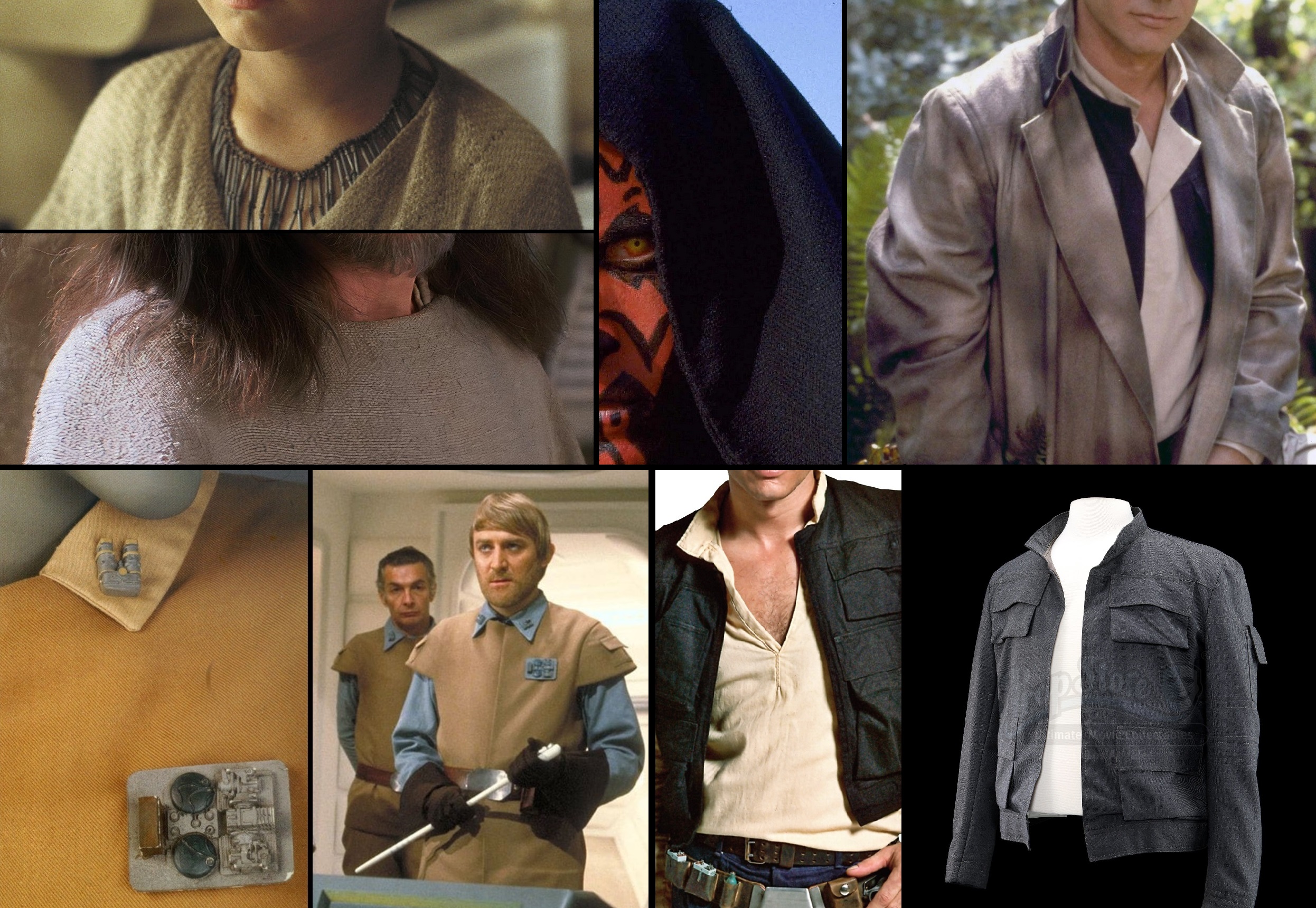
–Synthetics are fine blended with the previous natural materials, but these tend to have less texture (see Lando’s general duds just above) – which is fine for upper leadership. Han’s duster gets away with it by using more-textured linen, and having a blotchy camouflage pattern that holds visual interest; if it were simply a solid color of linen/poly it would probably tell a different story.
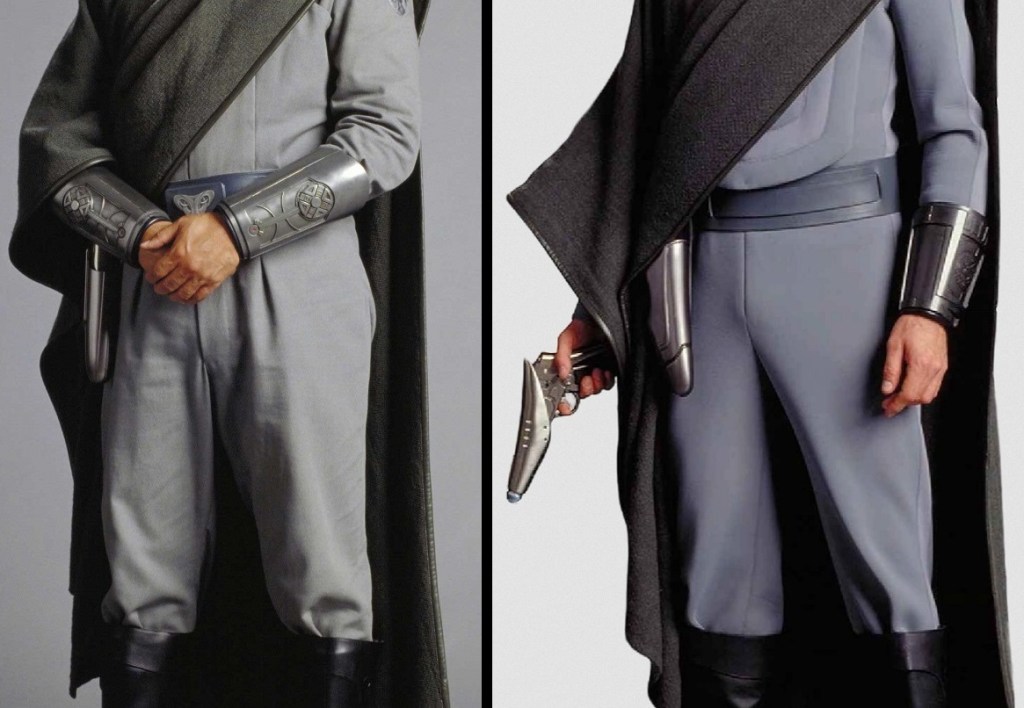
As another example, compare the jumpsuits of Bail Organa and Captain Antilles – and how the former looks more classically ‘Swarzy‘. I haven’t been able to find any specific details on what their fiber content is, but seen up-close Organa’s looks suspiciously like cotton duck canvas, while I would be willing to bet that Antilles’ contains a significant chunk of some synthetic fiber.
When it does make an appearance, slick, shiny plain nylon is best used sparingly to remind us of the GFFA’s 1970s influences, in the form of puffy racing-type jackets and jumpsuits – though the same material would be inappropriate to construct something like, for example, a Tatooine peasant’s tunic.

Another good reason to avoid synthetics is that they simply don’t age or weather the same as natural materials (especially so-called “vegan leathers” like polyurethane, AKA pleather).
Aside from aesthetics, it is especially important in the context of our reenacting/living-history needs to limit the use of synthetic materials, as wearing them around open flames (such as a campfire!) is a straight road to misery: while natural fibers merely burn or char (or self-extinguish!), synthetics tend to melt, and molten plastic is really good at sticking to skin.
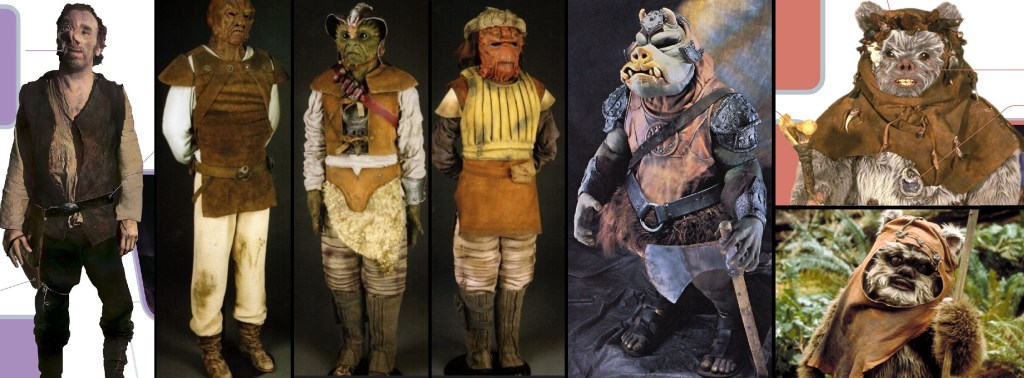
Finally, while TONS of characters (okay actually MOST of them) wear leather accessories like belts, holsters, and pouches, its use for garments is comparatively rare, but as we can see here is usually worn by rough-around-the-edges types of characters – whether that be members of the galactic underworld or wild ‘noble savage’ tribes!
And I think that will cover most of our bases! If you want to craft your own in-universe garments from authentic materials but fabric prospecting isn’t working out, check out Dharma Trading (silk, wool, hemp, linen, and more!), Fabric-Store (linen), and Wm Booth Draper, Burnley and Trowbridge, Hamilton Dry Goods, or Echo Historical for wool!
What is your favorite fabric to wear? Are there any examples of these materials I haven’t included here? Drop a line in the comments below, or come join in the discussion with us in the SWLH facebook community!
Thanks to my readers! Researching, writing, and editing a post like this takes a lot of time and energy (no ChatGPT here!), so if you’ve enjoyed reading, learned something, or have been inspired to reconsider the materials of your own outfit, please consider supporting my work via ko-fi, or with a small donation below! If you can’t give, please share this post or site with your friends! Thank you!
Make a one-time donation
Make a monthly donation
Choose an amount (US dollars only – unfortunately, I cannot currently accept Republic credits 😉
Your contribution is greatly appreciated and will help me continue to bring you this kind of in-depth material! Alternately, you can support my work via ko-fi as well.
Your contribution is greatly appreciated and will help me continue to bring you this kind of in-depth material! Alternately, you can support my work via ko-fi as well.
DonateDonate monthly Living History in the Star Wars Galaxy