
Welcome back to another installment of the Galactic Style Guide, the bimonthly series where we break down the ‘Star Wars aesthetic’ in order to help you create a more authentic ‘outer persona’! It’s been a minute since our last entry in this series, but here on the last weekend of Star Wars Month, we’re taking a look at examples of garments which have been part of the GFFA look since the very beginning: ponchos! For our purposes, we’re defining a poncho as a garment worn as an outer layer for protection from the elements and which covers the front of the body; things like capes and cloaks tend to be open in the front and worn more for form than function (hence their frequent use by ‘classes’ like gamblers and politicians). As we’ll see, ponchos on the other hand are almost always associated with salt-of-the-earth folks who aren’t afraid to get their hands dirty. Let’s dig in!
The first poncho we see in the Original Trilogy is worn by Luke as part of his farmboy attire:

It has applied knit wool strips at the edges and shoulder line, and looks like it’s lined in a darker material? Supposedly, the trim material was also used for Luke and Han’s medals at the Yavin ceremony!

However, the screen-used poncho came up for auction at Christies in 2013, and it would appear to be unlined and all the same color. This provided shot lets us see the wool texture of the material and the ribbing of the knit trim (click for high-res):

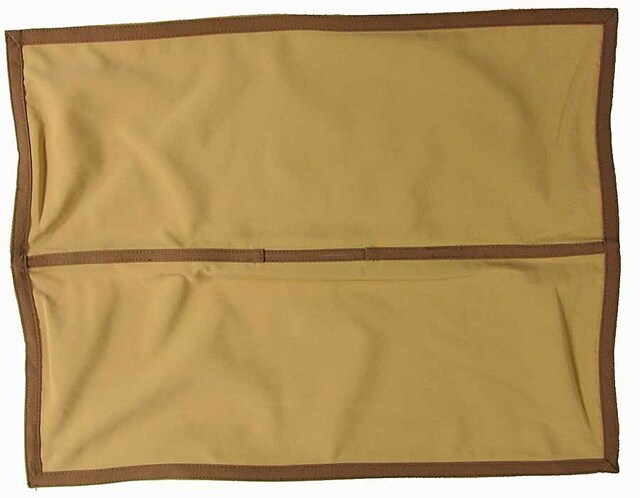
The overall pattern is an almost-square rectangle with central neckslit:
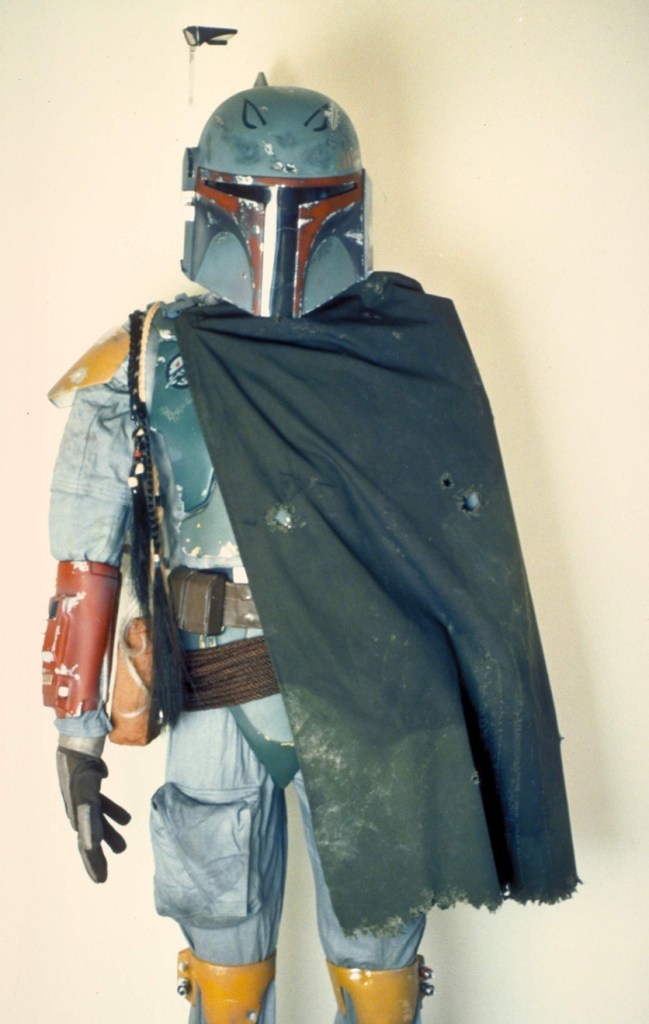
(Honorable mention goes to an early iteration of Boba Fett which sported a sort of half-poncho – a clear nod to his Spaghetti Western gunslinger inspiration:
As part of the Endor commando strike team, Luke dons a belted camouflage poncho; the pattern would appear to be a simple rectangle with an oversized hood:
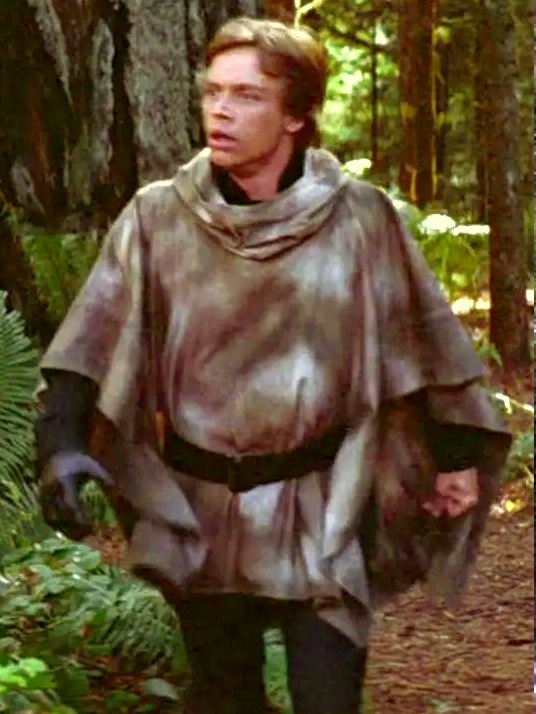
The neckhole appears to be just slightly forward of the centerline, as the poncho is longer in the back than the front. His sister’s poncho seems built along similar lines, albeit with a different camouflage scheme. Note especially the apparent weight of the material (a light canvas, perhaps?) and heavy weathering, including bloodstains and snagged holes:
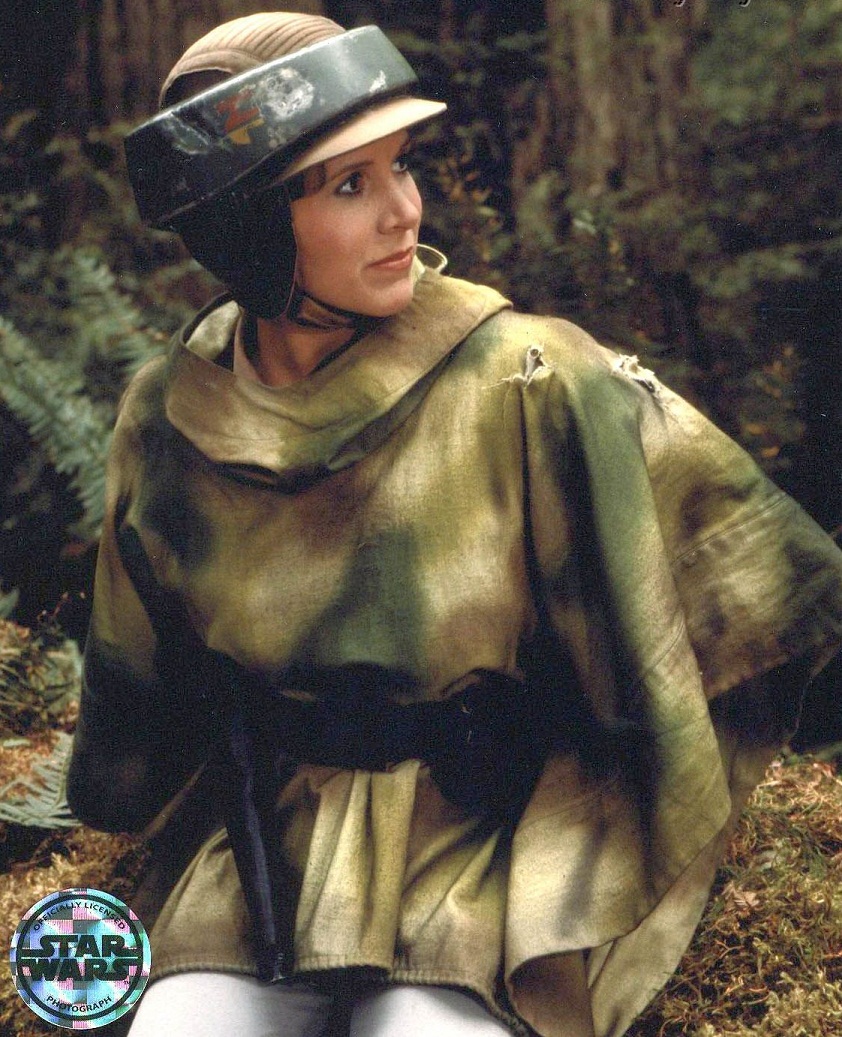

I’d like to draw attention to how simple the onscreen ponchos are. They feel authentic to the setting because they follow the general (grounded) rules of the setting: fabrics are natural and muted colors, are authentically weathered, text- and symbol-free, and have minimal ornamentation – they are sans greeblies, buckles, or any other such extraneous hardware: a poncho is a poncho, not a utility vest, bandoleer, or suit of armor.
In our next entry, we’ll see how these trends continue as we expand our sample pool with a look at the ponchos seen in Lucas’s prequel trilogy, plus a more recent source which added a ton of examples (you can probably guess which one)!
Is there anyone I’ve missed above? Leave a comment and let me know, or come discuss with us in the SWLH facebook community! See you next month!
(Special thanks to this month’s supporters C.C., P.R.F., P.D., and R.F.! Researching, compiling, and writing this series takes a lot of time and energy. If you’ve enjoyed reading, or will use this post as a research source for your own costume, please consider supporting my work via ko-fi, or with a small donation below! Thank you!
Make a one-time donation
Make a monthly donation
Choose an amount (US dollars only – unfortunately, I cannot currently accept Republic credits 😉
Your contribution is greatly appreciated and will help me continue to bring you this kind of in-depth material!
(Alternately, you can support my work via ko-fi as well.)
Your contribution is greatly appreciated and will help me continue to bring you this kind of in-depth material!
(Alternately, you can support my work via ko-fi as well.)
 Living History in the Star Wars Galaxy