
Back in 2015, a museum exhibit in Belarus showed off a set of reconstructed costumes from early medieval (8th-12th centuries CE) Baltic cultures. Shortly afterwards, the outfits began making the rounds online, eventually getting shared to a Middle-earth reenactment group I’m a part of. We all thought they were very impressive: inspiring examples of what culturally-cohesive outfits can look like. Then, a year or two ago, I saw the exact same pictures again—but this time in a Batuu-bounding group on facebook! There, they were prefaced with a message like, “check these out – wouldn’t these make great bounding outfits?!”

While they are still great outfits, as-is, I had to disagree with the idea that they would be appropriate for GFFA use. As Doug Chiang pointed out in a recent interview, the thing that makes Star Wars feel so authentic as a setting is the eclectic use of mix-and-matched historical inspirations* (thanks largely to John Mollo’s foundational designs)—not merely using unmodified, straight-up historical ensembles! [As it’s pure gold, I’ve included Doug’s full quote at the end of this post, so keep reading.]
However, I could definitely see the appeal, especially in the outfits’ silhouettes, and challenged myself to apply a GFFA lens to the Baltic costumes and see if I couldn’t bring them nearer to the Star Wars aesthetic. I challenge you to try the same thing with other historical styles you may be inspired to use in your own outfit!
Let’s start with the red kit first. My main method used was to try and find an in-universe equivalent to each item:
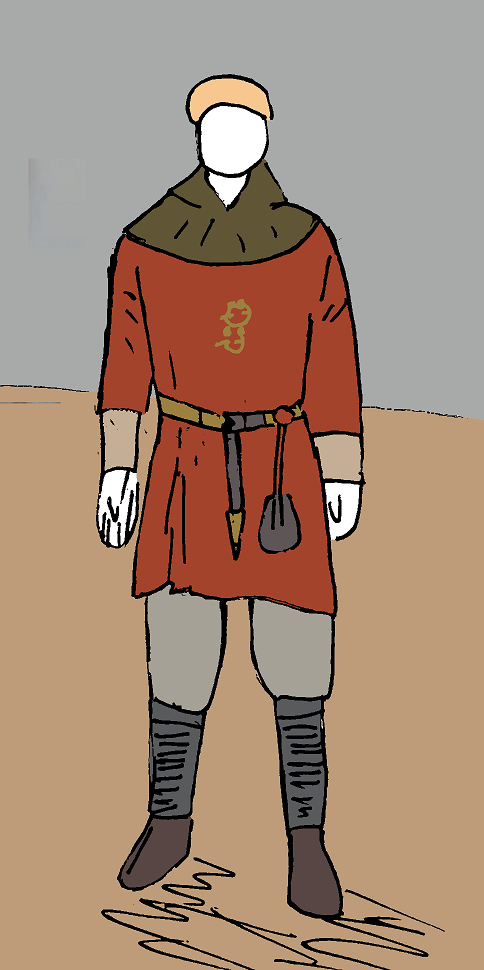
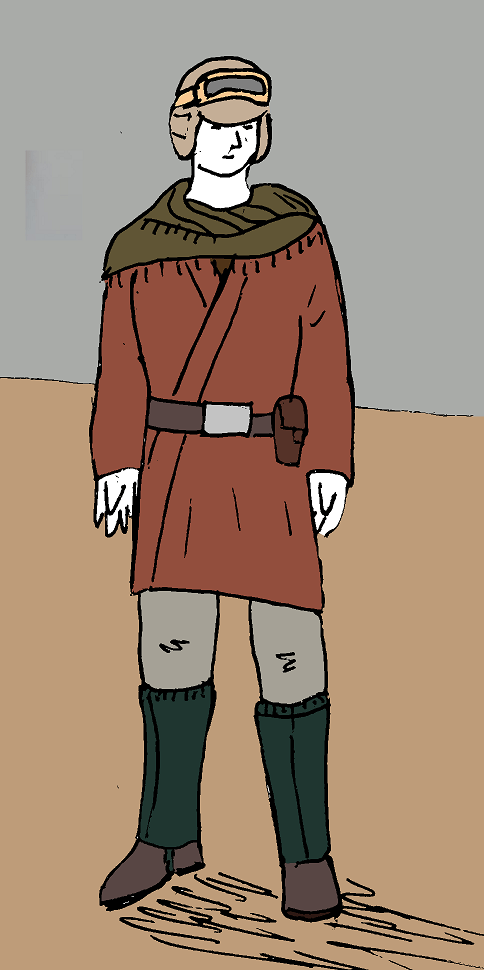
-The early medieval ‘Skoldeham-type’ hood has become a knotted scarf or shemagh
-The layered tunics have become a single tunic with wide wrist-length sleeves.
-GFFA characters don’t decorate their clothing with discrete things like penannular brooches (aside from rank bars and greeble badges, and a civilian like this typically wouldn’t wear them, and certainly not on the center of the chest), so those have been simply eliminated.
-Likewise, dangly belts and pouches aren’t really a part of the GFFA visual language, so I’ve translated these into a simple leather belt with plate buckle, and a leather milsurp-type ammo pouch to serve as a pocket.
-As I don’t think we ever see tunics of this length worn as pullovers, I’ve turned it into a more familiar kimono-type peasant closure.
-The single-piece (Søgård Mose-style) legwraps are okay, but I’ve translated them into an in-universe equivalent—Swiss snow gaiters—to give the ideal narrow-shin silhouette.
-The simple hat has been replaced with the ever-popular fitted Cap With Flaps and Goggles, akin to Philbee Jhorn.
Now that you can see my method, let’s tackle the blue kit next. What would you tweak to better reflect the GFFA aesthetic?
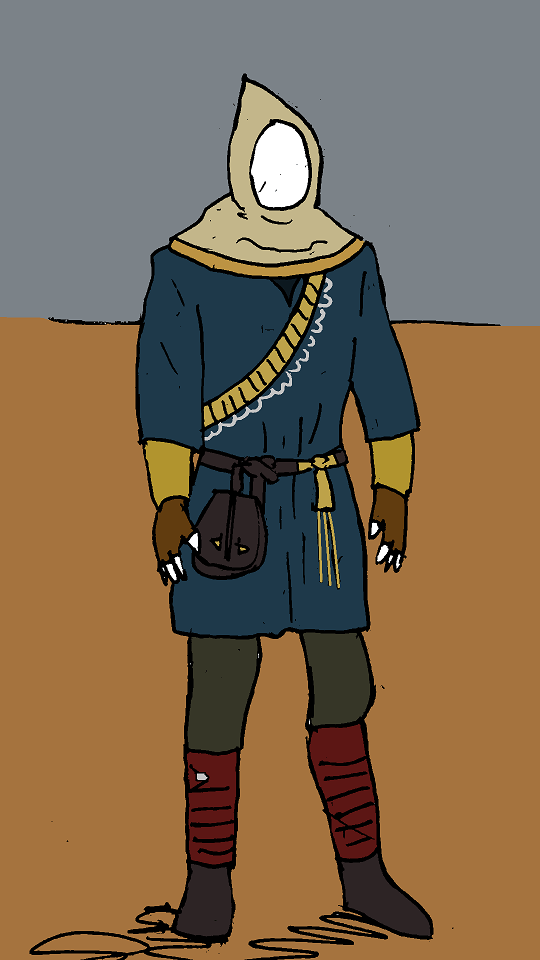

-I’ve turned his medieval hood into a sort of cowl-neck hood-thing, and retained the conehead look of the hood with a Tall Pointy Hat with a short visor. (more on those later, hopefully).
-I realized the gaudy bronze sash gave a similar look to a bandoleer, and since large dangly belt pouches aren’t really seen, I decided to combine the two with a Chewbacca-style bandoleer/purse.
-His belt has also been turned into a simple leather belt (oval buckle this time) and the dangling bronze decorations have become a tool hook.
-The pullover tunic has become a center-overlap parka, presumably with narrow sleeves worn with arm-wraps to achieve the same tapered forearm look.
-Puttees have been retained, and paired with plain Chelsea-type boots instead of turnshoes.
Hopefully this has given you some inspiration and practice for how to view historic outfits with a ‘Star Wars eye’. Have you done something like this before? I’d love to hear your experiences, so leave a comment below, or come discuss with us in the SWLH facebook group!
(Special thanks to my supporters this month, P.D., R.F., and M.A.! Writing this site takes a lot of time and energy. If you’ve enjoyed reading, have learned something from this post, or will use it as inspiration for your own outfit, please consider supporting my work via ko-fi, or with a small donation below! Thank you!
Make a one-time donation
Make a monthly donation
Choose an amount (US dollars only – unfortunately, I cannot currently accept Republic credits 😉
Your contribution is greatly appreciated and will help me continue to bring you high-quality content!
Your contribution is greatly appreciated and will help me continue to bring you high-quality content!
DonateDonate monthly
As promised, here is Chiang’s full quotation (which I will never stop sharing!):
This is one of the most important lessons I learned from working with George Lucas. Many people think that when you create [imaginary worlds], you just have to invent everything, let yourself be carried away by your own ideas and do nothing else. It is not the case at all. If the Star Wars universe speaks to so many people, it’s because it is rooted in reality. 80% of what you see on screen is from other cultures that exist or have existed on Earth. It is the mixture of these diverse, eclectic sources of inspiration, which sometimes have nothing to do with each other, that makes all the magic. In order to properly draw inspiration from it to create your own alternate universe, you have to do a lot of research, spend a lot of time stimulating your mind. If you are content with your own ideas, it will necessarily be seen; visually, the result will be disappointing for many people.
Doug Chiang
 Living History in the Star Wars Galaxy