
Welcome back to our monthly spotlight series! In this feature, I interview Star Wars costumers who have ‘gone the distance’ and put in the effort to create solid, in-universe outfits or personas. This month, we’re very fortunate to bring you a look inside the French organization Transfert à Ord Mantell. The group is made up of several traditional (historic) reenactors who have applied their skills at reenacting to the galactic setting. When the photoset from their recent Normandy beach shoot hit the interwebs last month, it made quite a splash, and I knew I just HAD to pick their brains and learn more!
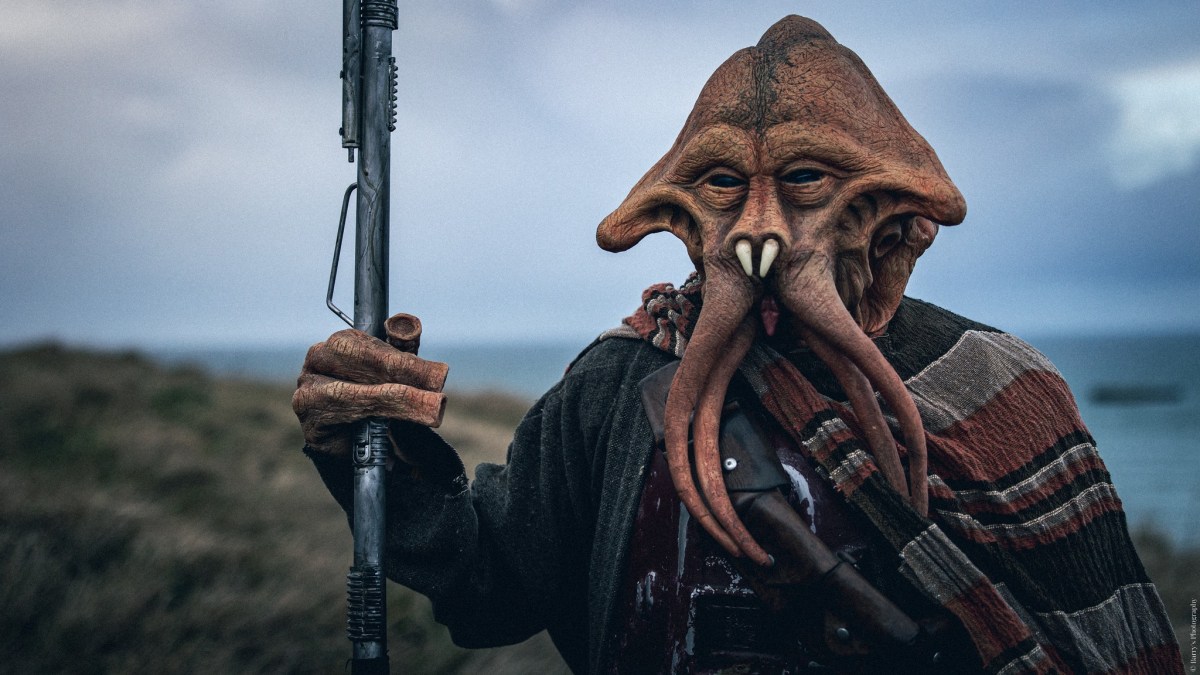
While there was obviously a lot of high-standard work on display, as the majority were existing character types (Imperial officer, stormtroopers, mudtrooper, scout trooper, a lowly rebel technician) or a known character (Boba Fett), the one that really caught my eye was their original Quarren character design:
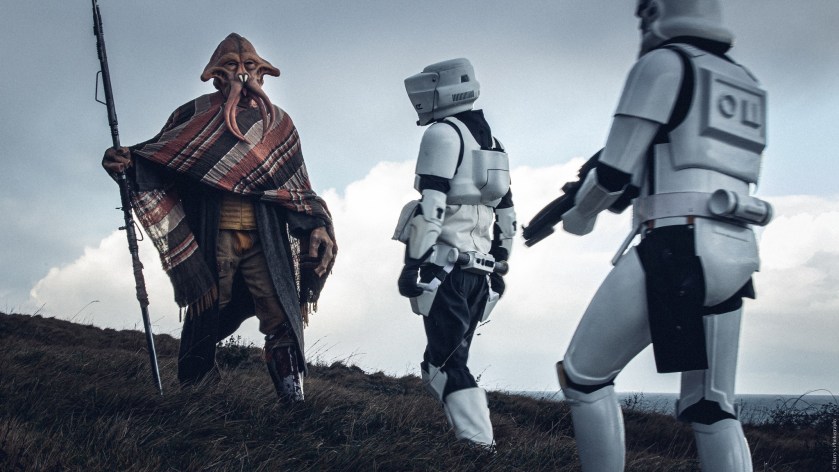
The outfit was conceived as a bounty hunter costume for an immersive event held by the group some years ago. The costume included a full helmet, a gambeson, and pieces of repainted Snowtrooper armor, with smaller items (such as a bandolier with a collection of grenades) used to complete the look. While originally made to allow a member’s son to take part in family Star Wars outings, as twelve-year olds tend to do, he quickly outgrew it.
This snowtrooper armor was originally a low-quality kit, to which were added greeblies, an orange cloth hose, and several components in the back, before being heavy weathered:

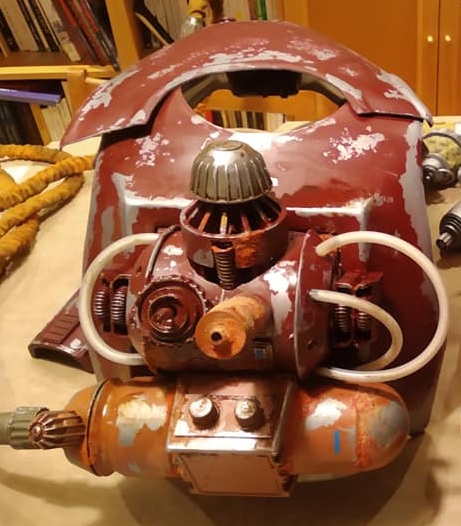
Because—despite modifications and repainting to make it less identifiable— the armor is still a legitimate in-universe design, the mind picks up on its recognizable Star Wars style, which contribute to a greater sense of verisimilitude than is likely with a fully-custom armor set. Take notes: if you’re creating an ‘original character’ and want to include some armor, instead of reinventing the wheel, pick and choose from existing in-universe pieces!
The outfits’ various belt greeblies and thermal detonators were 3D-printed, while the harpoon and other grenades were scratch-built.
For the Normandy photoshoot, the creation of this character was a group effort, as elements of the original (non-Quarren) bounty hunter costume were paired with the squidhead mask and hands, plus a cloak and harpoon contributed by other members. The harpoon turned out to be a wise prop in both senses of the word: not only did it give the reenactor something to hold in his hands that appropriately suggests a maritime livelihood, it also gave them much better balance!
The Quarren mask itself comes from Seven Heads Ten Horns (definitely check out their work!). All the textile parts of the outfit were self-made by T.B., who has been sewing reenacting gear (particularly of the mid-15th and early 16th century periods his group focuses on) for 30 years. Another reason this kit works so well is the wonderful combination of fabrics. The lower half uses gorgeous heavy linen (much like that of the Cz60 rucksack); the long cotton coat has a great rustic texture; and these are paired with a synthetic ‘technical’ fabric in a mustard yellow which recalls the 1970s. Throughout, the use of quilting (much like a Late Middle Ages gambeson!) helps anchor the pieces to the GFFA:

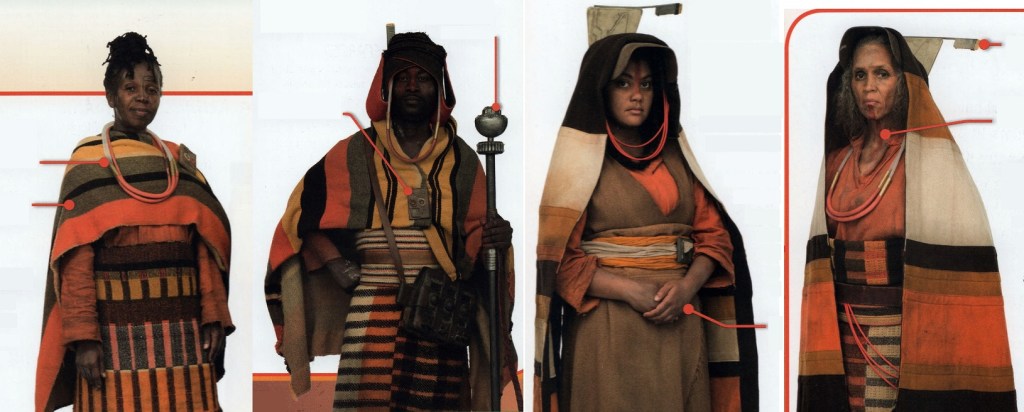
While we’re on the topic of soft kit, I want to draw special attention to our subject’s cloak/poncho. While patterned fabrics are comparatively rare in the Star Wars visual record, this piece makes it work by ‘checking all the boxes’:
-the use of a large over-garment hearkens back to the archetypal ‘medieval’ style that has been part of Star Wars DNA since the beginning.
-throwing the cloak back over one shoulder creates interesting asymmetry.
-it has a ‘crinkle’ texture and fringed edges which gives great visual interest and ensures it doesn’t hang flat and lifeless.
-Finally, the colors are subdued and earthy, and feel somewhat akin to the costumes of the locals of ‘Savareen’ seen in ‘SOLOASWS‘:
For any weathering nerds who want to replicate the worn look of this outfit, the following methods were used. For the armor, the main burgundy color was preceded by a metallic base layer, using toothpaste and/or coarse salt for masking. The rust effects were achieved by mixing wood powder with paint, while the “beautifully disgusting” grease stain effects were created with Vallejo paints. To weather the softgoods, powdered pigments and some gentle sanding (to show wear patterns from repetitive movements) were used, as well as oil washes to the gambeson to build patina, and salt to indicate areas of sweat stains. For the boots (little seen in the photoshoot but still indispensable to sell the ensemble), a muddy texture was created from a mixture of fine wood powder, white glue, and colored pigments, which was brushed onto the appropriate areas to imitate movement.
T.B. told me it took “a good year” to create this costume, but this was mostly because he had to set it aside for a while, as their group had numerous other costumes in progress (mudtroopers, a pirate pilot, a Trandoshan(!), etc) at the time.
When asked what topics he might use this character to teach in living-history format, T.B. paraphrased noted SW concept artist Doug Chiang, saying, “For an imaginary world to work and be credible, it must be rooted in the reality of our history and the histories of the countless civilizations that have preceded us. In fact, reconstructing Star Wars is also about, above all, being curious about our own world.”
He then passed on an excellent interview with Chiang, containing the following passage. As this perfectly encapsulates an idea I try to push wherever I can (and which I will certainly be unpacking in a future essay), I quote it in full:
“This is one of the most important lessons I learned from my collaboration with George Lucas. Many people think that when you create an imaginary world, you just have to invent everything, let yourself be carried away by your own ideas and do nothing else. This is not the case at all. If the Star Wars universe speaks to so many people, it’s because it’s rooted in reality. 80% of what you see on the screen comes from other cultures that exist or have existed on Earth. It’s the mixture of these diverse, eclectic sources of inspiration, sometimes having nothing to do with each other, that makes all the magic. In order to properly draw inspiration from them to create your own alternative universe, you need to do a lot of research and spend a lot of time stimulating your mind. If you just stick to your own ideas, it will show, visually, and the result will be disappointing for many people. While if you are interested in others, in history, in everything that has already been done, you are part of a legacy of several centuries. And, by the way, you are more honest with the audience.”
Doug Chiang
For whatever reason, I can’t help but feel that on the whole, Europeans seem to take the Costumed Arts more seriously, and their end products–especially when it comes to ‘custom characters’–are consistently of a higher standard than those in the States. Why is this? I’d love to hear your ideas! Leave a comment below, or come discuss with us at the Star Wars Living History facebook community. I’m always looking for future interviewees, so if you know a high-quality costumer you would like to nominate for this series, please get in touch!
Link time! If you’d like to see more from the Ord Mantell collective, check out their facebook page. The group’s members chiefly come from two historical reenactment groups: Letavia and La Confrerie Facetieuse. You can see the entire Wobani 4BBY photo shoot (plus tons of other stunning reenactor portraits) at Barry’s Photography.
(Special thanks to my monthly supporters P.D. and R.F.! Writing this site takes a lot of time and energy. If you’ve enjoyed reading, have learned something from this post, or will use it as inspiration for your own outfit, please consider supporting my work via ko-fi, or with a small donation below! Thank you!
Make a one-time donation
Make a monthly donation
Choose an amount (US dollars only – unfortunately, I cannot currently accept Republic credits 😉
Your contribution is greatly appreciated and will help me continue to bring you high-quality content!
Your contribution is greatly appreciated and will help me continue to bring you high-quality content!
DonateDonate monthly Living History in the Star Wars Galaxy
One thought on “Diamonds in the Rough – the ‘Normandy Quarren’”