Welcome back to our monthly spotlight series! In this feature, I interview Star Wars costumers who have ‘gone the distance’ and put in the effort to create solid, in-universe outfits or personas. This month we’re talking with the UK’s Phil Howard, who had an absolutely stellar Mandalorian pilot kit:
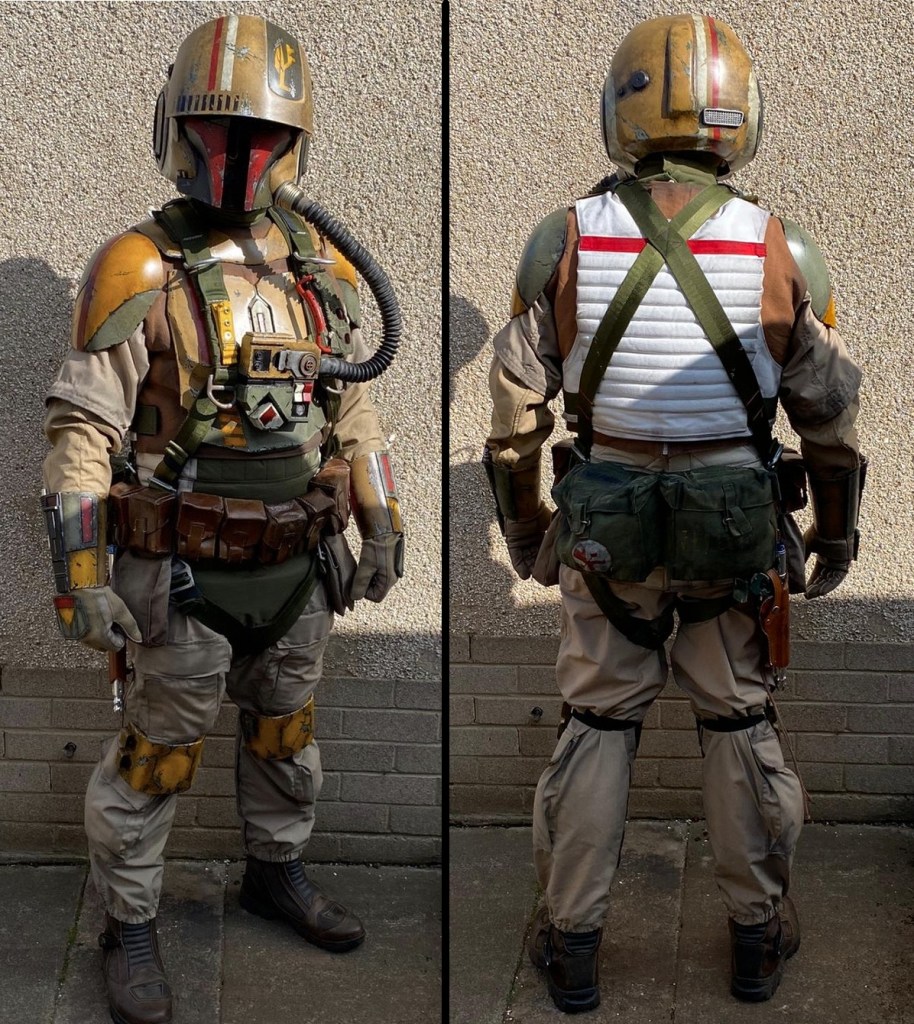
Color-wise, this ensemble is rock-solid. Much like Boba Fett’s classic Episode V/VI look, Phil uses a neutral-toned flightsuit with armor in limited complementary colors: mustard, deep red, OD green, and khaki. Much like WW2 airmen, he is armed only with a pistol, though it is clearly not the focus of the outfit. Like Rebel pilots of the Classic Trilogy, his use of flak vest, parachute webbing, and chest box provide character-appropriate layering, which give believable visual interest.
Phil told me that he was initially inspired to create this outfit while being in the MMCC [Mandalorian Mercs Costume Club] for a few years, where he had seen several others with ‘Mando Pilot’ kits and decided to simply “give it a go!”.
As he really liked the style of helmet designed for the ‘Resistance’ pilots in the post-Disney Sequel Trilogy, Phil wanted to base his custom Mando pilot on one of their helmets. In the same way that an Original Trilogy TIE pilot’s helmet is essentially just a stormtrooper faceplate added to an X-Wing pilot’s helmet, (or, on the flipside: the X-wing helmet is just a TIE helmet with the faceplate removed!), Phil “Frankenstined” a 3D-printed Mandalorian faceplate onto a 3D-printed ‘Resistance’ pilot helmet. This involved “much cutting, filling, and cursing”, but resulted in “a reasonable helmet” which helped motivate him to keep going and complete the rest of the kit.
By combining two iconic helmet components (instead of creating a totally custom design), Phil ensured that his creation would likewise be easily recognizable for what it is.
While he did not think about Persona-creating details while making this impression, due to the mix of kit parts used, Phil explained that it would necessarily have to be based “somewhere between the post-Imperial to early rise of the First Order”. While I choose not to recognize such details of the post-buyout timeline, Phil wisely acknowledges that when using design elements from a particular period, it only makes sense to stay within that period.
When asked for a full breakdown of the various layers that went into this kit, Phil did not disappoint, and I quote it here in full:
“The base flight suit is made from two AFV coveralls. I cut the sleeves of the main suit down to give the half-sleeve look, then took the full sleeves from the second (donor) suit to make the long sleeves, stitching them onto the main suit. The flak vest was made form some nice heavy IKEA fabric found in their bargain bins. [Editor’s note – I had no idea IKEA sold fabric! I must learn more!] The cummerbund was made from IKEA fabric as well and both vest and the ‘bund were padded slightly with wadding. On the back of the flak vest I added a back plate that I had made from a Resistance pilot vest, thinking that he’s a pilot and would have a buoyancy device instead of rear armour…plus it was comfier to wear. Boots are short-legged adventure motorcycle boots…
All the armour I 3d printed and colour-matched to the helmet. I had bought a dummy parachute harness to get the buckles off for my Edrio build, and of course, I thought that this would work well.
The 3d parts are as follows:
Helmet- TFA Pilot lid
Front Plate- Mando helmet
Chest Armour – Mandalorian Beskar
Shoulders – Mud Trooper
Chest box – U wing Pilot (reduced in size)
Gauntlets and Hand Guards- again, Mandalorian Beskar
Knees -old-style Mandalorian”

Amazingly, Phil reported that the whole thing only took about two months to put together! As someone whose Maker style is probably best described as “extreme ADHD” (I have multiple projects in progress at any one time), this is most impressive.
When it comes to real-world functionality, Phil told me the tube connecting his helmet and chest box is a gasmask tube, and of course the pouches are all military surplus.
One of the (many) things I love about this outfit is the level of wear and tear it appears to have – all of the hard parts appear to be authentically grimy as we would expect in the ‘used universe’ of the GFFA. Phil uses what he calls the “slop, blot, & buff” method: “I slop on watered down acrylic paint, with a drop or two of washing-up liquid. This helps it stick to the painted piece. I make mine about as thick as milk. This is slopped all over the piece. After a few minutes, I use an old damp terry towel and blot off the majority of the the paint. I then let that dry and again with the damp cloth take off more paint on the high parts of the piece.”
To see or maybe purchase some of his work, Phil sometimes sells bits and pieces through his sister’s Facebook shop, Hoth Creations UK.
If you know of a costumer whom you would like to nominate for inclusion in this series, please feel free to leave a comment below or come join the discussion at the SWLH facebook group! See you next month for another Diamond in the Rough!
Interviewing, compiling and writing this site takes a lot of time and energy. If you’ve enjoyed reading or this post has inspired your own persona, please consider supporting my work with a small donation below! Thank you!
Make a one-time donation
Make a monthly donation
Choose an amount (US dollars only – unfortunately, I cannot currently accept Republic credits 😉
Your contribution is greatly appreciated and will help me continue to keep this blog ad-free!
(Alternately, you can support my work via ko-fi as well.)
Your contribution is greatly appreciated and will help me continue to keep this blog ad-free!
(Alternately, you can support my work via ko-fi as well.)
 Living History in the Star Wars Galaxy