
While I started this blog back in 2017, I spent the first few weeks detailing the basic ideas behind the ‘Advanced Costumed Arts’ of reenacting and living history. Over the intervening three+ years this blog has been plugging away merrily, and those early posts—while still collected at the ^FIRST STEPS page^—are effectively buried for those who might find their way here and don’t want to endlessly scroll or use the search bar or Categories >>. Therefore, I wanted to put together a miniseries to lay out the underlying foundations for what it is we aspire to do here, why we do living history specifically, and how You can do it too!
WHAT are reenacting and living history?
(For a short but very complete general introduction to these activities, I recommend downloading F.L. Watkins’ The Reenactor’s Encyclopedia, from which I’ll be quoting here and there.) At their most basic, both reenacting and living history are activities in which participants seek to learn about and experience life in a non-contemporary time period. These activities usually involve the participant assembling a ‘kit’ (what you’ll often see referred to here as ‘the outer persona’) of “possessions…that might have been owned by his impression”; this should start with clothing, and then might extend to include tools, food, camp gear, sundries, and weapons.
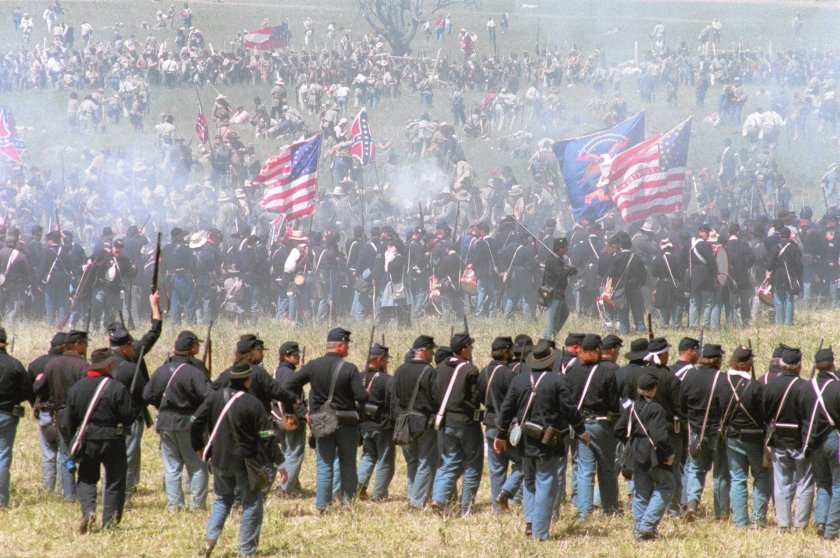
When people hear the term Reenactment, they tend to picture large-scale re-creations of specific historic events (too often these are skirmishes or battles, giving rise to the popular misconception that reenacting is merely the study of ‘Fighting Through The Ages’). Whether martial or civilian-centered, these events often take place before a public audience who have limited (if any) direct interaction with the participants; also, the creation of a ‘persona’ is rare. Sometimes the battle or event is narrated by an historian, whose interpretive commentary gives the public context for what they’re seeing.
On the other hand, doing Living History—whether in public or in private—is somewhat less ‘exciting’ but usually more educational. Private events tend to be more immersive: small skirmishes (a ‘tactical’), period-appropriate travel (a ‘trek’), or an encampment or domestic scene at an appropriate setting. Often these are opportunities for the participants to practice ‘experimental archeology’—using historic methods, materials, and skills to learn about the setting/period: for example, a recreated Paleolithic camp where the historians butcher an animal using only stone tools.
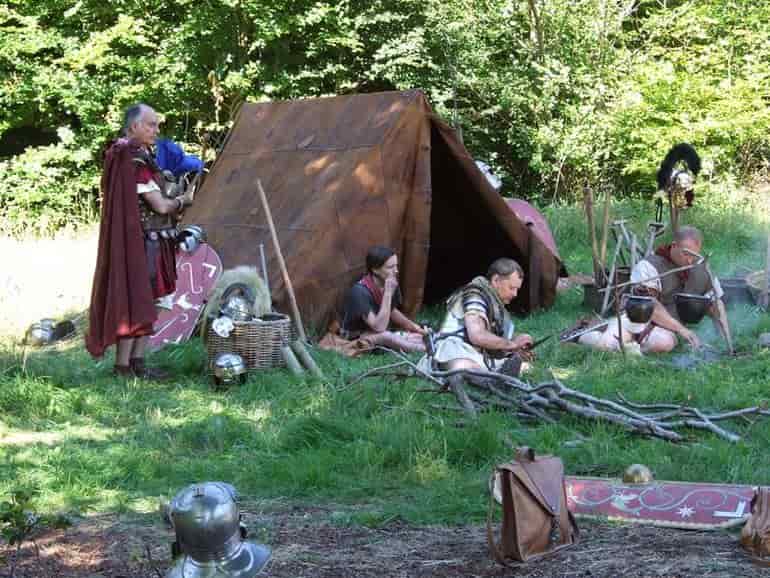
Public LH events typically involve a period camp which the historians inhabit and perhaps carry out camp chores or tasks of daily life, allowing the public opportunities to engage, interact, and learn from the participants. One common format for public LH events is a ‘timeline event’, in which several different time periods are represented.
Living history generally takes place in First Person or Third Person, and both approaches have their pros and cons.
– A historian presenting in First Person will stay in character and speak as if they are an historical individual with no knowledge beyond what their persona would know (“here in the Year of Our Lord 1280…what is this phone you speak of?”).
– Someone presenting in Third Person will speak in a more omniscient sense without portraying a specific individual (“Here in 2021, we might use x, but in 1776 they would clean their weapons like this:…”).
– A ‘Second Person’ approach bridges the two, in which the interpreter can present with knowledge of both the contemporary and historic periods (“In my time, I wear wool, but in your time, you have nylon to keep you dry”).
For examples on what top-tier First-Person living history from my home state looks like, check out the Kentucky Chautauqua lecture series!
WHY living history specifically?
Because reenacting events often depict military scenarios, and military engagements in the Star Wars Galaxy are dominated by the use of energy weapons (still thankfully well out of reach in our present), a fully-immersive Star Wars reenactment is simply not feasible. While hobbyists have been doing incredible things in the last few years to make BBs look like blaster bolts, even the highest-quality Star Wars reenactment still looks like a LARP, airsoft, paintball, or NERF shootout.
Alternately, Galaxy’s Edge at Walt Disney World/Land is an excellent immersive Star Wars-themed environment, which could provide great opportunities for reenacting activities (imagine an ‘after hours’, ‘participants-only’ event free of strollers and modern-clothed tourists!), except that the park doesn’t seem designed to reenact very much beyond in-universe shopping…hardly an enriching educational experience 
For this reason, I have chosen to focus my GFFA energies on the pursuit of living history. While the setting may be called Star Wars, for the average galactic citizen there is much more to life than fighting: thus it is theoretically possible to present an ‘in-universe’ encampment, engage in an immersive trek, or teach a relevant skill while avoiding the spacecraft-and-energy-weapons headache. Furthermore, living history pursuits tend to be much more geared towards sharing and education, and while much of the technology in the galactic setting remains beyond our own (repulsorlift vehicles for example), by using applicability it is possible to use Star Wars Living History to teach and educate on topics with real-world relevance. The galactic setting may be the ‘engagement hook’ to get the audience’s attention, but meaningful learning can still happen.
Next week, we’ll conclude with a brainstorm of ideas for how you can bring your own skills and interests into the realm of Star Wars living history! Questions? Drop them in the comment box or come discuss at the SWLH facebook community! See you next week!
Researching, compiling, and writing this site takes a lot of time and energy. If you’ve enjoyed reading or learned something from this post, please consider supporting my work with a small donation below! Thank you!
Make a one-time donation
Make a monthly donation
Choose an amount (US dollars only – unfortunately, I cannot currently accept Republic credits 😉
Your contribution is greatly appreciated and will help me continue to keep this blog ad-free!
(Alternately, you can support my work via ko-fi as well.)
Your contribution is greatly appreciated and will help me continue to keep this blog ad-free!
(Alternately, you can support my work via ko-fi as well.)
 Living History in the Star Wars Galaxy
One thought on “Back to Basics-What and Why?”