
In Guerilla Warfare, that wonderful time capsule of 1940s partisanship, Burt ‘Yank’ Levy describes an excellent way of ambushing a rapidly-moving, mounted fascist:
“A good way to stop a motor-cyclist is by stretching a quarter-inch cable or wire across a roadway. If you are sure a motor-cyclist is coming, put it up beforehand. Otherwise, have a brick tied to one end of it and be ready to sling it across the road, where others will secure it, while the Nazi is a mile away. Attach the wire to trees or fence-posts at a height of from three to three and a half feet from the ground…preferably, string your line diagonally across the road, at an angle of about 30 degrees. The effect of this will be to make the motor-cyclist, when he hits it, slide along it and into the ditch…right near where you and your companions are waiting” (72).
Reading this the other night, I started to wonder: if I was a member of a Rebel cell needing to ambush a pursuing scout trooper, how much time would I have in which to throw my cable across the path before he appeared?

That led me to wonder, ‘Well, how fast does a speederbike go?’ DK’s Complete Vehicles clocks the Aratech Repulsor Company’s 74-Z bike’s top speed at 310.6 miles per hour, which seems pretty excessive for a vehicle with an exposed pilot: hit a large insect at that speed and it would be like birdstrike to a biplane!
Instead, I remembered a conversation with ILM’s Dennis Muren, who describes how his team created the speeder chase on Endor:
“We had the idea of using a Steadycam, and walking through the woods, on a path that we had kind of disguised, shot with a camera that shot one frame of film every second. So, when you project it back 24 frames a second, it’s going 24 times faster. And, we figured you walked about 5 miles an hour, so it came up to about a hundred miles an hour.” (Empire of Dreams, 2004, 2:14:30).
If the speederbikes in Episode VI are meant to be going 100 mph, that’s good enough for me.
*DK’s Classic Trilogy Inside the Worlds (page 38) claims that the chase takes place at 124 mph.
So: at 100 mph, that’s 5,280 feet (one mile) times 100 miles per hour, or 528,000 feet traveled per hour (this of course, assumes constant cruising speed).
An hour is 3,600 seconds (60*60) long, and dividing the speed by the time gives us the rate of travel:
528,000 / 3,600 = 146.667 feet per second
To find Levy’s suggestion of one mile, or 5,280 feet away from the ambush point, we divide the number of feet in a mile by the rate of travel:
5,280 feet / 146.667 feet per second, which gives a nice, neat 35.9999 seconds.
In other words, if you wanted to set an ambush for a speeder, you’d need at least a 36 second window to prepare before he would be bearing down on you. Good to know! By comparison, to snag a 74-Z maxed out at 310.6 mph, you’d have less than 12 seconds (11.6 actually) to get ready.
(And for more comparison, a ‘motor-cycle’ of the 1940s going 35 mph would give you a leisurely minute-and-forty-three seconds in which to sling your cable. How the times have changed!
If a 36-second window isn’t challenging enough for you, just consider the skill it would take to snag one native-style, with a natural-cordage lasso!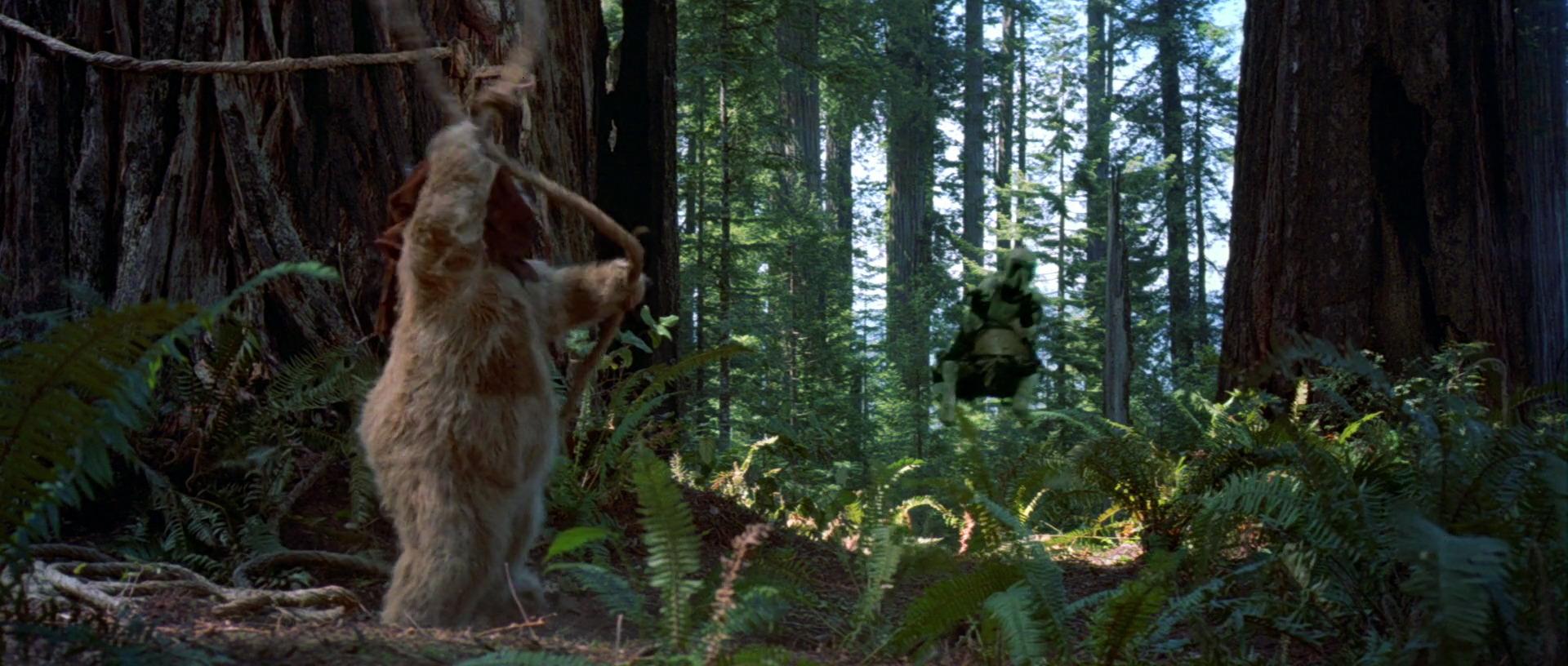

Researching, compiling, and writing this site takes a lot of time and energy. If you’ve enjoyed reading or have learned something from this post, please consider supporting my work with a small donation below! Thank you!
Make a one-time donation
Make a monthly donation
Choose an amount (US dollars only – unfortunately, I cannot currently accept Republic credits 😉
Your contribution is greatly appreciated and will help me continue to keep this blog ad-free!
(Alternately, you can support my work via ko-fi as well.)
Your contribution is greatly appreciated and will help me continue to keep this blog ad-free!
(Alternately, you can support my work via ko-fi as well.)
 Living History in the Star Wars Galaxy
2 thoughts on “Snagging a Speeder Bike (with Math!)”