
After finishing the retool of my DH-17, I realized that I needed a way to carry the blaster on my person during workshops or presentations (because it’s part of a kit instead of a costume prop, I need be able to do more than stand around, look pretty, and get photographed—I need my hands when I’m teaching!)
Preliminary research showed that the Rebel Fleet Troopers in Episode IV used a leather tubular holster, with a vertical retaining strap that looped over the pistol grip: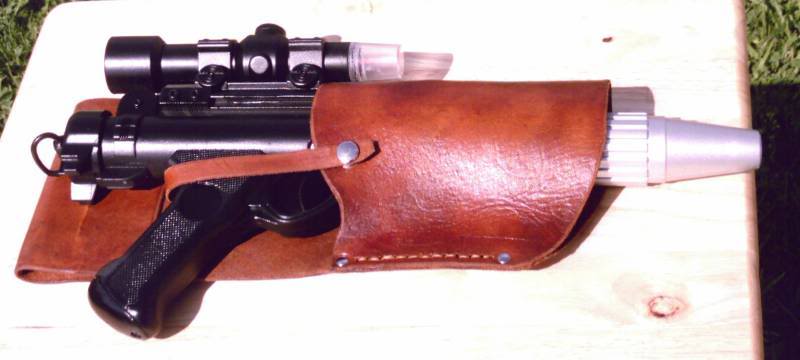
I had two problems with this setup: first, the prop weapons used in the Tantive IV firefight were castings of an original ‘hero’ blaster, which meant that as resin copies, not only were they lighter than an actual metal weapon would be, but they were also (due to casting shrinkage) smaller than the original!
Second, the iteration of the DH-17 used in Episode IV is shortened and heavily simplified from the Sterling SMG they were built from—most prominently, the entire magazine housing on the gun’s left side has been completely removed! Since my DH-17 was built based on the later Episode V model (which retained the magazine housing), the simple Episode IV holster couldn’t accommodate it.
A bit of further digging showed a second design of Rebel holster, this one originating with Rebel troops seen in the background on Hoth (see 04:50, 21:27, 24:32, and 25:28 on 2004 DVD: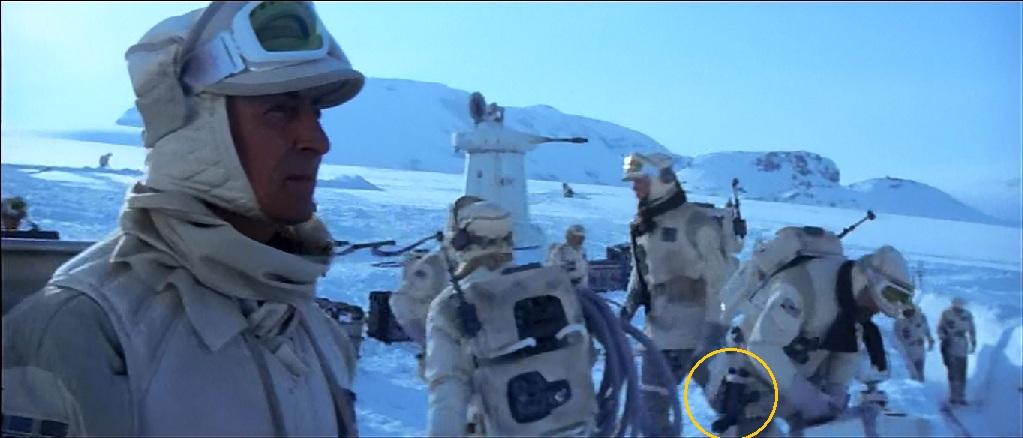
As would be expected from a piece of gear associated with Hoth soldiers, the holster was most recently seen in the cutscenes of the 2015 DICE/EA Battlefront: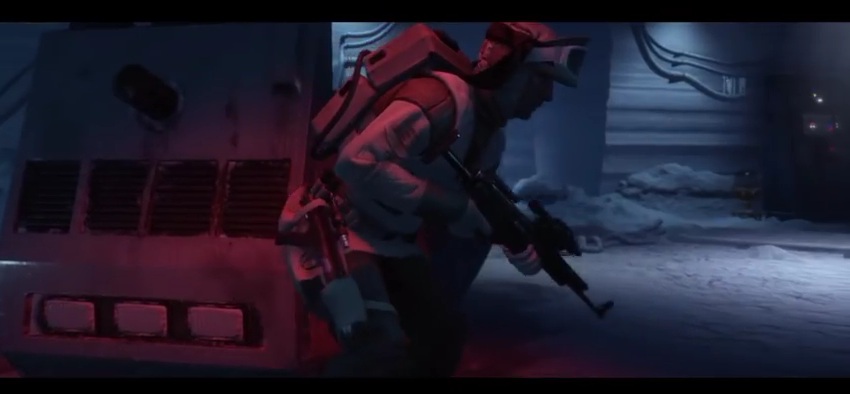
This holster also included a tubular section for the muzzle end of the blaster, but with the retaining strap rotated to the horizontal, where it looped around the blaster’s butt end (in the film, it wraps over the top of the scope, while in the game it only secures the receiver tube underneath the scope’s eyepiece). As my blaster was the full-length DH-17 with magazine, I thought this might be a better way to holster the weapon, so in the spirit of experimental archeology (recreating an item and seeing how it performs), I whipped up a mockup using scrap canvas left over from my sleeping bag bags and P37 webbing from my canteen’s original skeleton carrier.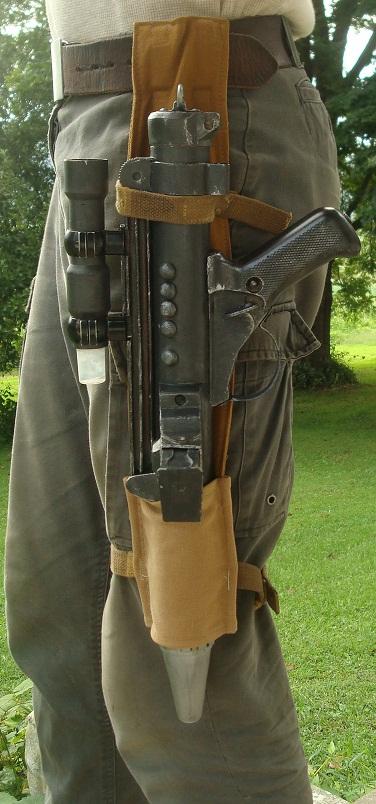
After some field tests (aka putting the holster on my belt, holstering the blaster, and then walking, kneeling, and running around the backyard), I can confidently say that this holster Doesn’t Perform Very Well!
Unlike a weightless piece of code in a video game or a plastic lump of cast resin, my DH-17 is a four-pound hunk of wood, plastic and metal, and believe me: four pounds is too much weight to be strapped to one’s leg to be able to comfortably move quickly and at ease. It’s fine for strolling around Echo Base, and perhaps if I had four pounds of counterweight on the other thigh it would balance out, but alone, the fastest I could move was a sort of gallop.
This seems to be the case of the on-screen holster as well, as a Rebel extra at 04:38 appears to move with a defined limp as a result of the holster. At 25:28, a squad of troopers jog through the shot with mixed results: the leader’s blaster appears to nearly jump out of his holster (likely a result of the lightweight casting) as he runs, while others try to run with their right arm at their side to hold the blaster in place; I found myself doing the same.
Further drawbacks: the blaster is almost the full length of my femur, which means that if I kneel on my left knee, the muzzle is in the dirt.
Additionally, the location of the retaining strap (wrapped around the rear receiver tube) places undue stress on the snap that I used to keep it in place, with the result that if I took any more than a handful of steps at a jog it would come undone, leaving the top ¾ of the blaster to wobble away from my side. (To be fair, I am fully aware that the snap hardware is the weak point in my execution of this mockup, although the one in the picture is actually the second type of snap I tried—and this one performed much better than the sew-on snaps I tried originally.) Presumably, if I had access to military-grade hardware, this wouldn’t be as much of an issue. If only!
(It’s interesting that in the film, the holster is always shown worn on the right leg, considering that this version of the DH-17 retains the magazine on the left side. As can be seen most clearly at 04:53, the blaster has been turned so that the grip faces forward: This allows for carry on the right thigh, although–since presumably most soldiers are right-handed—this means the grip must be drawn with the left hand and then moved to the right…not exactly convenient for a sidearm.
Have you done any Star Wars ‘experimental archeology’? Let me know in the comments how it worked out!
Researching, experimenting, and writing this site takes a lot of time and energy. If you’ve enjoyed reading, have learned something from this post, or will use it as inspiration for a project of your own, please consider supporting my work with a small donation below! Thank you!
Make a one-time donation
Make a monthly donation
Choose an amount (US dollars only – unfortunately, I cannot currently accept Republic credits 😉
Your contribution is greatly appreciated and will help me continue to keep this blog ad-free!
(Alternately, you can support my work via ko-fi as well.)
Your contribution is greatly appreciated and will help me continue to keep this blog ad-free!
(Alternately, you can support my work via ko-fi as well.)
 Living History in the Star Wars Galaxy