What follows is an itemized breakdown of the kit I eventually put together for my AgriCorps ‘washout’ Jedi impression, based during the Dark Times. The main thing I wanted to do with this persona was to help subtly differentiate it from the Jedi we’ve seen already and with whom we are most familiar.
I. Standard Jedi ‘uniform’ elements (as extensively documented in Episodes I-III and related Prequel era materials); originally constructed in 2011
Inner tunic:
The inner tunic is made of crinkle-textured cotton gauze (I seem to remember the color was named ‘potting soil’?), which it is believed was used to make Obi-Wan’s various outfits in the Prequels. I modified the sleeve pattern in order to taper and be tighter at the wrists. I went ahead and made two of these inner tunics so that I can have a spare packed in a dry-bag, since wearing damp or wet cotton—even thin as this material is—can be miserable and/or dangerous depending on conditions.
Outer tunics:
Before making these items, I first had to decide what material I would use. I had several options: Qui-Gon’s outfit was raw silk (which at the time I believed was both hard to find and expensive, though I’ve since learned this is not true; Ben Kenobi’s was thin wool (ditto), while popular opinion suggests most Jedi tunics in the Prequels were textured cotton gauze like my inner tunics.
As this was intended to be functional clothing and not a costume, I had a lot to ask of my fabric: I needed something that would wear hard, could dry fast, was relatively inexpensive, and yet would have some weight and texture. Eventually I decided to use natural-colored 100% linen (6-7 oz weight), which I then RIT-dyed tan. I chose this linen for its anti-microbial and fast drying properties…and because it was ½ off at JoAnn’s when I began this project in 2011. (All told, the fabric for two cotton inner tunics and two linen outer tunics cost $50.)
I made two outer tunics so that I could have one for warm seasons and one for cool seasons—my ‘summer tunic’ is unlined, while the ‘winter tunic’ is fully lined (essentially two tunics sewn together).
For finishing touches and extra texture, I topstitched around all edges by hand.
(Both inner and outer tunics were sewn using McCall’s pattern #2940 (kimono and gi).
Tabards:
These are the long strips that come together under one’s belt in the front and back. Since I made tunics for two seasons, I had to make two sets of tabards as well. Those for my winter tunic are two layers of heavier 8 oz. 100% linen, hand topstitched around all edges, and dyed with black walnut hulls. Those for my summer tunic are two layers of mid-weight beige linen scavenged from a $1 thrift store dress.
To prevent shifting, tabards are permanently attached to the outer tunic at top of each shoulder and at the small of the back.
Obi (sash):
While I made two of these as well, I tend to only use the one I made to go with my summer outfit, which is two layers of lighter textured cotton with interfacing to stiffen. It secures with hidden Velcro to accommodate wearing both the summer or the thicker winter tunic.
One thing I recently noticed (and which I haven’t gotten around to tweaking yet) is that in Episode I, Qui-Gon appears to have some sort of pocket behind his sash, where he can be seen stashing Mos Espa street food (pallies) young Anakin gives him: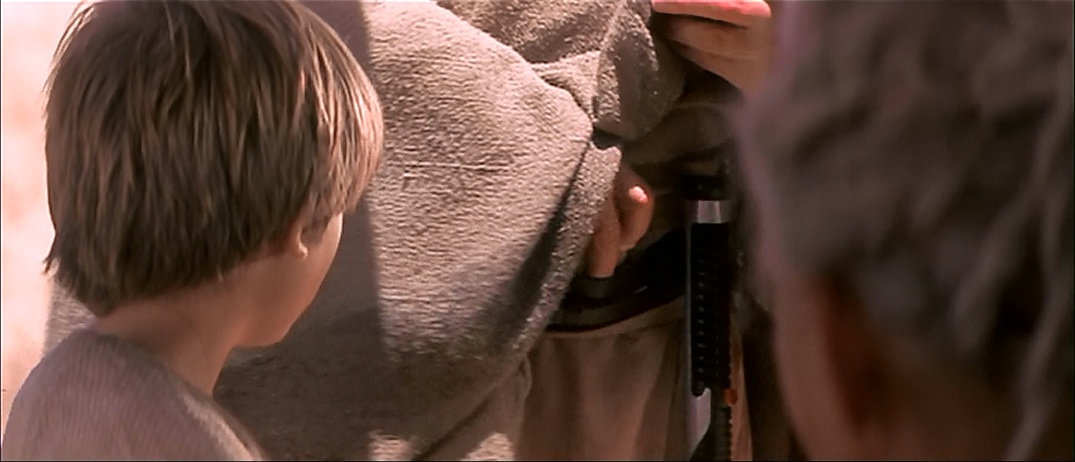
Trousers:
These are nothing fancy – 100% linen $2 thrift store finds. I tailored the hips and legs for a slimmer fit, and to ensure that I don’t need a belt to hold them up (unnecessary bulk under tunics). The zipper fly is a Must, since it’s hidden behind about six layers of tunics and tabards, which is plenty inconvenient when one has to visit the ‘fresher!
II. Deviations from standard outfit:
Bucket hat:
This is a simple, off-the-rack, beige cotton floppy hat: nothing fancy. The crown and brim were a little small, but I stretched it while wet with a hat-jack. (I had the perfect floppy hat some years back, but it was washed downstream while doing stream-health fieldwork. 😦
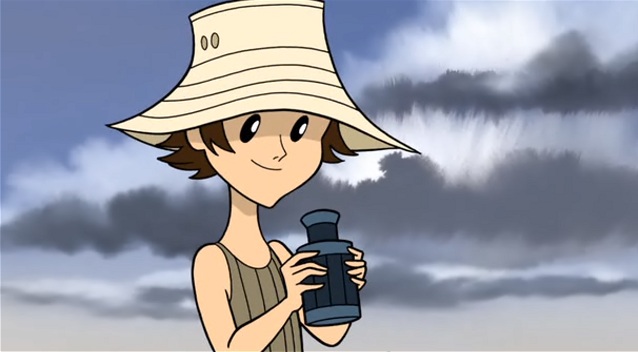
We generally think of hats as being rare in the GFFA though they really aren’t (and are necessary for outdoor work). In addition to the many, many background characters in Mos Eisley who wear them:
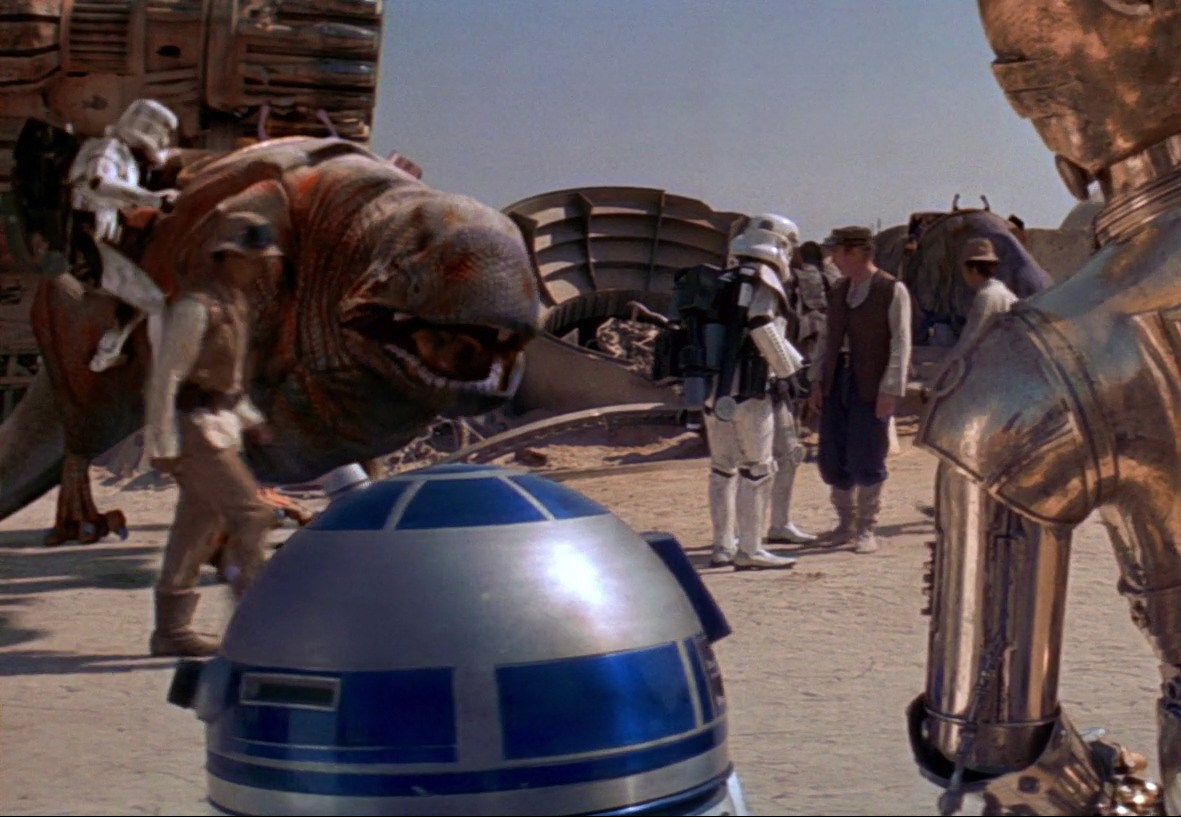
floppy hats are worn in ‘agricultural’ contexts by two figures:
none other than Luke Skywalker in the deleted ‘Treadwell’ scene of Episode IV,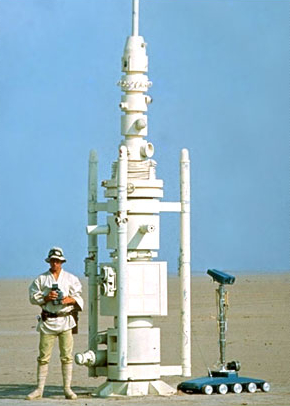 and Paxi Sylo of Dantooine in episodes 12 & 13 of Tartakovsky’s Clone Wars:
 Footwear:
I opted to wear a pair of Land’s End ‘Crosby’ moc-toe lace-up ankle boots, which fit a style that was pretty standard for the first half of 20th century. I’ve worn them in various applications over the last five or six years: for an Indiana Jones outfit, with wool puttees for a WW2 Soviet impression, on patrols as a Ranger with the Forest Service, etc; for as cheap as they are, they’ve held up surprisingly well.
I decided to pair the low boots with a pair of milsurp cotton canvas gaiters (technically ‘leggings Type II Class 2’) from the local army base. Originally khaki colored, I RIT-dyed them dark brown and weathered the hardware.
I went with low boots and gaiters mostly because they were already kicking around gathering dust, and I was ethically opposed to buying something new (I think Jedi should be thrifty minimalists) for an impression that would likely see limited publicity—although with that said, I’ve managed to wear this outfit to seven public events in the last year or so!
My justification for this choice is that the low boots/shoes+puttees/gaiters combo has historically been widely used as an economical alternative to tall boots, and why waste resources on a second-rate Jedi likely working on a backwater agriworld? Save the tall leather boots for the ‘front-line’ Knights who are in the public eye!
Belt:
I’ve seen far too many hideous interpretations (in the name of ‘personal expression’) of the two-piece Prequel-style belt, so I went with a plain leather belt and rectangular blank buckle. Anthony Waters’ AgriCorps image also appears to wear a low-slung simple belt with plain-ish buckle, and in 22BBY master Shaak Ti appears to wear a subdued plain rectangular buckle. As with footwear, it made sense to reserve the fancy resource-intensive hardware for frontline individuals, as well as to help further ground the impression in the Dark Times. Another option for ‘commoner style’ is a plain leather belt with USGI brass roller buckle a la Episode I Anakin.
All of my belts and buckles receive constant authentic usage (I wear them every day) to give them realistic dings and scuffs for the ‘used universe’ look.
The finished assemblage:
I hope this breakdown has given you some idea of the kinds of considerations that go into creating a believable ‘outer persona’ for living-history purposes – even when dealing with a fictional setting!
Researching, compiling, and writing this site takes a lot of time and energy. If you’ve enjoyed reading, have learned something from this post, or will use it as inspiration for an impression of your own, please consider supporting my work with a small donation below! Thank you!
Make a one-time donation
Make a monthly donation
Choose an amount (US dollars only – unfortunately, I cannot currently accept Republic credits 😉
Your contribution is greatly appreciated and will help me continue to keep this blog ad-free!
(Alternately, you can support my work via ko-fi as well.)
Your contribution is greatly appreciated and will help me continue to keep this blog ad-free!
(Alternately, you can support my work via ko-fi as well.)
 Living History in the Star Wars Galaxy